


Last updated: 11 November 2026. Checked against the Code on Wages, 2019 and the Code on Wages (Central) Rules, 2026.
A salary register, also called a wage register, is the monthly record of what each employee earned, what was deducted and what they were finally paid. Under the labour codes, the central format is Form IV: the register of wages, overtime, advances, fines and deductions.
It is the record that proves you paid people correctly. So when an employee disputes their pay or an inspector visits, the salary register is the document that settles it.
Salary register at a glance
| Point | 2026 position |
|---|---|
| What it records | Gross wages, overtime, advances, fines, deductions and net pay for each employee |
| Legal basis | Section 50(1) of the Code on Wages, 2019 |
| Central format | Form IV, under rule 51 of the Code on Wages (Central) Rules, 2026 |
| Paper or electronic | Either |
| Linked records | Muster roll (Form IX), employee register (Form I), wage slip (Form V) |
| Deduction limit | Total deductions cannot exceed 50% of wages in a wage period |
What is a salary register?
A salary register lists every employee for a wage period, usually a month, with a full breakdown of their pay. In other words, it is payroll in register form. Each row shows one employee, and each column shows one part of their pay or deductions.
People use “salary register” and “wage register” for the same record. “Wage register” is the term the law uses, while HR teams in offices tend to say salary register.
Is a wage register mandatory?
Yes. Section 50(1) of the Code on Wages requires every employer to keep a register of the persons employed, the muster roll and the wages paid. Rule 51 of the Code on Wages (Central) Rules, 2026 then sets out three core registers, which you can keep on paper or electronically:
- Form I: employee register.
- Form IV: register of wages, overtime, advances, fines and deductions.
- Form IX: attendance register-cum-muster roll.
You must also give each employee a wage slip in Form V on or before pay day. Some states still prescribe their own combined formats, so check your state rules as well.
What a salary register must contain
| Section | What to record |
|---|---|
| Employee details | Employee code, name, designation, date of joining |
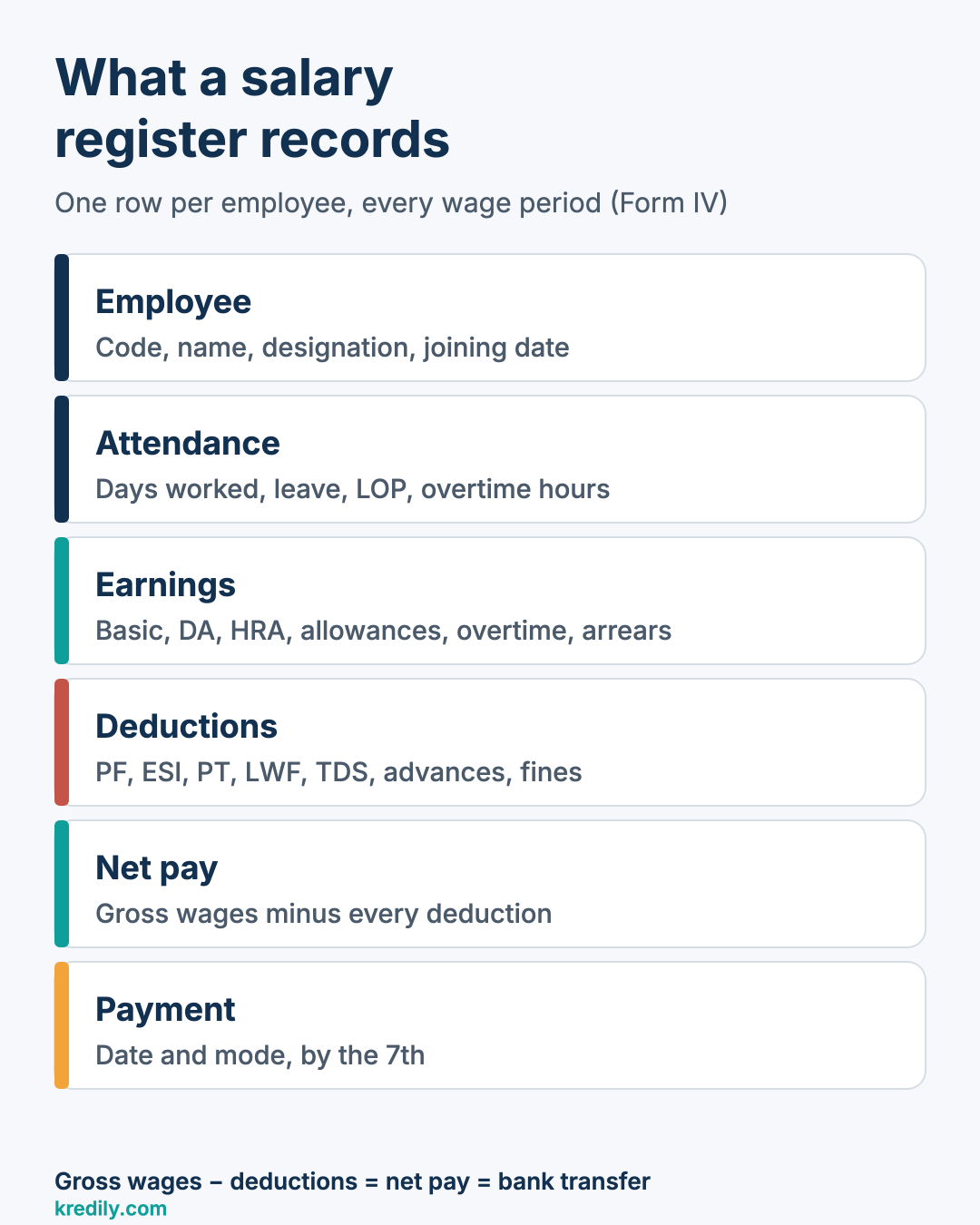
| Attendance | Days worked, paid leave, loss-of-pay days, overtime hours |
| Earnings | Basic pay, dearness allowance, HRA, other allowances, overtime pay, arrears |
| Gross wages | Total earnings for the period |
| Statutory deductions | PF, ESI, professional tax, labour welfare fund, TDS |
| Other deductions | Advances, loans, fines, deductions for damage or loss |
| Net pay | Amount actually paid |
| Payment details | Date of payment and mode, such as bank transfer |
The totals must tie up. Gross wages minus every deduction should equal net pay, and the net pay column should match your bank transfer for the month.
Worked example: one row of a salary register
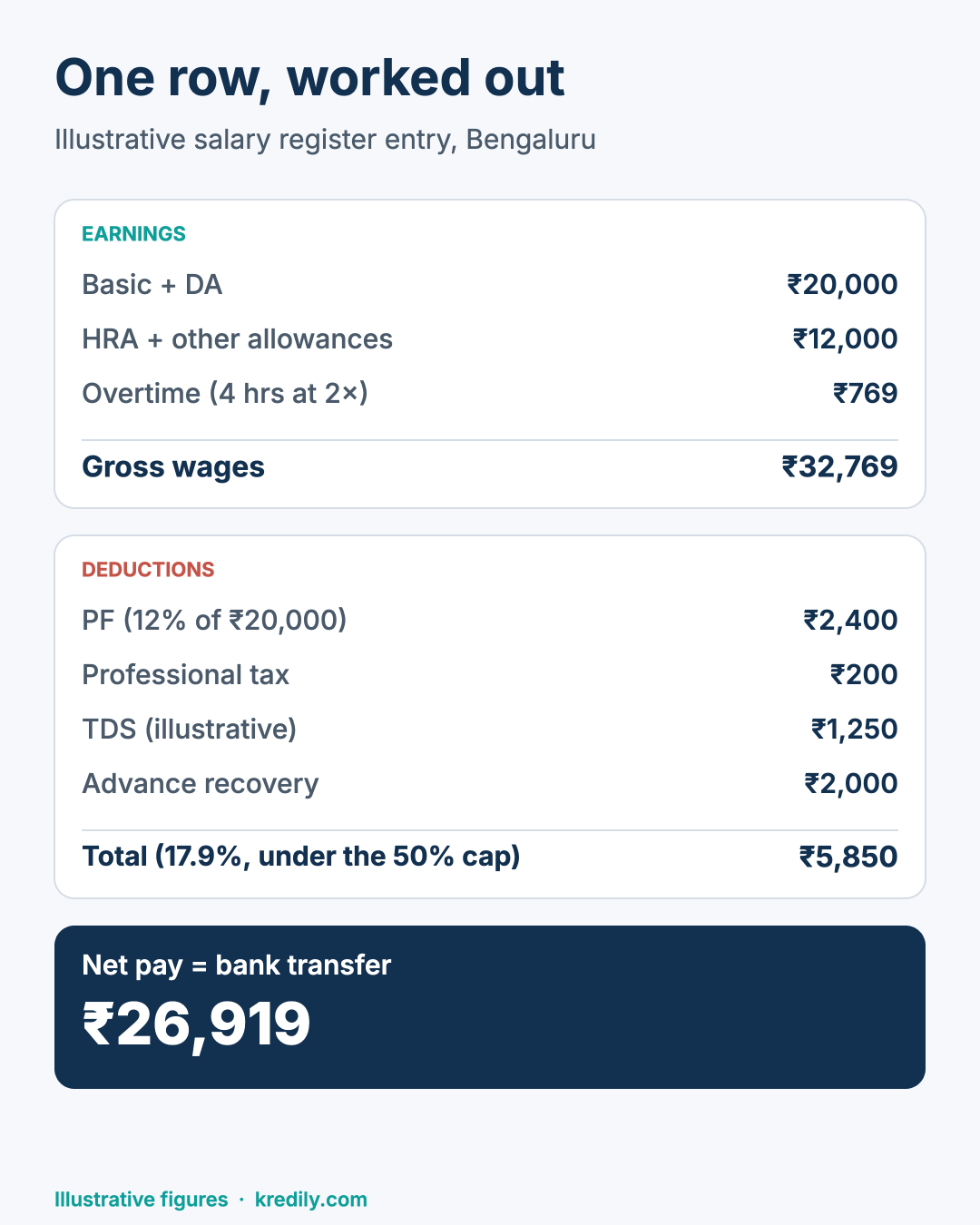
Here is how a single row comes together for a hypothetical employee in Bengaluru. Her monthly wages (basic plus DA) are ₹20,000, she gets ₹8,000 HRA and ₹4,000 in other allowances, and she worked 4 overtime hours this month.
| Item | Working | Amount |
|---|---|---|
| Basic + DA | Fixed monthly | ₹20,000 |
| HRA and other allowances | ₹8,000 + ₹4,000 | ₹12,000 |
| Overtime pay | 4 hours × 2 × (₹20,000 ÷ 208 hours) | ₹769 |
| Gross wages | ₹32,769 | |
| PF (employee) | 12% of ₹20,000 | ₹2,400 |
| ESI | Not applicable, gross above ₹21,000 | Nil |
| Professional tax | Karnataka slab | ₹200 |
| TDS | As per her declared regime (illustrative) | ₹1,250 |
| Salary advance recovery | Agreed instalment | ₹2,000 |
| Total deductions | 17.9% of gross, so within the 50% cap | ₹5,850 |
| Net pay | ₹32,769 − ₹5,850 | ₹26,919 |
Illustrative figures. Overtime here assumes 26 working days of 8 hours, paid at twice the ordinary rate.
That one row then feeds three other records. The ₹26,919 must match the bank transfer, the ₹2,400 PF goes into the ECR, and the whole breakdown appears on her wage slip.
Free salary register template
To get started quickly, use our free template in the Form IV layout. It has columns for attendance, every common earning and deduction, net pay and payment date, for up to 25 employees.
Download the free salary register template (CSV, Form IV layout)
It opens in Excel or Google Sheets. Fill one sheet per wage period, and check that the net pay total matches your bank file before you pay.
Paper or electronic: which is better?
The Central Rules allow both. In practice, an electronic register is easier to keep accurate, because payroll software calculates each row instead of someone typing it. It also makes inspections simpler, since you can pull any month in seconds.
Whichever you choose, make sure the register cannot be quietly changed after payment. So lock each month once wages go out, and keep a record of any later correction.
Rules on deductions you must follow
The wage register is also where deduction rules show up, because every rupee taken from wages appears in it.
- A 50% cap. Total deductions in any wage period cannot exceed half of the employee’s wages. If more is due, carry the excess forward in instalments.
- Only permitted deductions. The Code lists what an employer may deduct, such as statutory contributions, tax, advances, loans and approved fines. So anything else needs a clear legal basis.
- Fines with limits. Fines are allowed only for acts listed in an approved notice, and the total is capped at a small share of wages. Record every fine, with the reason and date.
For PF and ESI amounts, see our payroll statutory compliance guide, which also covers labour welfare fund and TDS.
Salary register vs muster roll vs payslip
| Record | What it shows | Who sees it |
|---|---|---|
| Muster roll (Form IX) | Daily attendance and overtime hours | Employer and inspector |
| Salary register (Form IV) | Earnings, deductions and net pay for all employees | Employer and inspector |
| Wage slip (Form V) | One employee’s pay for the period | The employee |
The three must match. Attendance in the muster roll drives the salary register, and each salary slip is one row of that register, shared with the employee.
How to maintain a salary register
- Lock attendance first. Finalise the muster roll before you run payroll.
- Calculate earnings and deductions for each employee, using current minimum wages and the ₹25,000 PF ceiling.
- Check the 50% deduction cap for anyone with advances or loans.
- Record payment details once wages are credited, which must happen by the 7th for a monthly wage period.
- Issue wage slips on or before pay day.
- Keep the register for the period your rules prescribe. Many employers keep at least three years.
Common salary register mistakes
- Totals that do not match the bank transfer.
- Unrecorded advances or recoveries, which look like unexplained deductions.
- Missing overtime pay, even though the muster roll shows overtime hours.
- Old wage rates after a minimum wage revision.
- Separate spreadsheets for each site that never get combined.
Prefer to automate it? Kredily payroll software produces the salary register, payslips and statutory reports from one payroll run, as part of its statutory compliance features.
Frequently asked questions
What is a salary register?
It is the monthly record of each employee’s earnings, deductions and net pay. Under the labour codes, the central format is Form IV, the register of wages, overtime, advances, fines and deductions.
Is a salary register the same as a wage register?
Yes. Both terms describe the same record. The law calls it the register of wages, while many offices call it the salary register.
Is a wage register mandatory in 2026?
Yes. Section 50(1) of the Code on Wages requires it, and rule 51 of the Code on Wages (Central) Rules, 2026 prescribes Form IV for it.
Can the salary register be kept electronically?
Yes. The Central Rules allow registers to be kept electronically or on paper, provided they contain the prescribed details and can be produced when asked.
What is the maximum deduction allowed from wages?
Total deductions in a wage period cannot exceed 50% of the employee’s wages. Any excess has to be recovered in later periods.
What is the difference between Form IV and Form V?
Form IV is the employer’s register of wages for all employees. Form V is the wage slip, which shows one employee’s pay for the period and goes to that employee on or before pay day.
How we checked this guide
We read section 50 of the Code on Wages and the register and deduction provisions of the Code on Wages (Central) Rules, 2026, and compared them with legal summaries of the new forms. Several states still use their own formats, so check yours.
Sources and notes
- Code on Wages, 2019, section 50(1), India Code.
- Code on Wages (Central) Rules, 2026, G.S.R. 343(E), 8 May 2026, rule 51 and Forms I, IV, V and IX, as summarised by BDO India.
- The 50% cap on total deductions, as summarised by Lexology.
This guide is for general information. It is not legal advice. For decisions about your own payroll, speak to your labour consultant.