


Last updated: 11 November 2026. Checked against the Code on Wages, 2019 and the Code on Wages (Central) Rules, 2026.
A muster roll is the daily attendance record an employer keeps for every worker. It shows who was present, who was absent or on leave, which shift each person worked, and how many overtime hours they put in. Under the labour codes, it is now called the attendance register-cum-muster roll, and the central format is Form IX.
Inspectors usually ask for it first, because it ties everything else together. Wages, overtime and leave all start from attendance. So if it is missing or does not match payroll, every other record looks doubtful.
Muster roll at a glance
| Point | 2026 position |
|---|---|
| What it records | Daily attendance, leave, shifts, place of work and overtime for each employee |
| Legal basis | Section 50(1) of the Code on Wages, 2019 |
| Central format | Form IX, attendance register-cum-muster roll, under rule 51 of the Code on Wages (Central) Rules, 2026 |
| Who must keep it | Every employer covered by the Code, plus contractors for their workers |
| Paper or electronic | Either; electronic records are expressly allowed |
| Linked registers | Employee register (Form I), wage register (Form IV), wage slip (Form V) |
What is a muster roll?
It is a register that lists every employee and marks their attendance for each day of the month. The word comes from military “musters”, when soldiers were called and counted. In payroll, it does the same job: it proves who was at work, and for how long.
A good one answers four questions for any date:
- Was the employee present, absent, on leave or on a weekly off?
- Which shift did they work, and where?
- Did they work overtime, and for how many hours?
- Was any absence paid or unpaid?
Payroll then turns those answers into wages, overtime pay and loss-of-pay deductions.
Is a muster roll mandatory in 2026?
Yes. Section 50(1) of the Code on Wages requires every employer to keep a register showing the persons employed, the muster roll and the wages paid. The Code on Wages (Central) Rules, 2026, notified on 8 May 2026, then set out the format.
Under rule 51, employers must maintain three core registers, either electronically or on paper:
- Form I: employee register.
- Form IV: register of wages, overtime, advances, fines and deductions.
- Form IX: attendance register-cum-muster roll.
Employers must also issue a wage slip in Form V on or before the day wages are paid. Where these registers are kept under the wage rules, they also count for the matching registers under the OSH Code, so you do not keep two sets.
What changed from the old muster roll formats
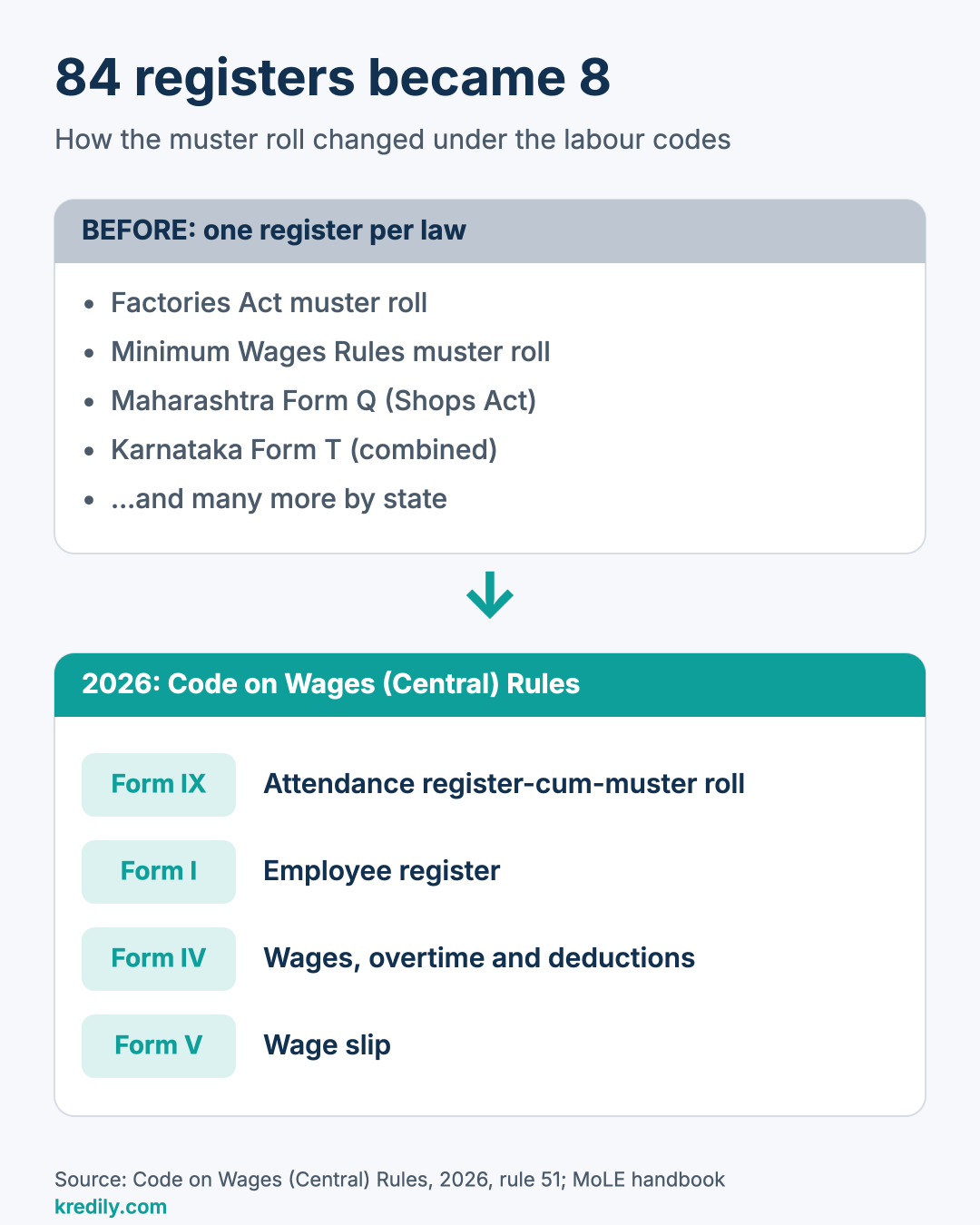
Before the labour codes, each law had its own register. A factory might keep one muster roll under the Factories Act, another under the Minimum Wages Rules, and a third under the state Shops and Establishments Act. States had their own forms too, such as Form Q in Maharashtra and Form T in Karnataka.
The codes cut this down sharply. According to Ministry of Labour and Employment figures, the number of registers fell from 84 to 8. For a typical business, there is now one combined attendance record that feeds both wages and working-hours compliance.
That said, check your state rules too, because several states are still aligning their own rules with the codes. Until they do, an inspector may still ask for the state format.
What details must a muster roll contain?
The exact columns depend on the form your state or the Centre prescribes. In practice, a compliant muster roll records:
| Section | Details |
|---|---|
| Establishment | Name, address, registration number, month and year |
| Employee | Serial number, employee code, name, gender, designation |
| Work details | Shift, place of work, and any assignment away from the workplace |
| Daily attendance | A mark for each date: present, absent, leave, holiday or weekly off |
| Hours | Normal hours worked and overtime hours |
| Month totals | Days present, paid leave, unpaid leave and overtime hours |
| Sign-off | Signature or authentication by the employer or manager |
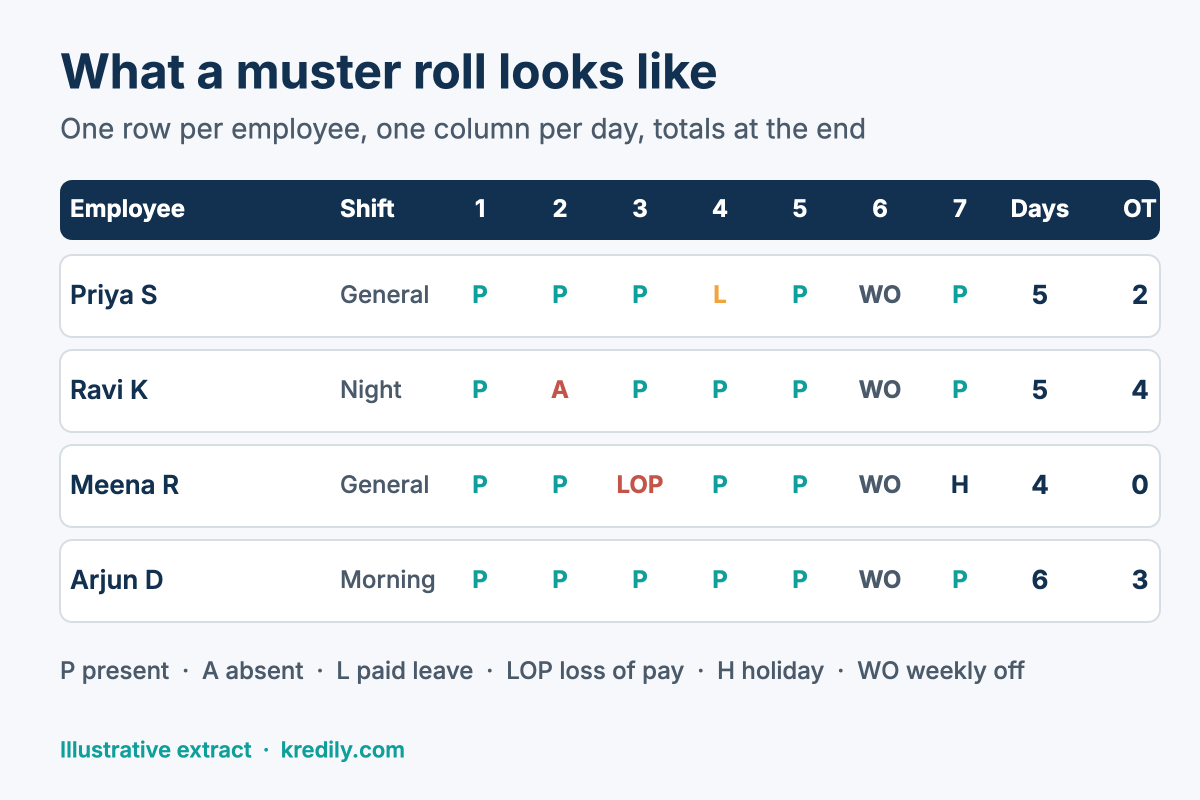
Use clear codes, and then stick to them. For example: P for present, A for absent, L for paid leave, LOP for loss of pay, H for holiday and WO for weekly off.
Muster roll format: a free template
To make this easier, we have built a free template that follows the Form IX layout. It covers one month, up to 31 days, with columns for shift, place of work, leave and overtime.
Download the free muster roll template (CSV, Form IX layout)
The file opens in Excel or Google Sheets, so you can start straight away. Add your establishment details at the top, list your employees, and mark each day. The totals at the end of each row should match the days and overtime you pay in that month.
How to keep attendance records correctly
- Record attendance daily, not at the end of the month. Back-filled registers are easy to spot.
- Use one set of codes across every site and shift.
- Capture overtime when it happens, with the actual hours worked.
- Match the muster roll to payroll before you run wages. Every LOP day and overtime hour should appear in both.
- Keep it where it can be produced, at the workplace or in an electronic system an inspector can access.
- Keep old registers for the period your rules prescribe. Many employers keep at least three years as a safe practice.
If you use biometric or app-based attendance, however, the system can produce the register for you. Our guide to the attendance register explains how digital records work in practice.
Muster roll for contract workers
Contractors must keep one for the workers they supply. Still, the principal employer should check it every month. If a contractor’s workers are underpaid or their overtime goes unrecorded, the principal employer can end up liable too.
So ask each contractor for their attendance and wage registers along with their monthly invoice. Compare the headcount with the people who actually came to your site.
Common mistakes to avoid
- Filling it at month end from memory, instead of daily.
- Leaving out overtime, which hides an overtime pay liability.
- Different records at different sites, which makes the total impossible to verify.
- Muster roll and payroll that do not match, especially on LOP days.
- Not keeping contractor muster rolls on file.
Monthly compliance checklist
- Choose one format, either Form IX or your state’s version, for every site.
- Record attendance and overtime daily.
- Reconcile the muster roll with payroll before each wage run.
- Issue wage slips in Form V on or before pay day.
- Collect contractor muster rolls every month.
- Store registers safely, on paper or electronically, so that you can retrieve them quickly.
Attendance records are only one part of payroll compliance, though. Our payroll statutory compliance guide covers the rest, and our minimum wages guide explains how attendance feeds into minimum pay and overtime.
Prefer to automate it? Kredily’s attendance management system records attendance, leave and overtime, and Kredily payroll software turns them into wages and salary slips.
Frequently asked questions
What is a muster roll in HR?
It is the register that records each employee’s daily attendance, leave, shifts and overtime for the month. HR and payroll use it to calculate wages and to prove compliance during inspections.
Is a muster roll mandatory under the new labour codes?
Yes. Section 50(1) of the Code on Wages requires every employer to keep a register with the persons employed, the muster roll and the wages paid. The central format is Form IX under the Code on Wages (Central) Rules, 2026.
What is Form IX?
Form IX is the attendance register-cum-muster roll under rule 51 of the Code on Wages (Central) Rules, 2026. It records daily attendance and overtime for each employee, with their shift and place of work.
Can a muster roll be maintained electronically?
Yes. The Code on Wages (Central) Rules, 2026 allow registers to be kept electronically or on paper. An attendance or payroll system that produces the muster roll in the prescribed format is fine.
What is the difference between a muster roll and a wage register?
The muster roll records attendance and hours. The wage register records the wages paid, overtime pay, advances, fines and deductions. Many states and small businesses combine them into one muster roll-cum-wage register.
How long should a muster roll be kept?
Keep it for the period your applicable rules prescribe. Many employers keep at least three years of registers as a safe practice, and longer where a dispute is open.
How we checked this guide
We read section 50 of the Code on Wages and the register provisions of the Code on Wages (Central) Rules, 2026, and compared them with how legal and HR firms describe the new forms. State rules are still catching up, so the guide flags where your state’s format may still apply.
Sources and notes
- Code on Wages, 2019, section 50(1), India Code.
- Code on Wages (Central) Rules, 2026, G.S.R. 343(E), 8 May 2026, rule 51 and Forms I, IV, V and IX, as summarised by BDO India and Mondaq.
- Reduction of registers from 84 to 8 under the four labour codes, as reported by Business Standard (24 September 2026) and BusinessToday (25 September 2026), citing Ministry of Labour and Employment figures.
This guide is for general information. It is not legal advice. For decisions about your own records, speak to your labour consultant.