


HRMS software for Indian businesses
What an HRMS actually has to do here — and how to tell a real one from a rebadged global tool.
A plain guide to HRMS software in India: the modules that matter, what statutory compliance really costs you when it's missing, what you should pay, and how to switch mid-year. Then start free for unlimited employees.
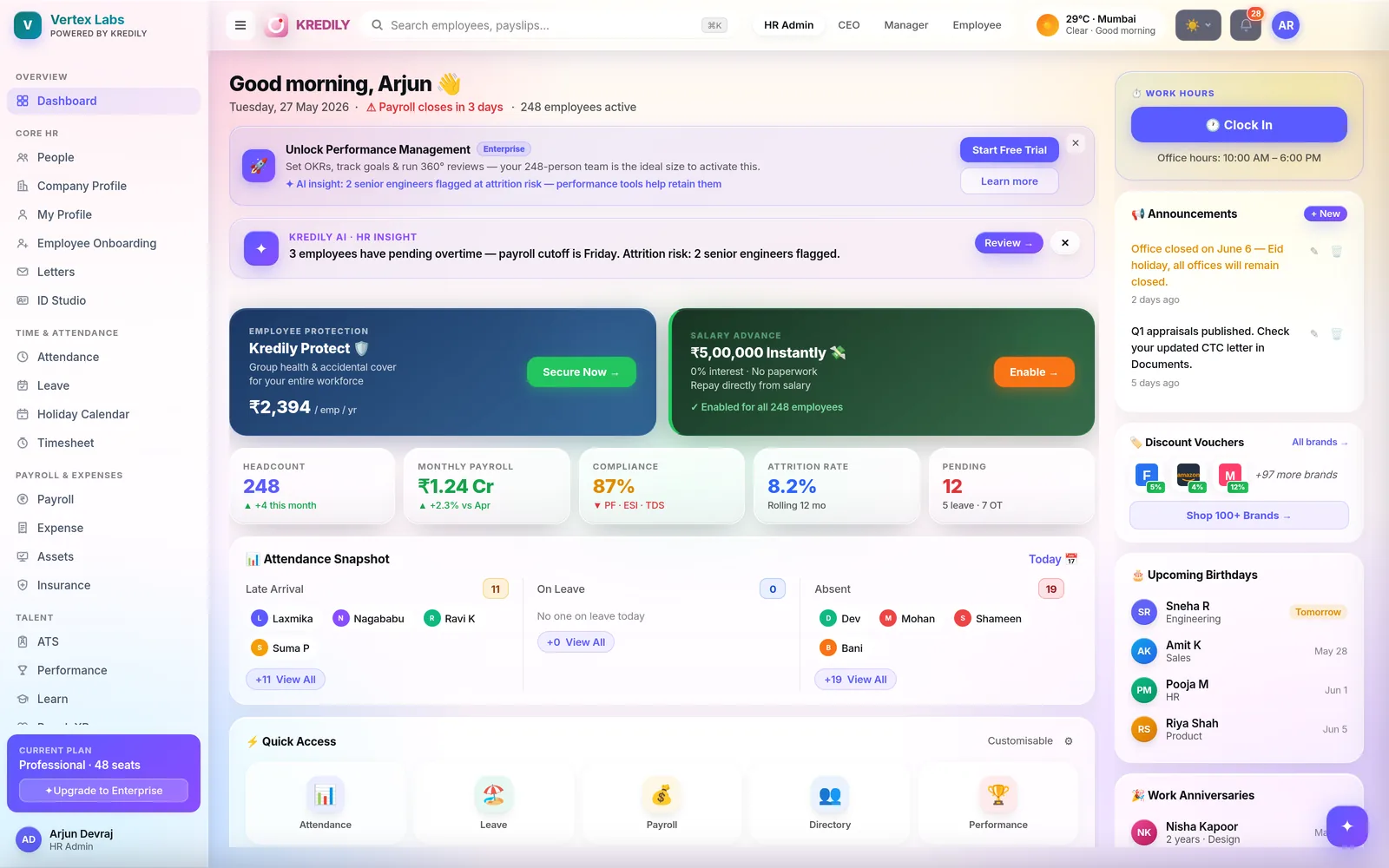
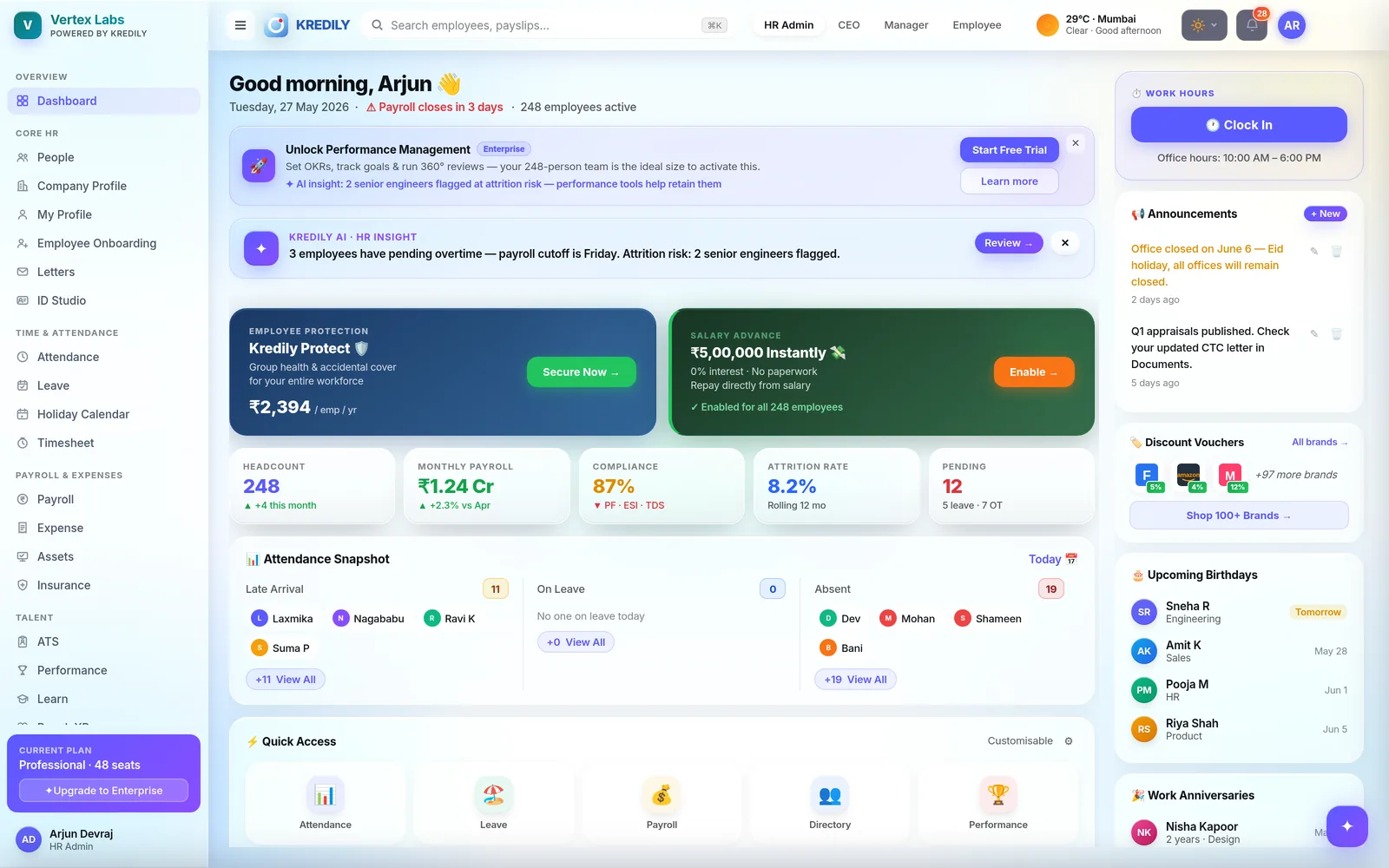
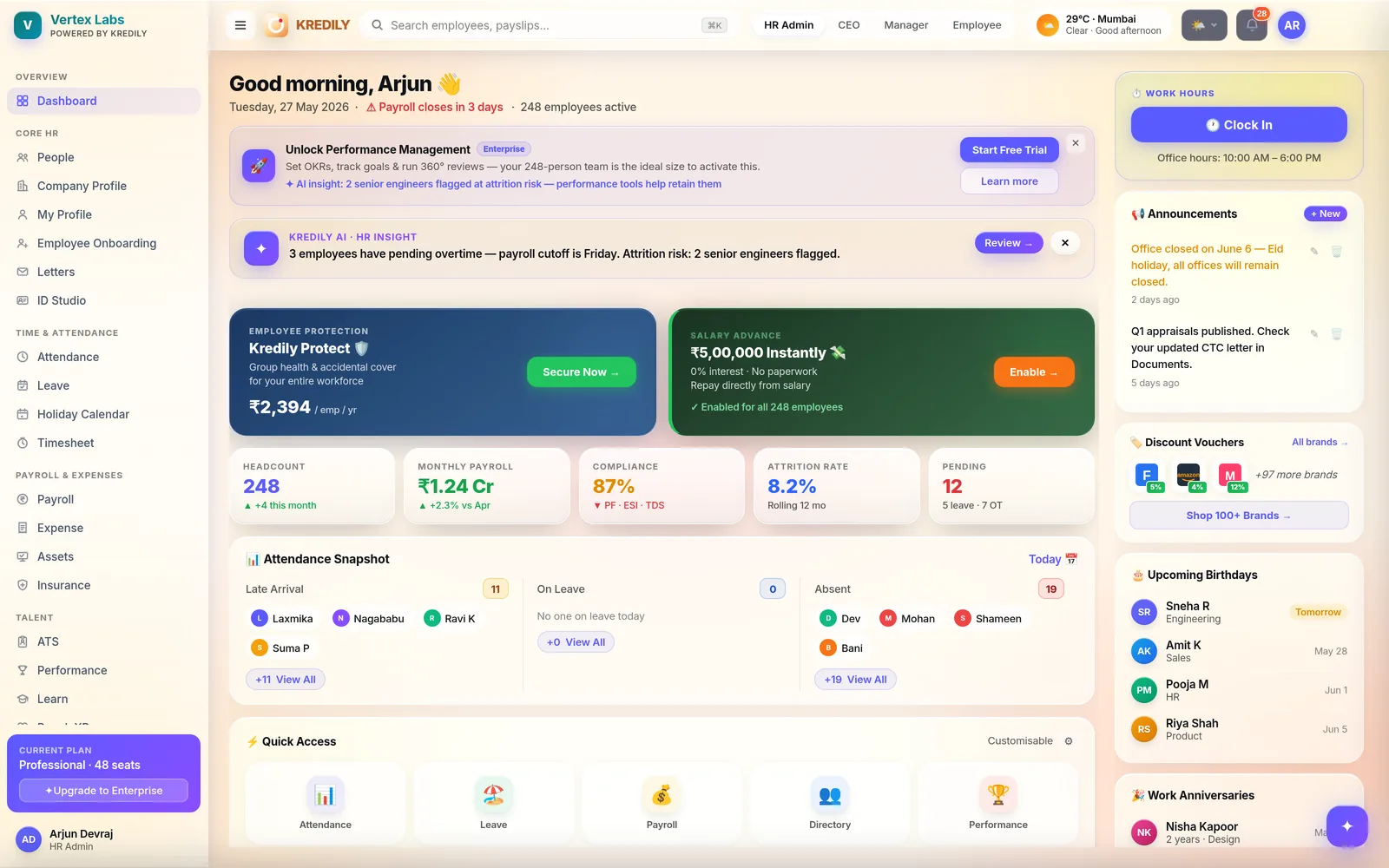
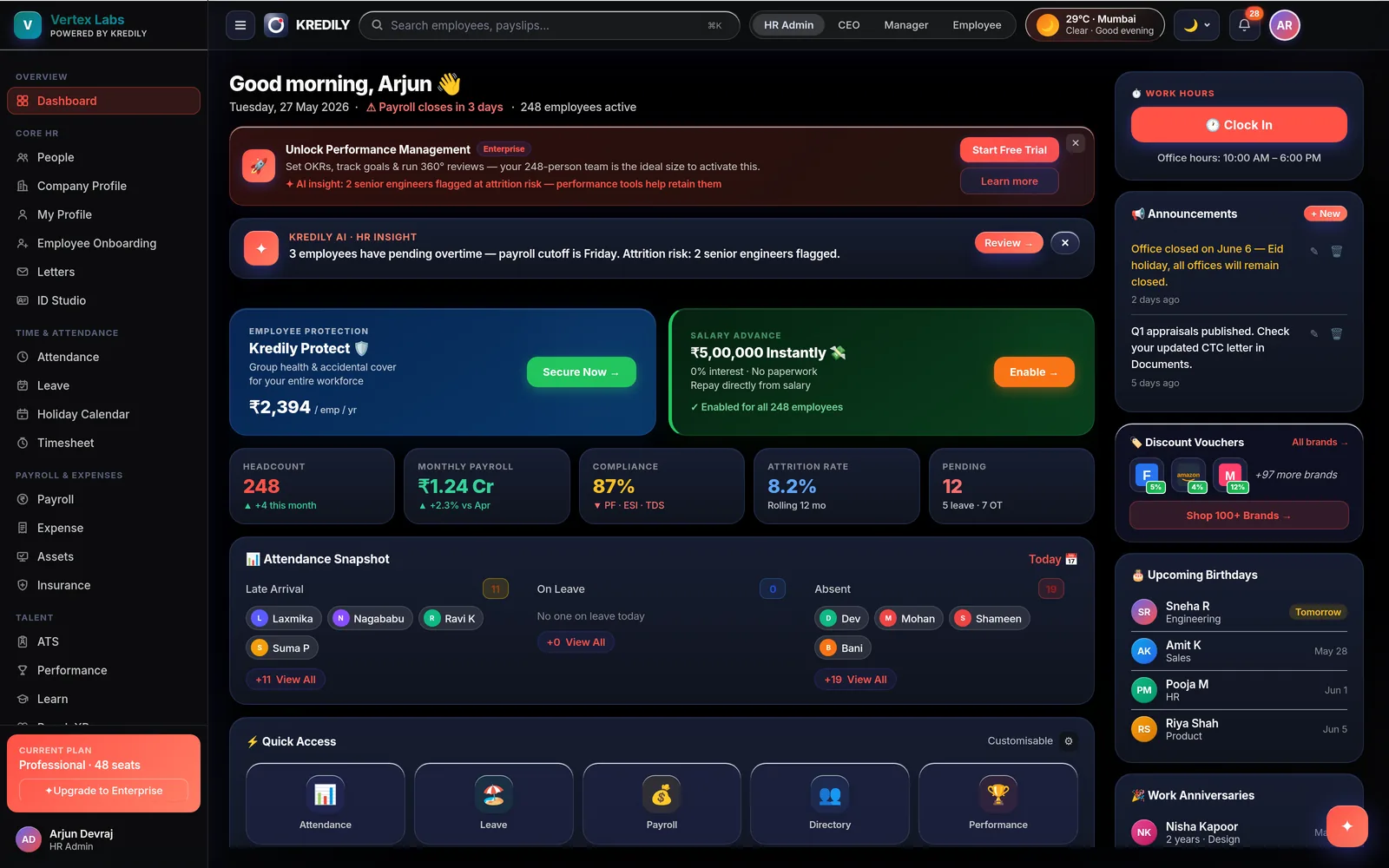
HRMS software (Human Resource Management System) is the single system a company uses to hold employee records and run the work built on top of them — onboarding, attendance, leave, payroll, documents, performance and exits. In India the deciding factor is rarely the HR features; it's whether the same system computes PF, ESI, Professional Tax and TDS natively, because an HRMS that stops short of statutory payroll pushes you straight back into spreadsheets. Kredily is an HRMS and payroll platform built for India, free forever for unlimited employees, with paid plans when you need bank payouts and advanced automation.
The six jobs an HRMS has to do
Feature lists are long and mostly identical. These are the jobs that decide whether the system survives contact with a real month.
Hold one record per person
Profiles, salary structure, documents, reporting lines and history in one place — so nobody maintains a parallel spreadsheet. See Directory.
Capture time honestly
Attendance you can defend at audit: web clock-in, mobile GPS, selfie validation, geo-fencing, biometric sync — with late marks and loss-of-pay computed, not argued. See Attendance.
Run your leave policy as written
Accruals, carry-forward caps, encashment, pro-rata joiners, probation rules, the sandwich rule — 50+ controls, so the policy runs as configuration rather than exceptions. See Leave.
Turn all of that into payroll
Attendance and leave should land in the salary run without a re-entry step, with PF, ESI, PT and TDS computed every cycle. See Payroll.
Be usable by the whole company
If employees can't check a payslip or apply for leave from a phone, HR keeps answering it. Self-service is what removes the query load. See Employee app.
Answer questions about your workforce
Headcount, attrition, cost and absenteeism as computed metrics — not a monthly export. See Workforce Intelligence.
What to demand from an HRMS in India
Take this into any demo — including ours. The middle column is the part vendors skip.
| Ask about | Why it decides the outcome | Kredily |
|---|---|---|
| Statutory payroll, natively | Global HR tools rarely compute PF, ESI, Professional Tax or TDS. Without it you run a second payroll tool and reconcile by hand. | Computed every cycle. Statutory calculation is included on the free plan; challan and Form 16 / 24Q generation are paid-plan features. |
| Attendance → payroll, in one hop | If attendance lives in a different product, someone re-keys it monthly. That's where payroll errors come from. | One platform — attendance and leave feed the salary run directly. |
| Per-seat cost at your real headcount | Per-employee-per-month pricing looks small in a demo and reprices your whole HR budget at 200 people. | Free forever for unlimited employees on the core plan; transparent published pricing above it. |
| How long implementation takes | "Six to twelve weeks of onboarding" is a real cost, usually paid in your team's time. | Magic Upload reads your existing employee spreadsheet and maps records and salary structures — most teams are live the same day. |
| Whether employees will actually use it | An HRMS nobody logs into becomes an HR data-entry job. Mobile adoption is the whole return. | OTP login, payslips, leave, attendance and claims in the mobile app — Android and iOS. |
| Where your data is held | Employee records are sensitive personal data. Hosting region and access control belong in the evaluation, not the contract's fine print. | India data residency and role-based access. Specifics in our Trust Center. |
| What the AI actually does | "AI-powered" is on every website now. The question is whether it acts on your live data or writes generic text. | The AI Copilot answers from your real records and performs actions, role-gated, with a human approving anything irreversible. |
HRMS, HRIS and HCM — the honest version
Vendors use these interchangeably. The distinction is mostly historical, but it's worth knowing what people mean.
HRIS Human Resource Information System
The record-keeping core: people data, org structure, documents, compliance records. The oldest of the three terms — a database with workflows on top.
HRMS Human Resource Management System
The HRIS core plus the operational modules — attendance, leave, payroll, onboarding, exits. This is what most Indian businesses are actually shopping for.
HCM Human Capital Management
Adds the talent layer — performance, learning, succession, engagement — and is usually how enterprise suites position themselves. Bigger scope, longer implementations.
In practice, ask what modules are included and which are paid extras. That answer is more useful than the acronym.
What HRMS software costs in India
Most Indian HRMS pricing is per-employee-per-month, which means your bill grows with your headcount. Here's ours, published in full.
| Free Forever₹0 /month | Payroll OS₹1,249 /mo · ₹50/emp 26+ | Professional₹1,749 /mo · ₹70/emp 26+ | EnterpriseCustom | |
|---|---|---|---|---|
| Employees | Unlimited | Up to 25, then per employee | Up to 25, then per employee | Custom |
| Core HRMS, attendance & leave | ✓ | ✓ | ✓ | ✓ |
| Payroll processing & payslips | ✓ | ✓ | ✓ | ✓ |
| Statutory calculation (PF, ESI, PT, TDS) | ✓ | ✓ | ✓ | ✓ |
| Challans, Form 12BB / 16 / 24Q | — | ✓ | ✓ | ✓ |
| Direct bank salary payout | — | ✓ | ✓ | ✓ |
| KredEYE face-recognition attendance | — | — | ✓ | ✓ |
| Advanced automation & analytics | — | — | ✓ | ✓ |
Free Forever is subject to our active-usage policy. Full plan detail and add-ons on the pricing page; to sanity-check what an HRMS should save you, try the payroll ROI calculator.
Moving off spreadsheets or another HRMS
You do not have to wait for April. Mid-year switches are routine — year-to-date figures come across so Form 16 stays whole.
Export what you have
Employee records, salary structures and year-to-date payroll figures — a spreadsheet is enough.
Magic Upload maps it
It reads your sheet and auto-maps people, salary heads and statutory configuration instead of asking you to re-key them.
Rebuild policies as rules
Leave types, accruals and attendance policies get configured once — the setup wizard walks the statutory settings.
Run one parallel cycle
Process a month alongside your old process, compare the register, then cut over with confidence.
What you're probably doing today
Spreadsheets
- Statutory rates maintained by hand
- No audit trail when a number is questioned
- One person holds the whole process
Legacy HRMS
- Quote-based pricing, per seat, every year
- Implementation measured in months
- Employees avoid the interface
One connected platform
- HRMS, attendance, leave and payroll in one system
- Free for unlimited employees to start
- Built for Indian statutory reality
HRMS software questions
What is HRMS software?
What is the difference between HRMS, HRIS and HCM?
Is there genuinely free HRMS software in India?
How much does HRMS software cost in India?
Does HRMS software handle Indian statutory compliance?
How long does it take to implement an HRMS?
Can we switch HRMS in the middle of a financial year?
Is HRMS software suitable for a small business?
Stop evaluating. Start a month.
The fastest way to judge an HRMS is to run one real cycle in it. Free forever for unlimited employees — set up today.