


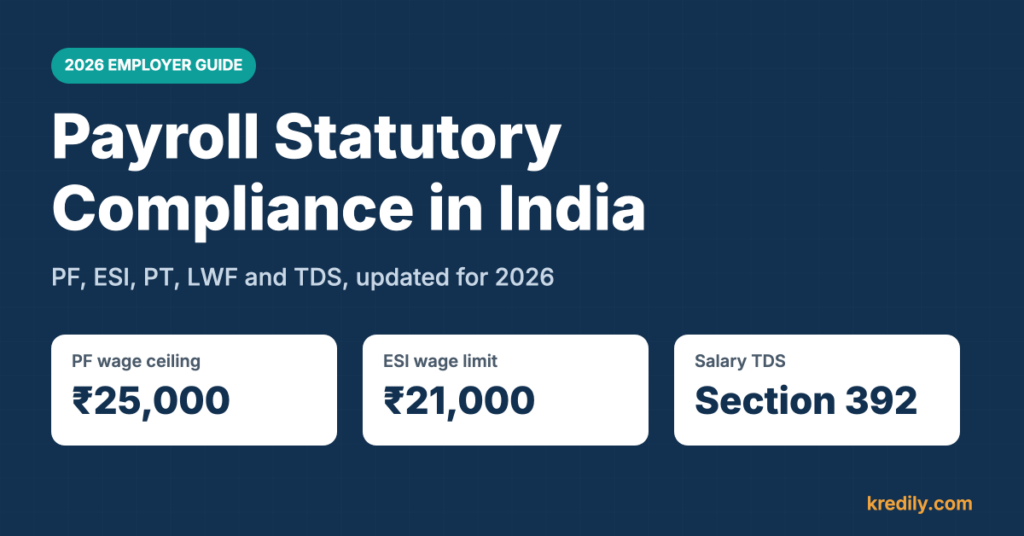
Last updated: 10 November 2026. Checked against the four labour codes, the Income-tax Act, 2025 and EPFO’s September 2026 wage ceiling notification.
Statutory compliance in payroll means paying wages and running deductions exactly as Indian law requires: the right amount, to the right authority, by the right date. For most employers in 2026, that covers eight areas. They are minimum wages, timely wage payment, PF, ESI, professional tax, labour welfare fund, TDS on salary, and statutory bonus with gratuity.
The rules shifted a lot in the last twelve months. The four labour codes came into force on 21 November 2025. A new Income-tax Act took over on 1 April 2026 and renamed the salary TDS forms. Then the PF wage ceiling jumped from ₹15,000 to ₹25,000 in September.
Plenty of payroll guides online still quote the old numbers. This one does not.
Payroll statutory compliance at a glance
| Obligation | Who pays | Key number in 2026 | Monthly due date |
|---|---|---|---|
| Provident Fund (PF) | Employee 12%, employer 12% | Wage ceiling ₹25,000 | 15th |
| ESI | Employee 0.75%, employer 3.25% | Wages up to ₹21,000 | 15th |
| Professional tax (PT) | Employee, deducted by employer | Up to ₹2,500 a year | Varies by state |
| Labour welfare fund (LWF) | Employee and employer | Small fixed amount | Half-yearly or yearly, by state |
| TDS on salary | Employee, deducted by employer | Section 392, Income-tax Act, 2025 | 7th |
| Statutory bonus | Employer | 8.33% to 20% of bonus wages | Yearly, 30 November |
| Gratuity | Employer | 15 days’ wages per year of service | On exit |
| Minimum wages | Employer | State or Central notified rate | Every wage period |
What does statutory compliance mean for payroll?
Statutory compliance is the set of legal duties an employer owes simply because it employs people. Some are payments, such as PF and ESI. Others are deductions you hold in trust, such as TDS and professional tax. The rest are records and returns that prove you did both.
Two features make statutory compliance in Indian payroll harder than it looks. First, it sits on two layers of law. PF, ESI, TDS, gratuity and bonus come from central law. Professional tax and LWF come from state law, and minimum wages come from both. Second, most thresholds depend on headcount or wages, so one hire or one increment can switch an obligation on.
Every statutory compliance task falls into one of three jobs:
- Calculate the right deduction or contribution for each employee.
- Deposit it with the right authority on time.
- Record and report it through registers, returns and payslips.
Miss any one of the three and you are out of compliance, even if the money itself was right.
What changed in statutory compliance in 2025 and 2026
Four changes matter more than everything else this year.
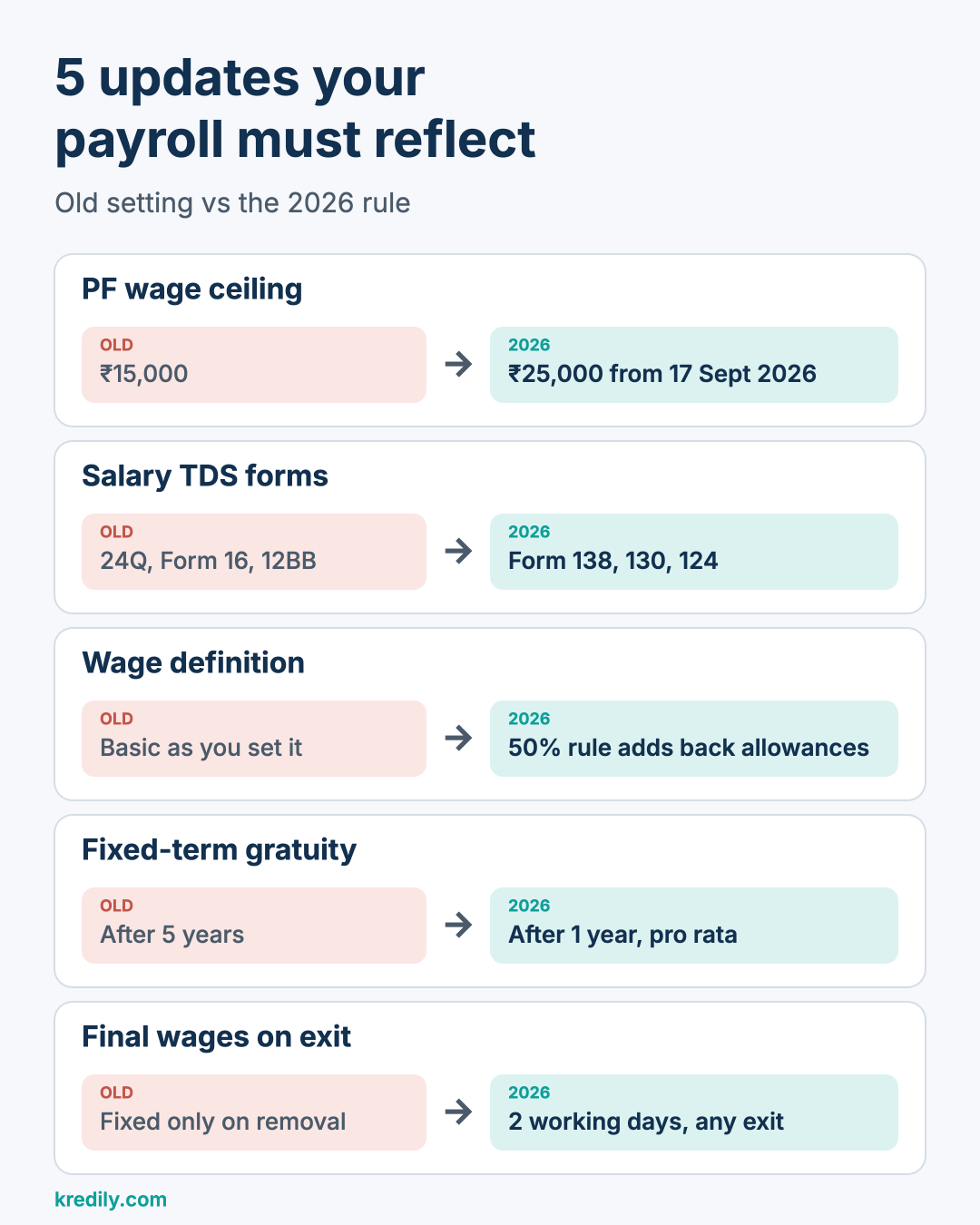
The labour codes replaced 29 older laws. From 21 November 2025, four codes took over: Wages, Social Security, Industrial Relations, and Occupational Safety, Health and Working Conditions. So the old Payment of Wages, Minimum Wages, EPF, ESI, Bonus and Gratuity Acts now live inside the codes. Statutory compliance today means following the codes, not the old Acts.
Wages now have one definition. Under the codes, wages broadly mean basic pay, dearness allowance and retaining allowance. When excluded allowances such as HRA and conveyance cross half of total pay, the excess goes back into wages. That single rule now drives PF, gratuity and bonus. Our New Labour Codes guide explains it with examples.
The PF wage ceiling rose to ₹25,000. It took effect on 17 September 2026, so maximum PF contributions went from ₹1,800 to ₹3,000 a month on each side. The PF wage ceiling guide covers the September split-month calculation.
Salary TDS moved to a new Act. From 1 April 2026, the Income-tax Act, 2025 governs TDS on salary under section 392, which replaced section 192. Form 24Q became Form 138, Form 16 became Form 130, and Form 12BB became Form 124. Returns for FY 2025-26 still use the old forms.
The core statutory compliances in payroll
Provident Fund (PF)
PF applies to establishments with 20 or more employees. Employee and employer each contribute 12% of PF wages, capped at the ₹25,000 ceiling. Out of the employer’s 12%, 8.33% goes to the pension scheme (EPS) and the rest to the EPF account.
You upload the electronic challan cum return (ECR) and pay by the 15th of the following month. Every member needs a UAN, so enrol new joiners in the month they join.
Employees’ State Insurance (ESI)
ESI covers employees earning gross wages of up to ₹21,000 a month, or ₹25,000 for persons with disability, in establishments with 10 or more employees. The employee pays 0.75% and the employer pays 3.25%. Contributions are due by the 15th.
ESI now sits under the Code on Social Security. The government has not yet notified new ESI wage limits or rates under the Code, so the existing figures continue. Our ESI calculation guide walks through the maths.
Professional tax (PT)
Professional tax is a state tax on employment, and the employer deducts it from salary. The Constitution caps it at ₹2,500 per person per year. Not every state levies it, and those that do set their own slabs, registration rules and due dates.
If you hire in a new state, check PT before the first payroll. Kredily’s professional tax slab guide and state pages such as Karnataka and Tamil Nadu list current slabs.
Labour welfare fund (LWF)
LWF is another state-level levy. Both employee and employer pay a small fixed amount into a state welfare fund, usually half-yearly or once a year. The amounts, the due months and the employer threshold all vary.
Because the sums are small, LWF is the deduction teams forget most often. Check the rules in each state you operate in, for example Maharashtra or Karnataka.
TDS on salary
Every employer must deduct tax from salary when an employee’s estimated taxable income calls for it. You estimate the full year’s income, apply the slab rates of the regime the employee chose, and deduct the tax evenly across the remaining months.
Deposit TDS by the 7th of the following month. For March, the deadline is 30 April. File the quarterly salary TDS return, now Form 138, by 31 July, 31 October, 31 January and 31 May. Then issue Form 130 to each employee by 15 June. Our TDS on salary explainer covers the basics, and the Form 16 glossary entry explains what Form 130 replaced.
Statutory bonus
Establishments with 20 or more persons must pay a minimum bonus of 8.33% of bonus wages to employees earning up to ₹21,000 a month. The maximum is 20%. Bonus for an April to March year is due by 30 November. Our full statutory bonus guide covers eligibility and worked examples.
Gratuity
Gratuity applies to establishments with 10 or more employees. A permanent employee qualifies after five years of continuous service. The labour codes added a big change here: fixed-term employees now qualify after just one year, on a pro rata basis.
The formula is 15 days’ wages for every completed year of service, using 26 working days a month. The labour codes gratuity guide explains the change, and the gratuity calculator does the arithmetic.
Minimum wages and timely payment
These two apply from your very first employee. Under the Code on Wages, every employee must get at least the notified minimum wage for their skill level and area. Many states revise their rates twice a year through dearness allowance, so a rate that was correct in March may be short by October.
The Code also fixes when you must pay wages. For a monthly wage period, wages are due by the 7th of the following month. When someone leaves, whether by resignation, dismissal or retrenchment, you must clear their dues within two working days. That makes a quick full and final settlement a legal requirement, not a courtesy.
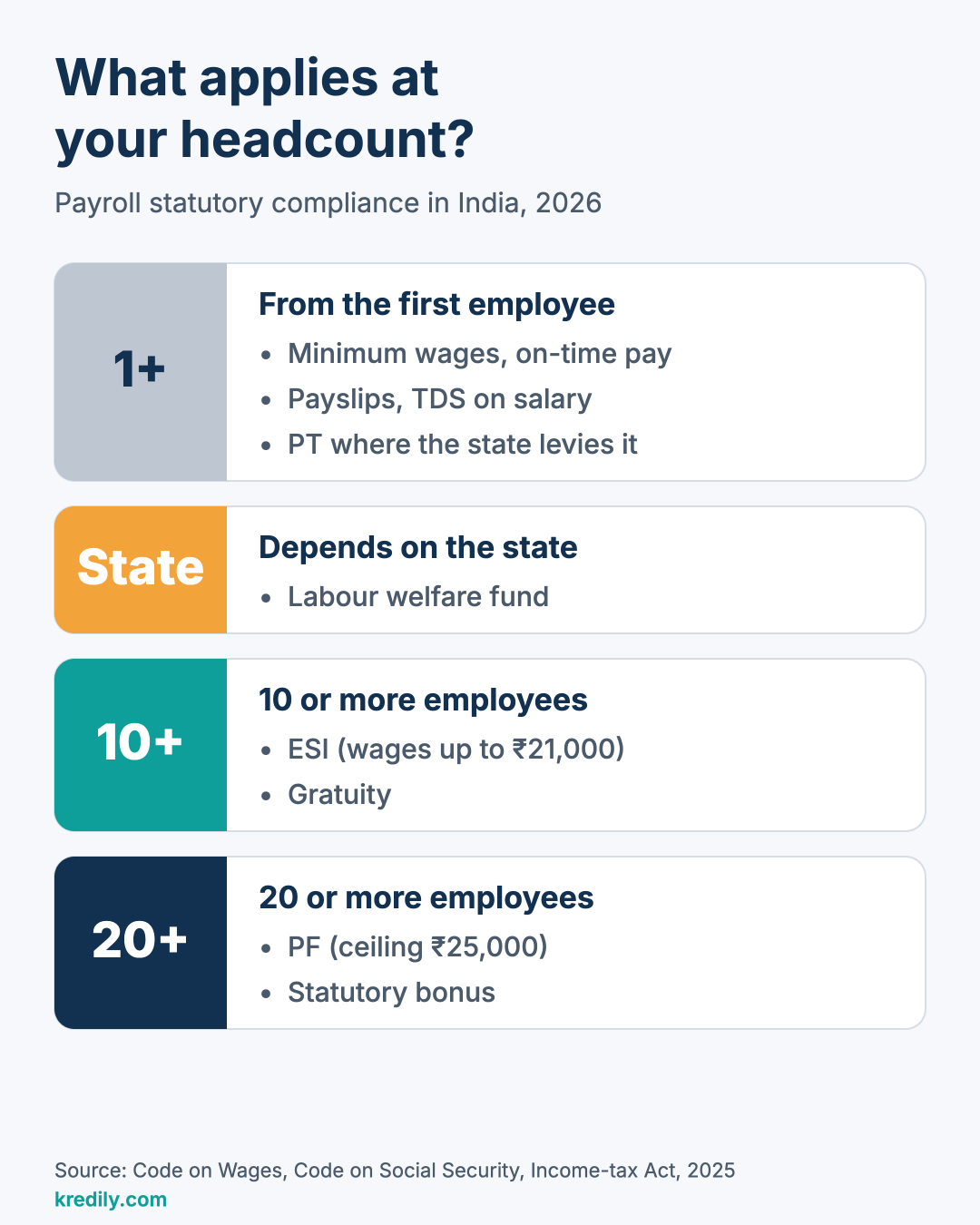
Which statutory compliances apply at your headcount?
Headcount decides most of your statutory compliance. Here is how the obligations stack up as a business grows.
| Headcount | What applies | Law |
|---|---|---|
| From 1 employee | Minimum wages, timely payment, payslips, TDS on salary, PT (in states that levy it) | Code on Wages, Income-tax Act, 2025, state PT law |
| Varies by state | Labour welfare fund | State LWF law |
| 10 or more | ESI (for employees earning up to ₹21,000), gratuity | Code on Social Security |
| 20 or more | PF, statutory bonus | Code on Social Security, Code on Wages |
Two counting rules catch people out. PF and bonus look at the number of persons employed, not just those on payroll, so contract workers can count. And for bonus, reaching 20 on any single day of the year is enough.
Statutory compliance calendar for payroll
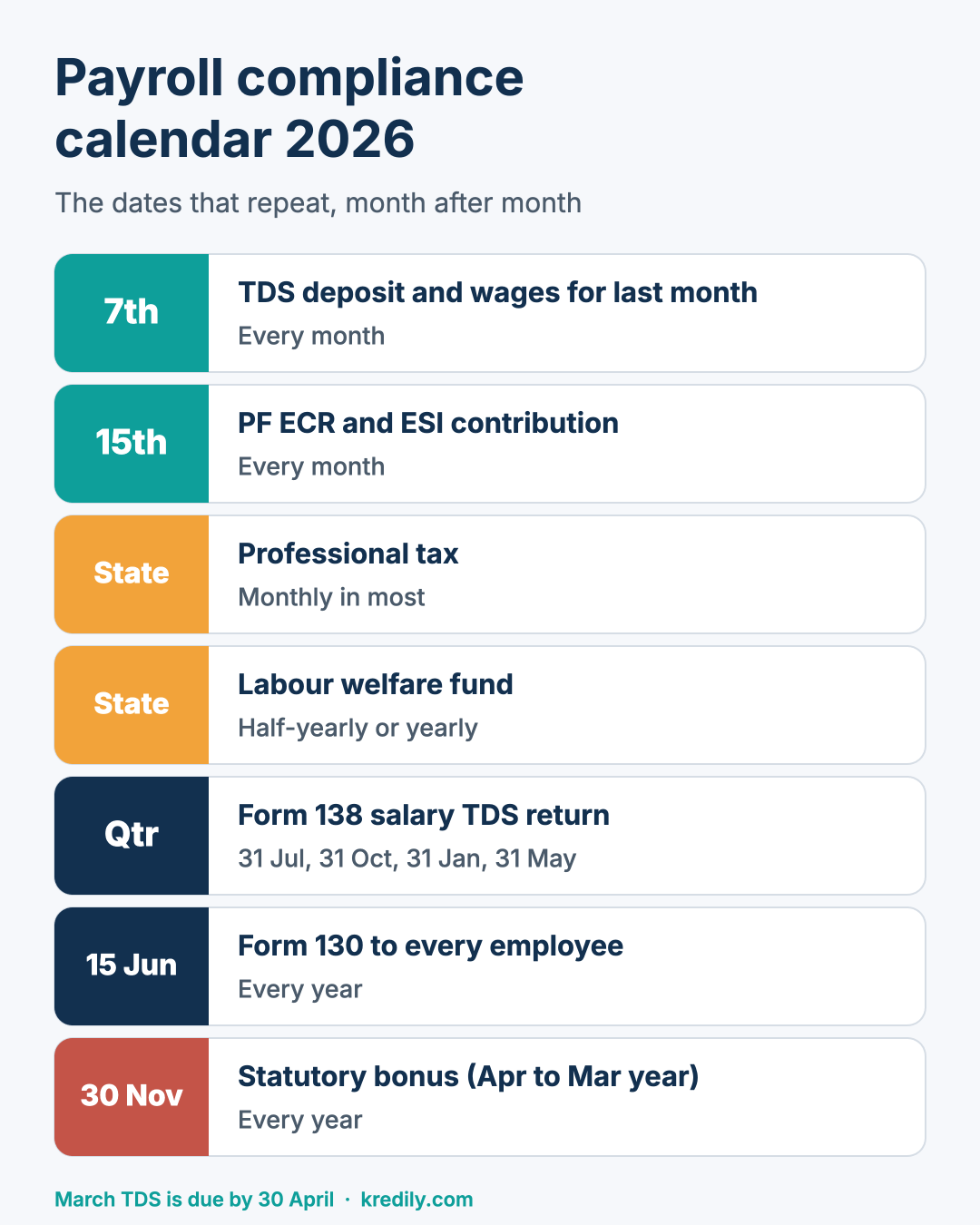
Most statutory compliance follows a fixed monthly rhythm, so build your payroll calendar around these dates.
| Date | What is due |
|---|---|
| 7th of every month | TDS on the previous month’s salary (March TDS: 30 April); wages for the previous month |
| 15th of every month | PF ECR and payment; ESI contribution |
| State-specific | Professional tax payment and returns |
| Half-yearly or yearly | Labour welfare fund, depending on the state |
| 31 July, 31 October, 31 January, 31 May | Quarterly salary TDS return (Form 138) |
| 15 June | Form 130 to every employee |
| 30 November | Statutory bonus for an April to March year |
When a due date falls on a holiday, do not assume an automatic extension. Pay a day early instead. Our annual compliance checklist adds the non-payroll filings to this list.
Registers and records for statutory compliance
Inspectors rarely start with your challans. Usually they start with your records, because statutory compliance has to be provable. Keep these up to date for every employee:
- Appointment letter. The OSH Code requires one for every employee.
- Attendance and muster roll, including overtime hours.
- Wage register, showing gross wages, every deduction and net pay.
- Wage slip for each wage period. A clear salary slip format covers most of this.
- Leave records, including leave encashed.
- Bonus register and gratuity records.
- PF, ESI, PT and LWF challans and returns, plus TDS challans, Form 138 returns and Form 130 certificates.
You can now keep most of these electronically. What matters is that each record exists, matches your payments, and that you can produce it on request.
Penalties for missing statutory compliance
The cost of getting it wrong comes in three layers:
- Interest and damages. Late PF, ESI and TDS deposits attract interest from the due date, and PF can add damages on top.
- Fines. Under section 54 of the Code on Wages, paying an employee less than the amount due can lead to a fine of up to ₹50,000. A repeat within five years can bring imprisonment of up to three months, a fine of up to ₹1 lakh, or both.
- The original dues. Penalties never replace the unpaid amount. You pay both.
The third point is the one that hurts small businesses most, because arrears for a whole team, plus interest, can run into lakhs.
Seven common statutory compliance mistakes in payroll
- Still capping PF at ₹15,000. The ceiling has been ₹25,000 since 17 September 2026, yet many templates and even some published guides still use the old figure.
- Using old TDS form numbers. For FY 2026-27, the return is Form 138 and the certificate is Form 130.
- Ignoring the 50% wage rule. A low basic with heavy allowances can raise PF, gratuity and bonus costs once excluded allowances are added back.
- Forgetting PT and LWF in a new state. The first hire in a new state often triggers both.
- Running last year’s minimum wage. State revisions mid-year are easy to miss.
- Slow full and final settlements. The two-working-day rule now applies to resignations too.
- Not checking contractors. You can be liable for unpaid PF or wages of contract workers, so ask for their challans every month.
Statutory compliance checklist for every payroll run
- Confirm headcount and wages against each threshold: 10 for ESI and gratuity, 20 for PF and bonus.
- Recalculate wages under the 50% rule for any salary structure with a low basic.
- Check minimum wages for every role, in every state, for the current month.
- Deduct PF on wages up to ₹25,000, ESI on gross wages up to ₹21,000, plus PT, LWF and TDS.
- Pay wages by the 7th and TDS by the 7th.
- File the PF ECR and pay ESI by the 15th.
- Issue payslips and update the wage register.
- Collect contractor challans and keep them on file.
- Diarise the quarterly Form 138 returns, Form 130 in June and bonus in November.
Prefer to automate it? Kredily payroll software calculates PF, ESI, PT and TDS in each payroll run as part of its statutory compliance features. For quick checks, try the free PF and ESI calculator and professional tax calculator.
Frequently asked questions
What is statutory compliance in payroll?
It is the set of legal duties an employer must meet when paying employees. In India, that means paying at least minimum wages on time, and deducting and depositing PF, ESI, professional tax, labour welfare fund and TDS. It also means paying statutory bonus and gratuity where they apply, and keeping registers, returns and payslips that prove all of it.
What are the main statutory deductions from salary in India?
There are five. PF takes 12% of PF wages up to ₹25,000, and ESI takes 0.75% of gross wages for employees earning up to ₹21,000. Professional tax runs up to ₹2,500 a year in states that levy it. Labour welfare fund applies in states that have it. Finally, TDS on salary applies to every employee whose income is taxable.
Is PF mandatory for companies with fewer than 20 employees?
No. PF becomes mandatory once an establishment employs 20 or more persons. Smaller employers can join voluntarily.
What is the ESI wage limit in 2026?
₹21,000 a month in gross wages, or ₹25,000 for persons with disability. The government has not yet notified new limits under the Code on Social Security, so these figures continue.
What replaced Form 24Q and Form 16?
Under the Income-tax Act, 2025, the quarterly salary TDS return is now Form 138 and the annual TDS certificate is Form 130. They apply from tax year 2026-27. Returns and certificates for FY 2025-26 still use Form 24Q and Form 16.
When should salary be paid under the Code on Wages?
For a monthly wage period, wages are due by the 7th of the following month. When an employee leaves for any reason, including resignation, their wages are due within two working days.
Do fixed-term employees get gratuity?
Yes. Under the Code on Social Security, fixed-term employees qualify for gratuity after one year of continuous service, on a pro rata basis. Permanent employees still need five years.
What is the penalty for not following statutory compliance?
It depends on the law. Late PF, ESI and TDS deposits attract interest, and PF can add damages. Under the Code on Wages, underpaying an employee can lead to a fine of up to ₹50,000, and repeat offences can bring imprisonment. The unpaid amount stays payable on top of any penalty.
How we checked this guide
We read the labour codes and the official notifications directly rather than relying on summaries of the old Acts. We then checked every rate and threshold against EPFO’s September 2026 ceiling notification, the August 2026 bonus notifications and the Income-tax Act, 2025. Several items, including PT, LWF and minimum wages, depend on your state, so this guide points you to state-level pages rather than quoting one national figure. We update this page when a rate, threshold or form changes.
Sources
- Code on Wages, 2019, including section 54, India Code
- EPFO FAQs on the revised ₹25,000 wage ceiling, September 2026
- Income Tax Department, Income-tax Act, 2025 and Income-tax Rules, 2026
This guide is for general information. It is not legal or tax advice. For decisions about your own payroll, speak to your consultant.