


Last updated: 11 November 2026. Rates cross-checked across several state-wise compilations; confirm with your state welfare board before filing.
The labour welfare fund (LWF) is a small state-level contribution that employers and employees pay into a welfare board. The board then uses the money for workers’ housing, health, education and recreation. LWF applies in 16 states and union territories, but each one sets its own amounts, frequency and due dates.
The sums are tiny, often ₹10 to ₹100 per employee. That is exactly why LWF gets missed. A skipped December deduction does not hurt anyone’s take-home pay, so nobody notices. It still leaves a compliance gap that shows up later with interest.
Labour welfare fund at a glance
| Point | Rule |
|---|---|
| Type of law | State law, separate in each state |
| Where it applies | 16 states and UTs, including Maharashtra, Karnataka, Tamil Nadu, Gujarat, Delhi and West Bengal |
| Who pays | Both employee and employer; the employer’s share is usually two to three times larger |
| How it is calculated | A fixed amount per employee in most states; a percentage of wages in Haryana |
| Frequency | Monthly, half-yearly or yearly, depending on the state |
| Most common due dates | 15 July and 15 January for half-yearly states; 15 or 31 January for yearly states |
What is the labour welfare fund?
The labour welfare fund is a statutory fund created under each state’s Labour Welfare Fund Act. A state labour welfare board then manages it. Contributions come from three places: employees, employers and, in some states, the state government.
The board spends the fund on schemes for workers and their families. Typical schemes include scholarships for children, medical aid, sewing and computer training, holiday homes and help with funeral costs.
LWF is separate from PF and ESI. It is not a savings scheme, so employees cannot withdraw it. Instead, it works more like a small welfare levy.
Which states have labour welfare fund?
LWF currently applies in 16 states and union territories:
Andhra Pradesh, Chandigarh, Chhattisgarh, Delhi, Goa, Gujarat, Haryana, Karnataka, Kerala, Madhya Pradesh, Maharashtra, Odisha, Punjab, Tamil Nadu, Telangana and West Bengal.
If your employees work only in other states, such as Uttar Pradesh, Rajasthan or Bihar, there is no LWF to deduct. If you have people in several states, check each one separately, because the rules never match.
Labour welfare fund rates by state (2026)
The table below shows the most widely reported rates for 2026. However, several states revise amounts by notification, so published compilations do not always agree. Use it as a starting point, and confirm the current figure with the state board before you file.
| State / UT | Employee share | Employer share | Frequency |
|---|---|---|---|
| Andhra Pradesh | ₹30 | ₹70 | Yearly |
| Chhattisgarh | ₹15 | ₹45 | Half-yearly |
| Delhi | ₹0.75 | ₹2.25 | Half-yearly |
| Goa | ₹60 | ₹180 | Half-yearly |
| Gujarat | ₹6 | ₹12 | Half-yearly |
| Haryana | 0.2% of wages, up to ₹35 | Twice the employee share, up to ₹70 | Monthly |
| Karnataka | ₹50 | ₹100 | Yearly |
| Kerala | Depends on the type of establishment | Depends on the type of establishment | Monthly or half-yearly |
| Madhya Pradesh | ₹10 | Reported between ₹30 and ₹50 | Half-yearly |
| Maharashtra | ₹25 | ₹75 | Half-yearly |
| Odisha | ₹10 | ₹20 | Half-yearly |
| Punjab | ₹5 | ₹20 | Monthly |
| Tamil Nadu | ₹20 | ₹40 | Yearly |
| Telangana | ₹2 | ₹5 | Yearly |
| West Bengal | ₹3 | ₹30 | Half-yearly |
Amounts are per employee for each contribution period. Maharashtra’s figures apply to employees above the lowest wage band. Chandigarh broadly follows Punjab’s scheme.
For details on a single state, see our pages for Maharashtra, Karnataka, Tamil Nadu, Gujarat, Andhra Pradesh, West Bengal, Delhi, Haryana and Odisha.
Labour welfare fund due dates
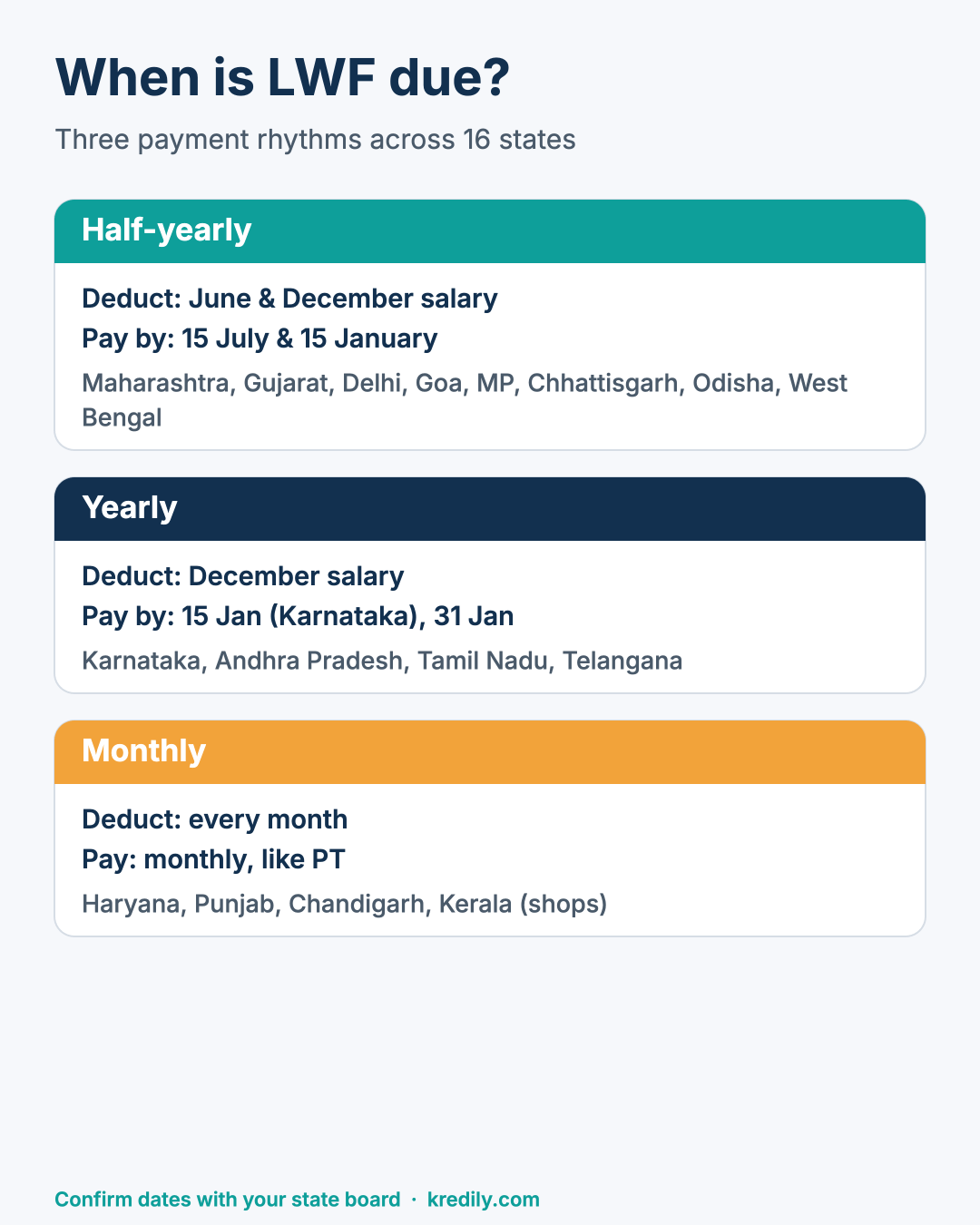
Most states, however, fall into one of three payment rhythms.
Half-yearly states
Maharashtra, Gujarat, Delhi, Goa, Madhya Pradesh, Chhattisgarh, Odisha and West Bengal follow this pattern. You deduct LWF from the June and December salaries. After that, you pay the board by 15 July and 15 January.
Yearly states
Karnataka, Andhra Pradesh, Tamil Nadu and Telangana collect once a year, usually from the December salary. Karnataka’s payment is due by 15 January. The other three usually expect it by 31 January.
Monthly states
Haryana and Punjab collect every month, and so does Kerala for shops and commercial establishments. So treat these like any other monthly statutory deduction.
Who must pay labour welfare fund?
Two tests decide whether LWF applies, and both vary.
- The establishment. Each state Act covers certain types of workplaces, such as factories, shops and commercial establishments. Most also set a minimum headcount, which ranges from one employee in some states to five, ten or twenty in others.
- The employee. Many states cover only employees below a wage or grade threshold. For instance, some exclude managerial staff or employees above a set salary.
Because both tests vary, read the Act for each state you operate in. If the state uses wage bands, as Maharashtra does, the amount can change when an employee’s pay moves into a new band.
How to calculate and deduct labour welfare fund
The process is simple once you know the state rules, so the work is mostly in the set-up:
- List eligible employees in each state on the deduction date, usually the last day of June or December.
- Deduct the employee share from that month’s salary and show it as a separate line on the salary slip.
- Add the employer share. This is a separate cost and must never come out of the employee’s pay.
- Pay the board through its online portal or challan by the due date.
- Keep the receipt with your payroll records.
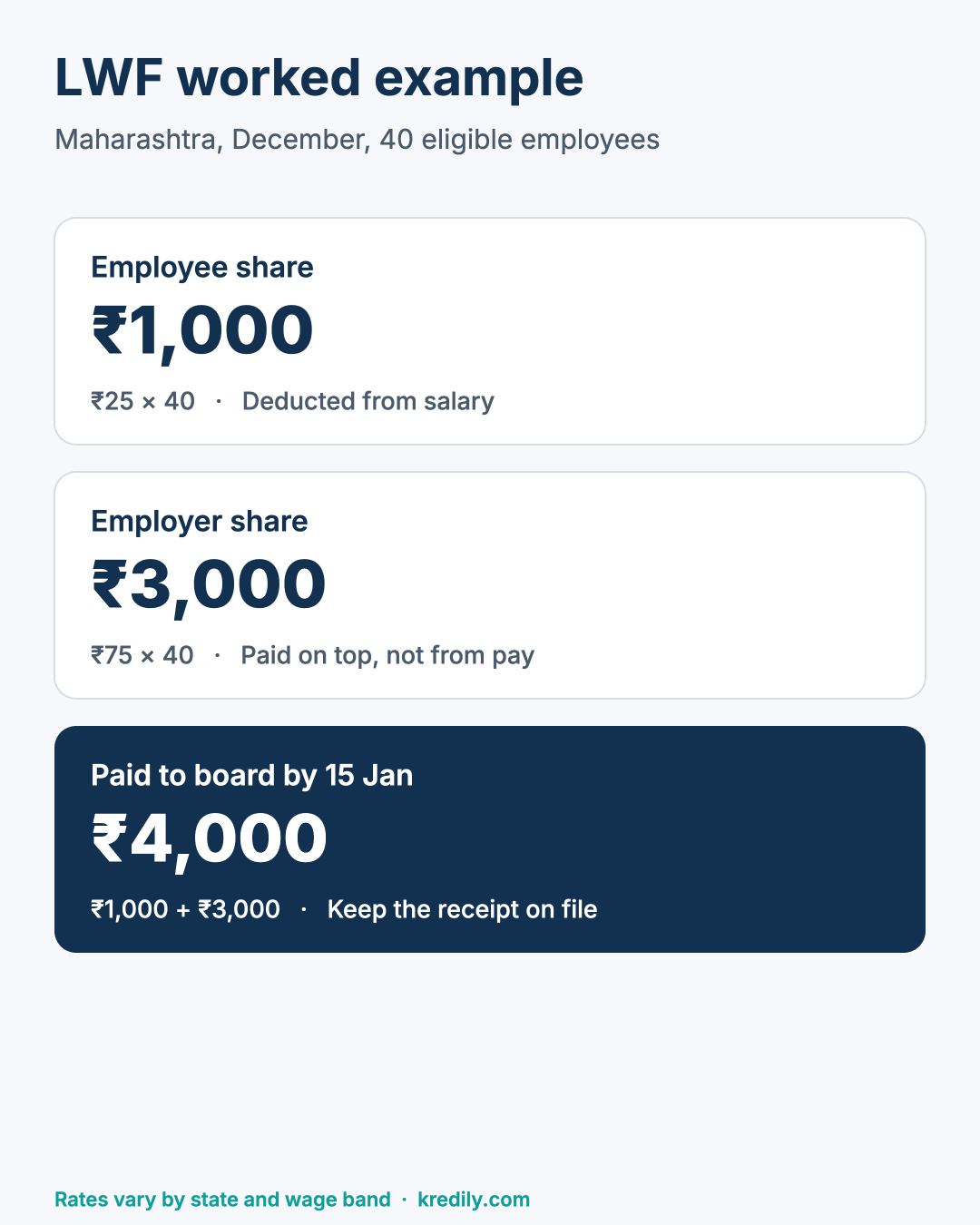
Here is a worked example, using Maharashtra. A Pune firm has 40 eligible employees in December. Maharashtra’s half-yearly rate is ₹25 from each employee and ₹75 from the employer. So the firm deducts ₹1,000 from salaries and adds ₹3,000 of its own, paying ₹4,000 by 15 January.
What happens if you miss LWF?
Late or missed payments usually attract interest, and some states add penalties on top. The amounts are small, but the problem still compounds over several years and several states. Missed LWF also tends to surface during due diligence, audits or labour inspections, when it is awkward to explain.
Still, the fix is the same in every state. Pay the arrears with interest, file any pending returns, and add the deduction to your payroll calendar so it does not slip again.
Common labour welfare fund mistakes
- Forgetting the December deduction. It falls in a busy month, especially with bonus and year-end tax work due.
- Deducting the employer share from salary. The employer’s share is the employer’s cost.
- Using one rate for every state. Each state has its own amount and frequency.
- Missing new states. Your first hire in a new state may also trigger LWF registration.
- Ignoring wage bands. In states with bands, the amount changes when pay moves up a band.
Labour welfare fund checklist
- List every state where you have employees, and mark which ones levy LWF.
- Note each state’s amount, frequency and due date in your payroll calendar.
- Check establishment and employee coverage rules for each state.
- Deduct in June, December or monthly, as each state requires.
- Pay the employer share on top, never from salary.
- Pay the board by the due date and file any returns.
- Keep receipts with your wage register.
LWF is one of eight payroll obligations. Our payroll statutory compliance guide covers the rest, including professional tax and minimum wages.
Running payroll in several states? Kredily payroll software includes LWF in its statutory compliance features alongside PF, ESI, PT and TDS.
Frequently asked questions
What is the labour welfare fund in salary?
It is a small deduction for a state welfare fund that appears on payslips in states that levy it. The employer then adds its own, larger share. The state board uses the money for workers’ welfare schemes.
Is labour welfare fund mandatory?
Yes, in the 16 states and union territories that have an LWF Act, for the establishments and employees the Act covers. In other states, however, there is no LWF.
How much is the labour welfare fund contribution?
It depends on the state. Most states charge a fixed amount, from ₹2 a year in Telangana to ₹60 every half-year in Goa for the employee. Haryana charges 0.2% of wages, capped at ₹35 a month for the employee.
When is labour welfare fund deducted?
In most states, from the June and December salaries. Karnataka, Andhra Pradesh, Tamil Nadu and Telangana deduct once a year, usually in December. Haryana and Punjab deduct every month.
Can an employee get the labour welfare fund money back?
No. LWF is not a savings scheme like PF. Instead, employees and their families can apply for the board’s welfare schemes, such as scholarships or medical aid, but the contribution itself is not refundable.
Is labour welfare fund part of the new labour codes?
No. LWF comes from separate state laws, which continue alongside the four labour codes.
How we checked this guide
LWF rates come from state notifications that change at different times, and published compilations often disagree. We compared several recent state-wise sources and used the figures that most of them agree on. Where they conflict, as for Madhya Pradesh and Kerala, we say so rather than pick one. Always confirm the current rate with the state labour welfare board before filing.
Sources and notes
- State-wise LWF rates and due dates for 2026, compared across Digiliance, IncorpX and HR Engage, all updated in October or November 2026.
- West Bengal’s employer share of ₹30 has applied since January 2024, as reported by EZHRM.
- Each state’s Labour Welfare Fund Act and its latest notification, available from the state labour welfare board, remain the final authority.
This guide is for general information. It is not legal advice. For decisions about your own payroll, speak to your labour consultant.