


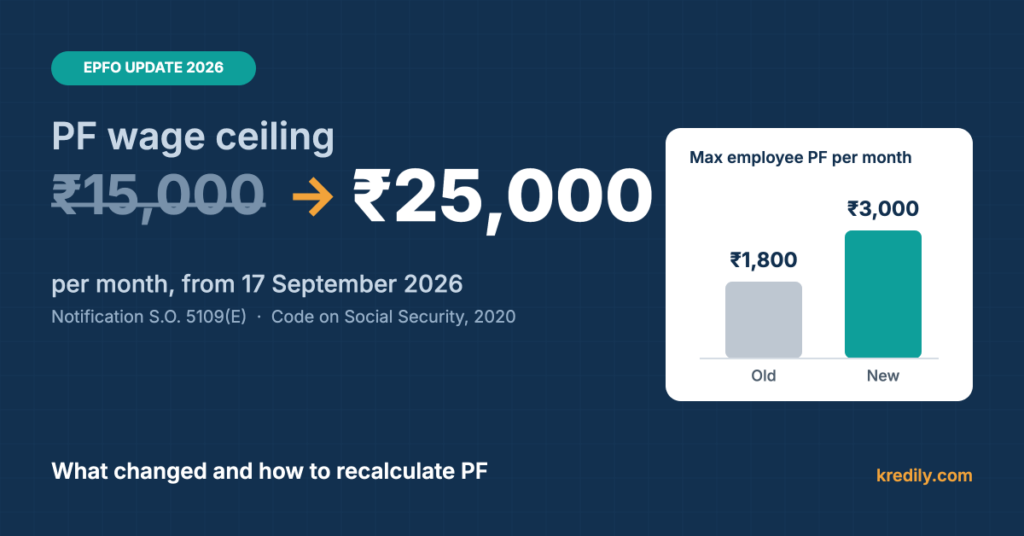
If you run payroll in India, the PF number you have used since 2014 no longer applies. From 17 September 2026, the EPF wage ceiling is ₹25,000 a month, up from ₹15,000. The contribution rates did not change. What moved is the wage those rates are charged on, and the point at which PF stops being optional.
The timing matters this month. October 2026 is the first full wage month on the new ceiling, and its ECR is due by 15 November. If your September return went out on the old ceiling, there is a correction to make as well.
The short version
- The EPF wage ceiling is ₹25,000 a month from 17 September 2026, under Notification S.O. 5109(E). EPFO has confirmed it is not being pushed to 1 October.
- Employee and employer still pay 12% each. At the ceiling, that is ₹3,000 a month from each side instead of ₹1,800.
- The employer’s pension (EPS) share can now reach ₹2,083 a month, up from ₹1,250.
- Employees with PF wages above ₹15,000 and up to ₹25,000 must be enrolled in EPF, EPS and EDLI. Enrolment is the employer’s job, and the employee does not need to apply.
- September 2026 is split: 16 days on the old ceiling and 14 days on the new one, reported in one ECR.
- The ESIC wage limit of ₹21,000 has not changed.
What changed on 17 September 2026
The statutory wage ceiling for EPF, EPS and EDLI went from ₹15,000 to ₹25,000 a month. It is the first revision since September 2014, when the ceiling moved from ₹6,500 to ₹15,000.
The notification behind the change
The Ministry of Labour and Employment issued Notification S.O. 5109(E), published in the Gazette of India on 17 September 2026. It sets the ceiling under section 2(89) of the Code on Social Security, 2020, for Chapter III of the Code, which covers provident fund. The Union Cabinet had approved the change a day earlier.
Three details are easy to miss:
- It replaced, not amended, the earlier rule. S.O. 2702(E) of 29 May 2026 had kept the ceiling at ₹15,000. That notification is now superseded.
- It took effect on the day of publication. Nothing in the notification moves the start date to 1 October, and EPFO’s FAQs say so directly.
- It reaches a lot of people. The government estimates more than 51 lakh additional employees will come under mandatory coverage. EPFO’s own reasoning is that in at least eight states and UTs, the minimum wage for unskilled work had already crossed ₹15,000.
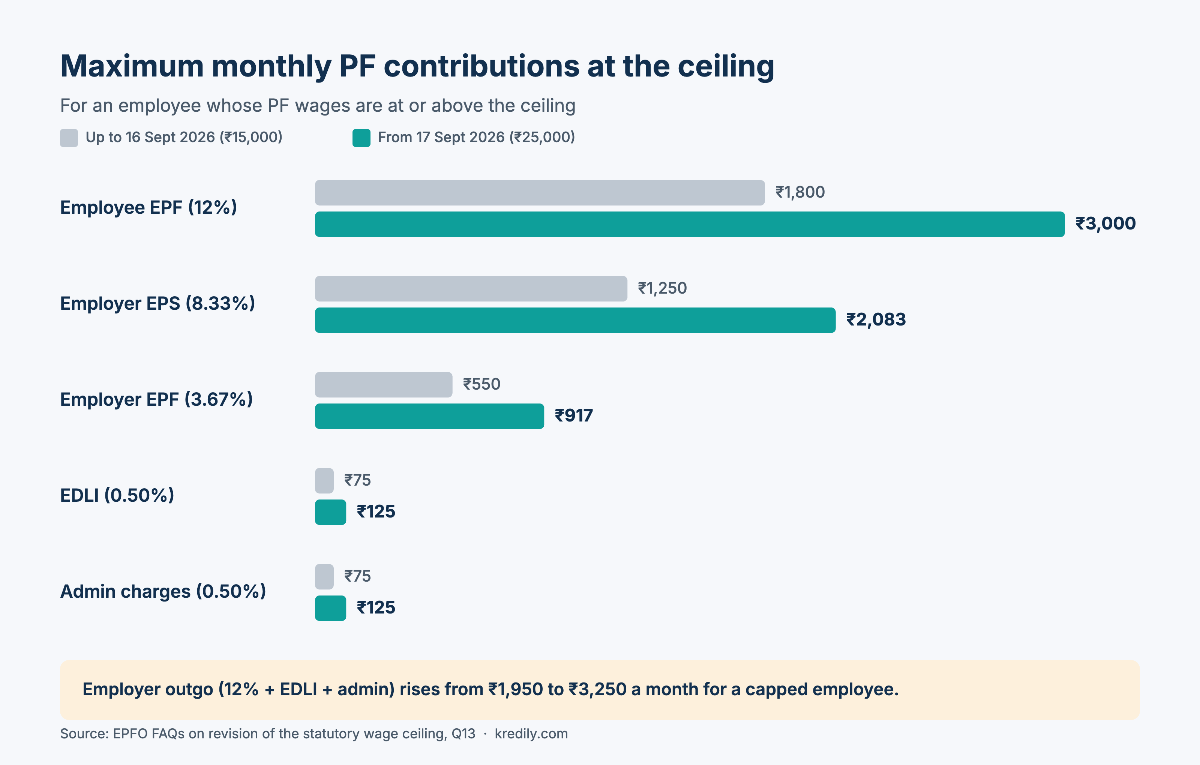
Here is how the maximum monthly contribution looks on each side of the change, for an employee whose PF wages are at or above the ceiling.
| Contribution (per month, at the ceiling) | Up to 16 Sept 2026 | From 17 Sept 2026 |
|---|---|---|
| Wage ceiling | ₹15,000 | ₹25,000 |
| Employee EPF (12%) | ₹1,800 | ₹3,000 |
| Employer share (12%) | ₹1,800 | ₹3,000 |
| of which EPS (8.33%) | ₹1,250 | ₹2,083 |
| of which EPF (3.67%) | ₹550 | ₹917 |
| EDLI (0.50%, employer) | ₹75 | ₹125 |
| Admin charges (0.50%, employer) | ₹75 | ₹125 |
Source: EPFO FAQs on the revised wage ceiling, Q13.
What did not change
- The rates. 12% from the employee, 12% from the employer, with 8.33% of wages going to EPS and the rest to EPF. EDLI and admin charges stay at 0.50% each, and admin charges keep their minimum of ₹500 a month for an establishment with at least one contributing member.
- The government’s EPS contribution. It stays at 1.16% of wages up to ₹15,000, so a maximum of ₹174 a month per member.
- The EDLI cap. The maximum life cover stays at ₹7 lakh, even though the formula at ₹25,000 wages would work out higher. EPFO says an actuarial review will come first.
- ESIC. The ESI wage limit of ₹21,000 is a separate rule and this notification does not touch it. Our ESI calculation guide covers that limit.
Who is affected by the ₹25,000 ceiling
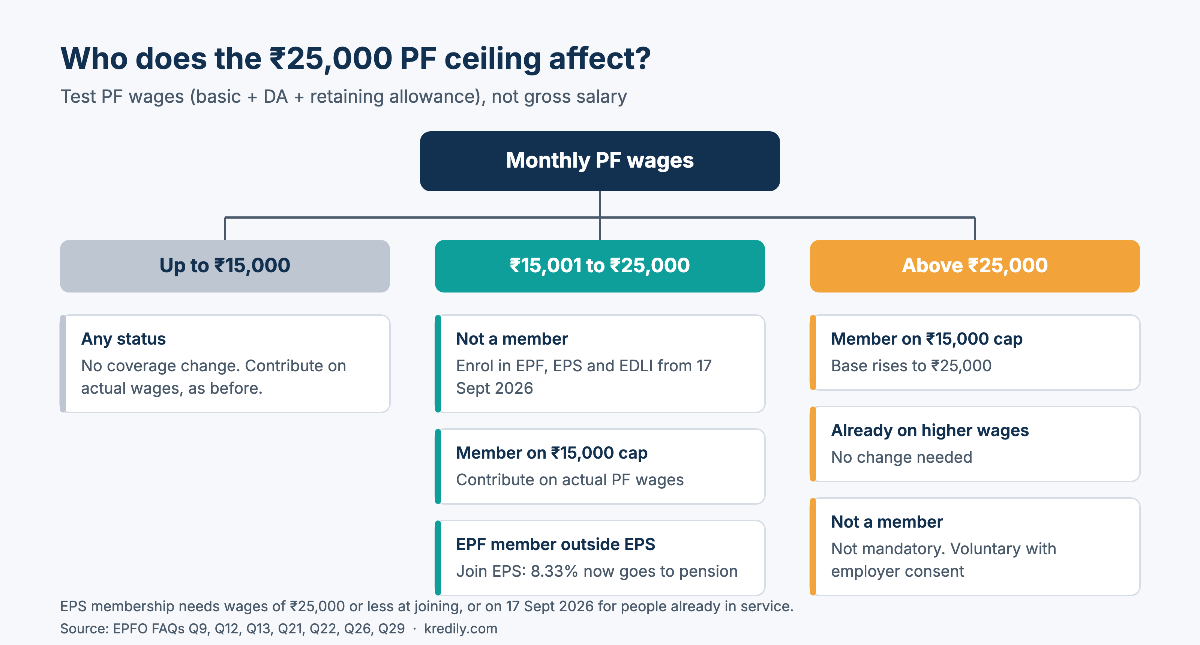
Anyone whose PF wages sit above ₹15,000 is affected, but not in the same way. Some people join PF for the first time, some contribute on a higher base, and some see no change at all. EPFO warns employers against applying ₹25,000 to everyone mechanically. Each employee’s existing membership and contribution arrangement decides the outcome.
| Position on 16 Sept 2026 | PF wages | What happens from 17 Sept 2026 |
|---|---|---|
| Not a PF member (excluded because wages were above ₹15,000) | Above ₹15,000, up to ₹25,000 | Must be enrolled in EPF, EPS and EDLI. Contributions start from 17 September. |
| Member contributing on the ₹15,000 cap | Above ₹15,000, up to ₹25,000 | Contribution moves to actual PF wages. |
| Member contributing on the ₹15,000 cap | Above ₹25,000 | Contribution generally moves to the new cap of ₹25,000. |
| EPF and EDLI member, but outside EPS | Above ₹15,000, up to ₹25,000 | Must join EPS. 8.33% of the employer share now goes to pension. |
| Member already contributing on actual wages above ₹25,000 | Above ₹25,000 | No change needed. The higher-wage arrangement continues. |
| Not a PF member | Above ₹25,000 | Not compulsorily covered. Can join voluntarily with the employer’s consent. |
Source: EPFO FAQs, Q9, Q12, Q21, Q22, Q26 and Q29.
New joiners follow the same line. Someone hired today on PF wages of ₹20,000 has to be enrolled in both EPF and EPS. EPS membership is open only to employees whose wages did not exceed ₹25,000 when they joined, or on 17 September 2026 for people already in service.
Nobody affected has to apply. EPFO puts enrolment, including EPS, on the employer.
PF wages, not gross salary, decide coverage
The ₹25,000 test runs on wages as defined in section 2(88) of the Code on Social Security: basic pay, dearness allowance and retaining allowance. It does not run on gross pay or CTC.
EPFO’s own examples make the point:
- Gross salary ₹60,000, PF wages ₹30,000: not compulsorily covered. Voluntary membership is possible with the employer’s consent.
- Gross salary ₹50,000, PF wages ₹25,000: must be a member of EPF, EPS and EDLI.
One caution for structures with a low basic and heavy allowances. Under the Code’s definition of wages, if excluded allowances such as HRA and conveyance exceed half of total pay, the excess is added back into wages. Check PF wages against that rule before deciding someone is above the ceiling. Our New Labour Codes 2026 guide explains the 50% rule in detail.
How to recalculate PF from October 2026
From the October 2026 wage month, the new ceiling applies for the whole month, so the maths is simple again. The only change is the cap on the base.
The formula
- Find the PF wage base: PF wages or ₹25,000, whichever is lower. If an employee already contributes on higher wages by agreement, keep that base.
- Employee EPF = 12% of the base.
- Employer EPS = 8.33% of the base, for EPS members. At the ceiling this is ₹2,083.
- Employer EPF = 12% of the base, minus the EPS amount. For an employee outside EPS, the full 12% goes to EPF.
- EDLI = 0.50% of the base, and admin charges = 0.50% of the base. Both are paid by the employer.
One practical check before you run October. Many payroll setups have a setting that restricts PF to the statutory limit, and some store that limit as a fixed ₹15,000. If yours does, the deduction will look correct and still be wrong.
Contributions at common wage levels
| Monthly PF wages (basic + DA) | Employee EPF (12%) | Employer EPS (8.33%) | Employer EPF (3.67%) | EDLI (0.50%) | Admin (0.50%) |
|---|---|---|---|---|---|
| ₹10,000 | ₹1,200 | ₹833 | ₹367 | ₹50 | ₹50 |
| ₹15,000 | ₹1,800 | ₹1,250 | ₹550 | ₹75 | ₹75 |
| ₹20,000 | ₹2,400 | ₹1,666 | ₹734 | ₹100 | ₹100 |
| ₹25,000 | ₹3,000 | ₹2,083 | ₹917 | ₹125 | ₹125 |
| ₹35,000, not an EPS member | ₹3,000 | Nil | ₹3,000 | ₹125 | ₹125 |
Source: EPFO FAQs, Q13. Figures as published by EPFO, rounded to the rupee.
Employees who want to save more than the statutory 12% can still do so through Voluntary Provident Fund (VPF). Our PF contribution guide explains how each share is split between accounts.
What it costs the employer
The employer’s total outgo is 13% of the PF wage base: its 12% share plus 0.50% EDLI and 0.50% admin charges. That gives three cost situations:
| Employee situation | Monthly employer outgo before | From October 2026 | Extra per month |
|---|---|---|---|
| Existing member on the ₹15,000 cap, PF wages ₹25,000 or more | ₹1,950 | ₹3,250 | ₹1,300 |
| Existing member on the ₹15,000 cap, PF wages ₹20,000 | ₹1,950 | ₹2,600 | ₹650 |
| Newly covered employee, PF wages ₹20,000 | Nil | ₹2,600 | ₹2,600 |
To see what this means for a business, take a 40-person company where 15 people were capped members with PF wages of ₹25,000 or more. That alone adds ₹19,500 a month, or ₹2,34,000 a year, before counting anyone newly brought in. EPFO points to the incentive of up to ₹3,000 a month for each additional job created under PMVBRY as a partial offset, subject to that scheme’s own conditions.
How September 2026 should have been calculated
September straddles two ceilings, so EPFO asks for the month to be worked out in two parts and filed as one return. The September ECR was due by 15 October 2026.
The split-month method
EPFO’s FAQs set out the method:
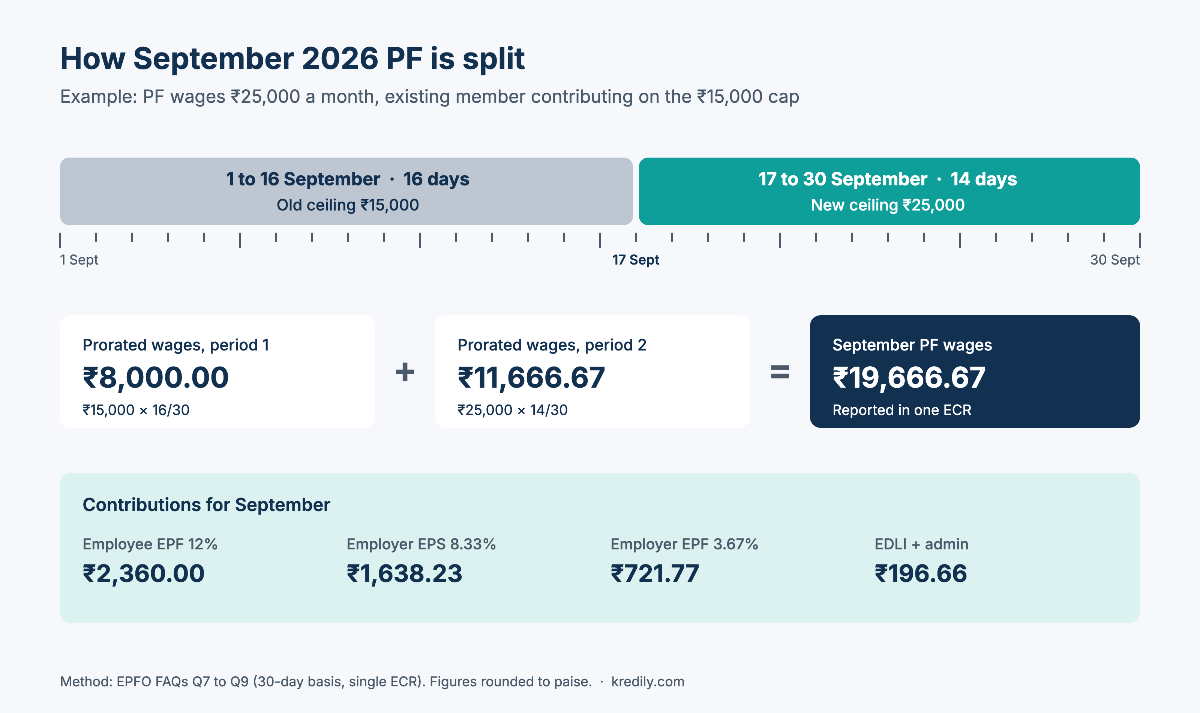
- 1 to 16 September (16 days): prorate wages on a 30-day basis and apply the old ₹15,000 ceiling.
- 17 to 30 September (14 days): prorate wages on a 30-day basis and apply the new ₹25,000 ceiling.
- Add the two parts to get the month’s EPF and EPS wages, then apply the usual rates.
- Report everything in a single ECR for September. Two returns are not needed.
For employees newly brought into PF, the first period is simply nil. They were not members before 17 September, so contributions run only on the 14-day portion.
Worked example: an employee capped at ₹15,000
Take Priya, a hypothetical accounts executive in Pune. Her PF wages (basic plus DA) are ₹25,000 a month. She has been an EPF and EPS member for years, contributing on the ₹15,000 cap. This is how her September works out.
| Step | Calculation | Amount |
|---|---|---|
| Wages, 1 to 16 Sept | ₹15,000 × 16/30 | ₹8,000.00 |
| Wages, 17 to 30 Sept | ₹25,000 × 14/30 | ₹11,666.67 |
| September EPF and EPS wages | Sum of both periods | ₹19,666.67 |
| Employee EPF (12%) | 12% of ₹19,666.67 | ₹2,360.00 |
| Employer EPS (8.33%) | 8.33% of ₹19,666.67 | ₹1,638.23 |
| Employer EPF (balance of 12%) | ₹2,360.00 − ₹1,638.23 | ₹721.77 |
| EDLI (0.50%) | 0.50% of ₹19,666.67 | ₹98.33 |
| Admin charges (0.50%) | 0.50% of ₹19,666.67 | ₹98.33 |
| Total September remittance | ₹4,916.66 |
If her September had been filed on the old basis of ₹15,000, both the employee and employer shares would be ₹560 short. EDLI and admin charges would each be ₹23.33 short. From October, her contribution is ₹3,000 from each side. EPFO’s FAQ Q7 works through three more cases at ₹20,000 wages, including a newly covered employee and someone joining EPS for the first time.
If your September ECR used the old ceiling
The 15 October deadline has passed, so this is now a correction rather than a calculation. A sensible order:
- Re-run September on the split method for every affected employee and note the shortfall for each one.
- Enrol anyone who was missed. Newly covered employees should be members from 17 September, with a UAN generated if they never had one. See what a UAN is.
- Pay the difference as soon as you can. EPFO’s revamped ECR system generally allows an upward revision of a filed return, while downward revisions are only possible before payment. Check the current option on the employer portal before you file.
- Expect interest on the delay. Late remittance attracts interest and damages under the applicable provisions, and the cost grows with time.
- Handle the employee share carefully. EPFO allowed employers to recover a September employee share they could not deduct, for newly covered employees, from the next payroll. That concession assumed the September ECR and full payment were made on time. If yours was not, take advice from your PF consultant or regional office before recovering arrears from salaries.
What changes for take-home pay, CTC, pension and insurance
Employees on PF wages above ₹15,000 will see a bigger PF deduction. In return, they get a matching employer contribution, a larger pension base and the same insurance cover.
Take-home pay and CTC
At PF wages of ₹25,000, an employee who was on the old cap now pays ₹3,000 a month instead of ₹1,800. That is ₹1,200 less in hand each month before tax. A newly covered employee on ₹20,000 PF wages sees a fresh deduction of ₹2,400.
That money is not lost to the employee. It goes into their own EPF account, the employer matches it, and it earns 8.25% interest for FY 2025-26. Members can withdraw up to 75% of the eligible balance in specified situations.
How the extra employer cost lands depends on how you write CTC:
- CTC excludes the employer’s PF. The employer absorbs its higher share on top of CTC. The employee’s take-home falls only by their own higher 12%.
- CTC includes the employer’s PF. Holding CTC flat means another component has to shrink, and that is where care is needed.
EPFO is direct on this point. CTC is not a statutory concept for PF. The employer’s contribution and the employee’s contribution are legally separate, and the employer’s share cannot be turned into an employee deduction by calling it part of CTC. Statutory wages must also not be reduced contrary to law. If you plan to restructure pay in response, get legal advice first, and tell employees before the payslip changes rather than after.
Pension (EPS) and insurance (EDLI)
The pension component offers the biggest long-term benefit. EPS contributions can now apply to wages up to ₹25,000. As a result, the employer’s monthly pension share can climb to ₹2,083 instead of ₹1,250. Furthermore, calculating the pensionable salary up to this new ceiling directly boosts your monthly payout after retirement.
EPFO is careful to add that existing pensioners and members do not get an automatic proportionate increase. The actual pension still depends on pensionable salary, pensionable service and the EPS formula. The EPS glossary entry covers how the scheme works.
EDLI life cover stays capped at ₹7 lakh. The premium of 0.50% of wages is paid by the employer, so newly covered employees get this cover at no cost to themselves.
Employer checklist for November payroll
Use this before you close October payroll and file its ECR by 15 November 2026.
- List PF wages for every employee: basic, DA and retaining allowance, with the 50% add-back checked. Do not use gross pay.
- Flag three groups: people with PF wages between ₹15,000 and ₹25,000 who are not enrolled, members still capped at ₹15,000, and EPF members who sit outside EPS.
- Enrol the newly covered with effect from 17 September 2026, including EPS, and generate UANs where needed.
- Fix the payroll setting. Replace any hard-coded ₹15,000 cap with ₹25,000.
- Audit September. If it was not split 16 days and 14 days, correct it now (see the section above).
- Run October on the full ₹25,000 ceiling and file the October ECR on time.
- Check your contractors. Where you use contract labour, ask each contractor for the September ECR and split workings for workers in the ₹15,000 to ₹25,000 band before releasing bills.
- Update offer letters and CTC templates that mention ₹15,000 or a fixed PF amount.
- Tell employees what is changing on their payslip, and why, before they see it.
- Keep an audit trail of the calculations, and watch EPFO for further circulars.
Run payroll without the manual maths. See how Kredily payroll software and its statutory compliance features handle PF, ESI, PT and TDS every month.
Frequently asked questions
What is the new PF wage ceiling in 2026?
The EPF wage ceiling is ₹25,000 a month from 17 September 2026. It was ₹15,000 before that. The change was made by Notification S.O. 5109(E) under the Code on Social Security, 2020, and it applies to EPF, EPS and EDLI.
Is PF now mandatory for employees earning up to ₹25,000?
Yes, if their PF wages are ₹25,000 or less. PF wages mean basic pay, dearness allowance and retaining allowance, not gross salary. An employee on ₹50,000 gross with ₹25,000 PF wages must be enrolled. One on ₹60,000 gross with ₹30,000 PF wages need not be.
Was the effective date moved to 1 October 2026?
No. The notification took effect on the date of publication, 17 September 2026. EPFO’s FAQs specifically deny any plan to move it to 1 October.
What is the maximum PF contribution now?
At PF wages of ₹25,000 or more, the employee pays ₹3,000 a month and the employer pays ₹3,000. Of the employer’s share, up to ₹2,083 goes to EPS and the rest to EPF. The employer also contributes ₹125 each toward EDLI and administrative charges.
Do employees have to apply to be covered under the new ceiling?
No. EPFO places the responsibility for enrolment, including EPS membership, on the employer. Newly covered employees should be enrolled with effect from 17 September 2026.
Does the ESIC wage limit change with the new PF ceiling?
No. The ESIC wage limit is a separate rule and stays at ₹21,000 a month. The EPF notification does not affect it.
Will EDLI insurance cover go up to ₹10.5 lakh?
Even with wages of ₹25,000, the maximum EDLI payout stays capped at ₹7 lakh. Furthermore, the EPFO confirmed that an actuarial fund review must happen before any rules change.
Can an employer recover its higher PF contribution from the employee’s CTC?
The EPFO states that CTC has no legal standing under PF rules. Therefore, companies cannot deduct their own share from your pay simply by packaging it into CTC. They also cannot lower your wages below the legal minimum. Because of this, you should consult an employment lawyer before you change pay structures.
Sources
All figures were checked against these on 6 November 2026. Rates and rules can change, so confirm the latest EPFO circulars before acting.
- Notification S.O. 5109(E), Gazette of India, 17 September 2026, Ministry of Labour and Employment
- EPFO: FAQs on Revision of EPFO Statutory Wage Ceiling from ₹15,000 to ₹25,000 per month
- PIB: Cabinet approves enhancement of EPFO wage ceiling, 16 September 2026
- Code on Social Security, 2020, sections 2(88) and 2(89)
This article explains the rules for general information. It is not legal advice. For decisions on your own payroll, speak to your PF consultant or the EPFO regional office.
Leave a Reply