



Checked against the OSH Code, 2020, the Code on Wages, 2019 and their Central Rules, 2026.
Comp off, short for compensatory off, is a paid day off that an employee gets for working on a day they would normally have off, such as a weekly off or a public holiday. If you work on Sunday, for example, your company might let you take Wednesday off instead. In India, comp off is mostly a matter of company policy. The law sets a floor, though: for workers covered by the labour codes, rest-day work brings overtime pay and a substitute rest day, and comp off alone does not replace that pay.
Most disputes come from vague rules. Nobody knows how long the day stays valid, who approves it, or whether a half day counts. A clear policy answers all of that in one page.
Comp off in India at a glance
| Point | What applies |
|---|---|
| What it is | A paid day off in return for working on a weekly off or holiday |
| Legal basis | Mostly company policy; labour codes set rules for covered workers |
| Covered workers working on a rest day | Overtime pay plus a substitute rest day |
| Managers and senior staff | Comp off as per company policy |
| Common validity | 30 to 90 days, set by policy |
| Approval | Prior approval for the extra work, then approval to take the day |
| Encashment | Only if the company policy allows it |
What is comp off?
Comp off means compensatory off. An employee works on a day that is normally non-working, and in return the company gives them another day off with full pay. The extra day is compensation for the lost rest, not extra leave earned through service.
The usual triggers are:
- Working on a weekly off, such as a Sunday.
- Working on a declared public or festival holiday.
- Long project or event days, if the company policy covers them.
- Travel on a non-working day for official work, if the policy says so.
Compensatory off is common in IT, BPO, retail, events, hospitality and any business that runs on weekends or during festival peaks.
Is comp off mandatory in India?
The answer depends on who the employee is.
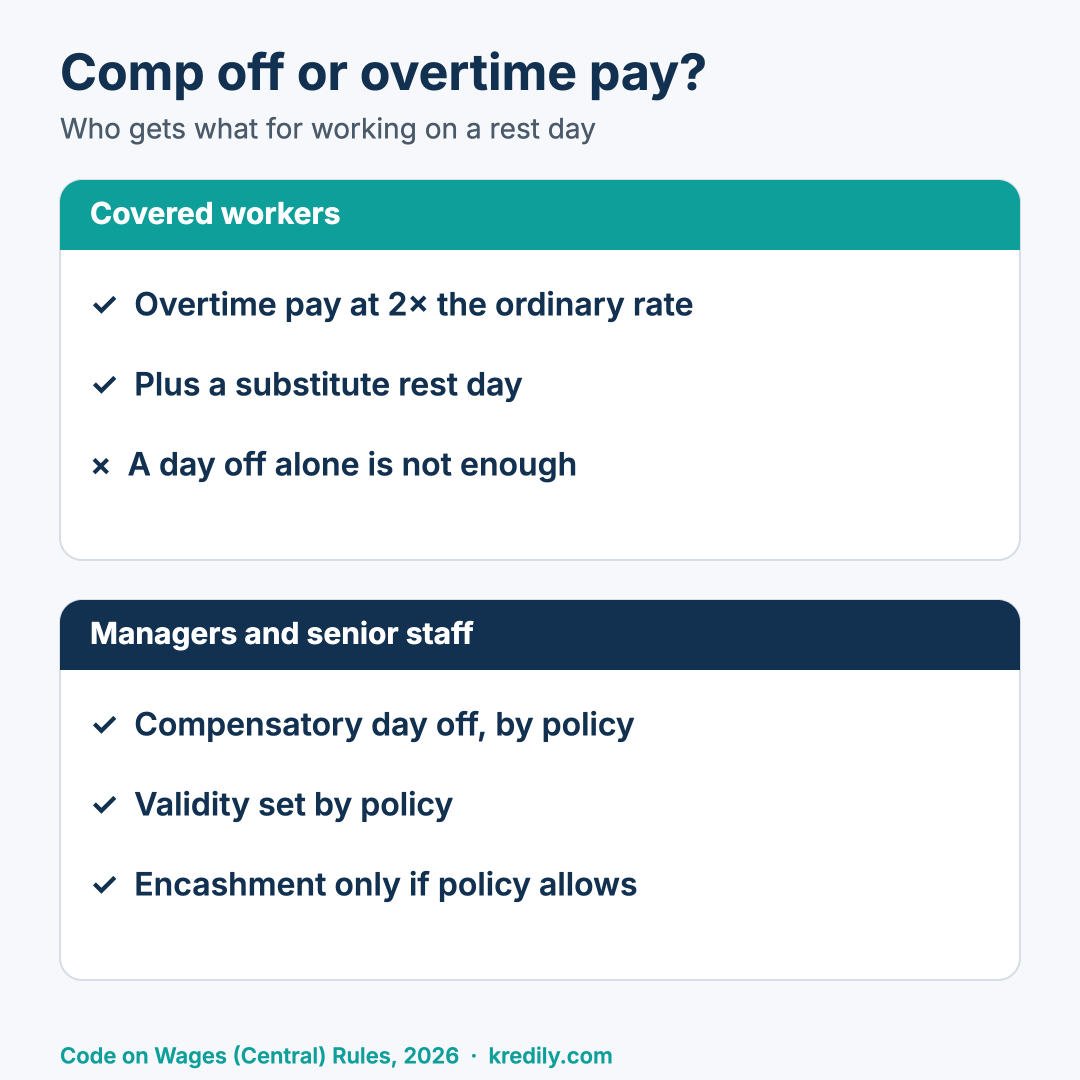
For workers covered by the labour codes, the law decides what happens. Under the Code on Wages (Central) Rules, 2026, a worker who works on their rest day generally gets overtime pay for that day and a substitute rest day as well. The OSH Code also caps normal work at 48 hours a week and requires a weekly day of rest. So for these workers, a day off is not a replacement for overtime pay. It comes in addition to it.
For managers, administrators and senior staff who fall outside the definition of “worker”, there is no fixed legal formula. It then depends on the employment contract and company policy.
State Shops and Establishments rules can add their own conditions on weekly holidays and substitute days. So check the rules in each state where you have staff.
Our guide to working hours and overtime pay explains who counts as a covered worker and how overtime is calculated.
Comp off vs overtime pay
| Point | Comp off | Overtime pay |
|---|---|---|
| What the employee gets | A paid day off later | Extra money, at least twice the ordinary rate |
| When it applies | Work on a weekly off or holiday | Work beyond normal hours or on a rest day |
| Covered workers | Substitute rest day, in addition to overtime pay | Mandatory under the labour codes |
| Managers and senior staff | Common, by policy | Usually not applicable |
| Cost to the company | Lost working day later | Direct payroll cost |
The key point: for covered workers, a company cannot simply give comp off instead of the overtime pay the law requires. The day off can sit on top of it, but not in place of it.
How the process works
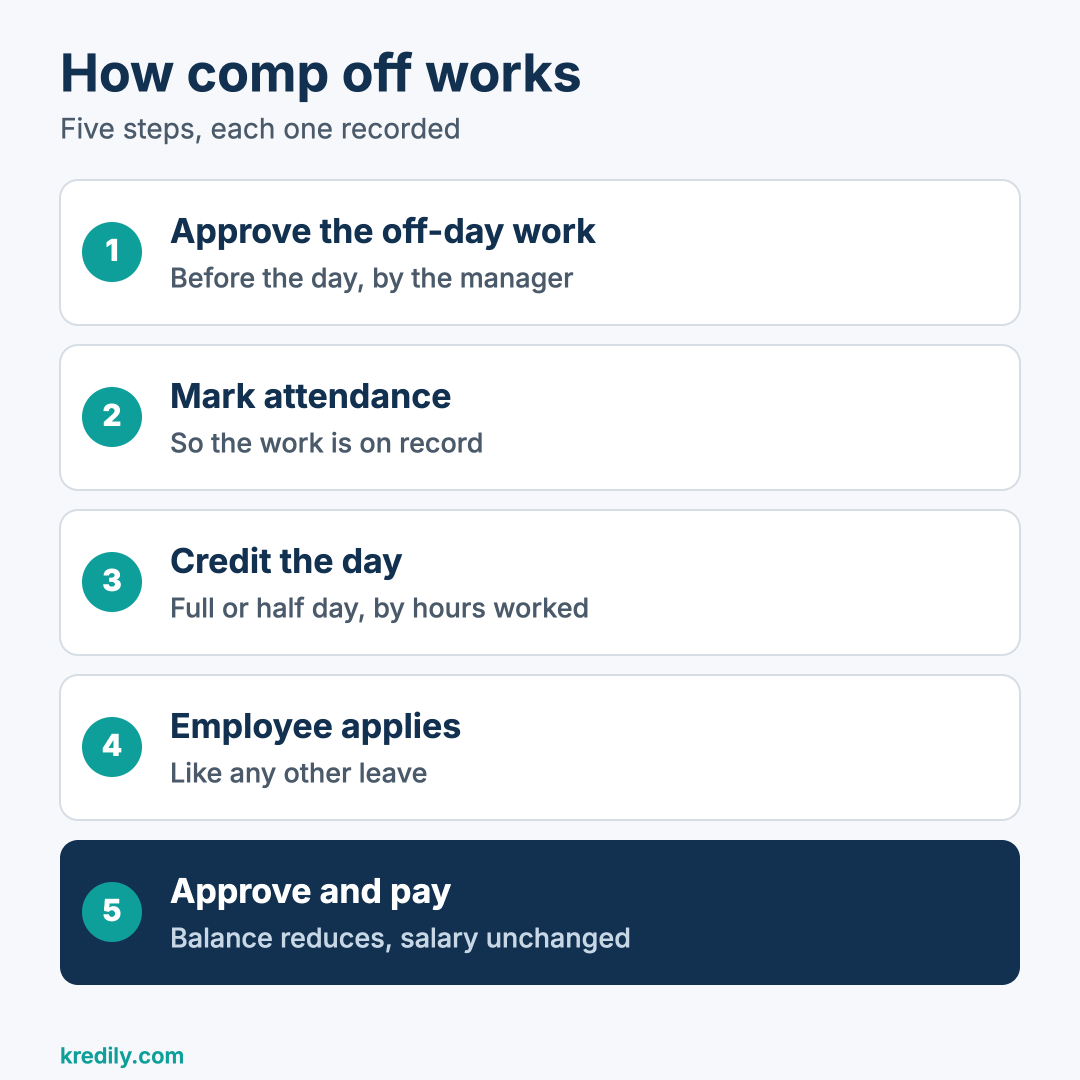
A clean process has five steps.
- Approval before the work. The manager approves the plan for the employee to work on the off day.
- Attendance on the day. The employee marks attendance, so the work is recorded.
- Comp off credit. Once the attendance is confirmed, one day (or a half day) is added to the employee’s balance.
- Request to use it. The employee applies for the day like any other leave.
- Approval and payroll. The manager approves, the day is paid, and the balance reduces.
Without step 1, it turns into a way of moving days around after the fact. Without step 2, there is no proof the work happened.
What to include in your policy
| Policy element | What to decide |
|---|---|
| Eligibility | Which roles earn it, and which get overtime pay instead |
| Triggers | Weekly offs, public holidays, travel days, or all three |
| Minimum hours | How many hours of work earn a full day, and a half day |
| Prior approval | Who must approve the off-day work in advance |
| Validity | How long it stays usable, such as 30, 60 or 90 days |
| Carry forward | Whether unused days lapse or carry into the next year |
| Encashment | Whether unused days can be paid out |
| Exit | What happens to the balance when someone resigns |
| Records | How attendance and approvals are stored |
These limits are policy choices, so write them down. A balance that “never expires” sounds generous but turns into a large, untracked liability.
Sample comp off policy
You can adapt this sample for your company.
1. Purpose. This policy explains how employees are compensated for working on a weekly off or a declared holiday.
2. Eligibility. Employees in managerial and supervisory roles earn compensatory off under this policy. Employees covered by statutory overtime rules receive overtime pay and a substitute rest day as required by law.
3. Earning it. Working at least 8 hours on a weekly off or declared holiday earns one compensatory day. Working at least 4 hours earns a half day.
4. Prior approval. Work on a non-working day must be approved by the reporting manager in advance.
5. Validity. Each compensatory day must be used within 60 days of the day worked. Unused days lapse after that.
6. Applying. Employees apply through the attendance system, at least one working day in advance where possible.
7. Encashment. Compensatory days cannot be encashed and are not paid out on exit.
8. Records. All off-day attendance, approvals and balances are maintained in the attendance system.
Change the hours, validity and encashment rules to suit your business.
Worked examples
Example 1: full day. A team lead works 9 hours on a Sunday for a product launch, with prior approval. Under the sample policy, she earns one compensatory day and takes the next Wednesday off with full pay.
Example 2: half day. An accounts executive works 5 hours on a public holiday to close the month. That earns a half day off.
Example 3: a covered worker. A warehouse worker works on his weekly off. Because he is a covered worker, he gets overtime pay for that day and a substitute rest day. A day off without the overtime pay would fall short of the law.
How it affects payroll
The day off itself does not change salary, because it is paid in the normal way. But it still touches payroll in three places:
- Attendance. The off-day work and the later day off must both appear in the muster roll.
- Leave balance. It sits alongside earned and casual leave, so the leave system must track its validity.
- Overtime. For covered workers, the overtime pay for rest-day work goes into that month’s salary and the salary register.
If a day expires unused and your policy does not allow encashment, nothing is paid. That is why the validity rule matters so much to employees.
Common mistakes to avoid
- Giving a day off instead of overtime pay to workers covered by the labour codes.
- No prior approval, so off-day work is claimed after the fact.
- No expiry, which builds a large, hidden leave liability.
- Not recording off-day attendance, so there is no proof of the work.
- Unclear half-day rules, which create small disputes every month.
- Inconsistent treatment across teams and managers.
Checklist for HR
- Decide who earns compensatory off and who gets overtime pay.
- Set the minimum hours for a full day and a half day.
- Require prior approval for off-day work.
- Set a validity period and an expiry rule.
- Decide whether unused days can be encashed or paid on exit.
- Track balances in the same system as leave.
- Review outstanding balances every quarter.
Our HR leave policy guide covers the other leave types your policy needs, and our sandwich leave policy guide explains how weekends and holidays interact with leave.
Want comp off tracked automatically? Kredily’s attendance app records off-day work, credits compensatory days and tracks their expiry alongside leave and payroll. Start free on Kredily
Frequently asked questions
What is comp off?
Comp off, or compensatory off, is a paid day off given to an employee for working on a weekly off or a public holiday.
Is comp off mandatory in India?
For managers and senior staff, it depends on company policy. For workers covered by the labour codes, work on a rest day brings overtime pay and a substitute rest day, so comp off cannot replace the overtime pay.
How long is comp off valid?
There is no legal limit. Validity is set by company policy, and most companies allow 30 to 90 days.
Can comp off be encashed?
Only if your company policy allows it. Many companies do not encash it and let unused days lapse.
Do employees get it for working on a public holiday?
Usually yes, under company policy. For covered workers, holiday work is also paid at the overtime rate where the law requires it.
Can it be taken as a half day?
Yes, if the policy allows it. A common rule is a half day for 4 hours of off-day work and a full day for 8 hours.
What happens to comp off when an employee resigns?
It depends on the policy. Many companies let unused days lapse on exit, while some adjust it in the full and final settlement.
What is the difference between comp off and leave?
Leave is earned through service under the leave policy. Comp off is earned only by working on a non-working day, and it usually expires sooner.
How we checked this guide
We checked the legal points on rest days, overtime and substitute rest days against legal summaries of the OSH Code, 2020, the Code on Wages, 2019 and their Central Rules, 2026. Validity, half days and encashment are company policy choices, so the guide gives options rather than fixed legal numbers.
Sources and notes
- Rest-day work, overtime pay and substitute rest days under the Code on Wages (Central) Rules, 2026, as summarised by Lexology.
- Weekly rest, the 48-hour week and overtime at twice the ordinary rate under the OSH Code, as summarised by Mondaq.
- Code on Wages, 2019, India Code.
This guide is for general information. It is not legal advice. Adapt the sample policy with your HR or legal adviser.