


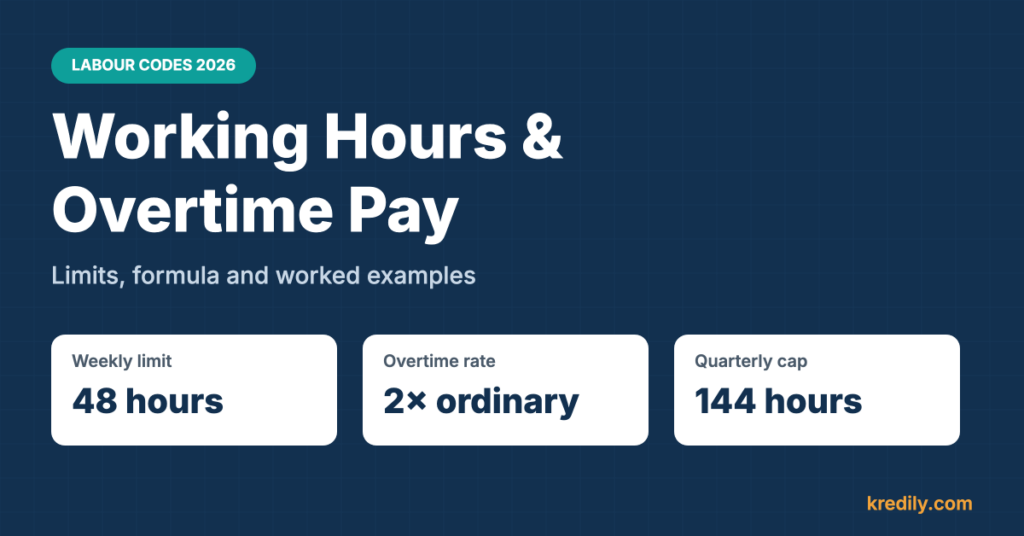
Under India’s labour codes, normal working hours are capped at 48 a week, with a daily limit of 8 hours for daily-rated workers. Any work beyond those limits is overtime, and overtime pay follows one simple rule: at least twice the ordinary rate of wages. The Central Rules of 2026 also cap overtime at 144 hours a quarter and require the worker’s consent.
Most payroll errors here, however, are not about the rate. They come from the wrong wage base, missed hours, or overtime that nobody recorded. This guide covers the limits, the formula and two worked examples.
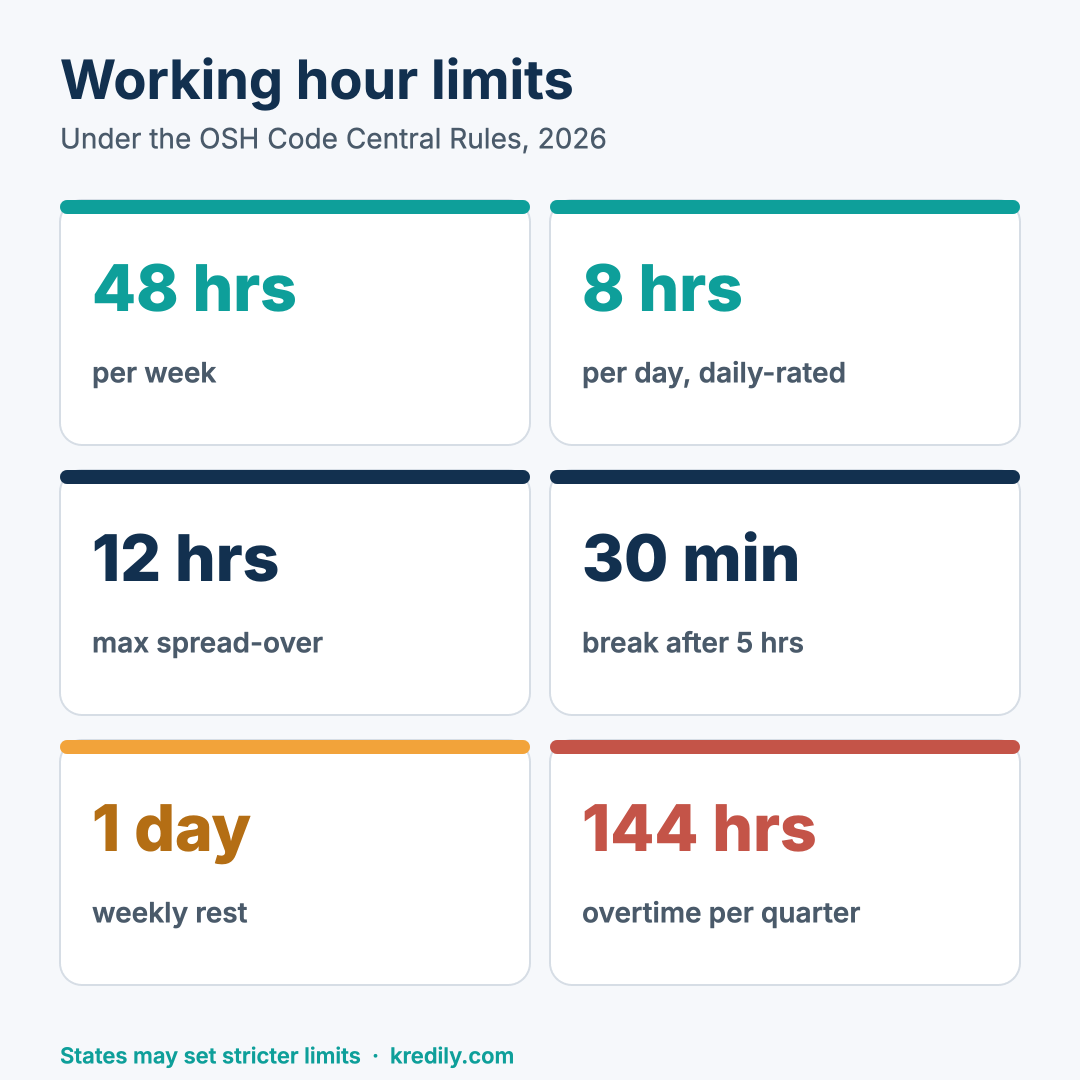
Working hours and overtime at a glance
| Rule | 2026 position |
|---|---|
| Weekly limit | 48 hours |
| Daily limit | 8 hours for daily-rated workers; state rules may allow up to 9 for others |
| Spread-over | Up to 12 hours a day, rest breaks included, under the Central Rules |
| Rest break | At least 30 minutes after 5 hours of continuous work |
| Weekly rest | One day off every week |
| Overtime rate | At least twice the ordinary rate of wages |
| Overtime cap | 144 hours a quarter, with the worker’s consent |
| Main laws | OSH Code, 2020 and Code on Wages, 2019, with their 2026 Central Rules |
What are the legal working hours in India?
Two codes share this ground. The Occupational Safety, Health and Working Conditions (OSH) Code, 2020 sets working hours, rest and overtime limits. The Code on Wages, 2019 then sets how overtime is paid. Both took effect on 21 November 2025, and their Central Rules were notified on 8 May 2026.
The core limits, however, are simple. Normal work cannot exceed 48 hours in a week. For daily-rated workers, the Central Rules also fix a normal working day of 8 hours. Many state Shops and Establishments rules still allow offices a 9-hour day, but the 48-hour week applies everywhere.
Spread-over
Spread-over is the full stretch of the working day, from start to finish, rest breaks included. Under the 2026 Central Rules it can run up to 12 hours. So an employee who starts at 9 am cannot be kept on duty past 9 pm, even if part of that time is a break. Some states set a shorter spread-over, so check yours.
Rest intervals and weekly off
Workers should get a rest break of at least 30 minutes after 5 hours of continuous work. They also get one day off every week. If someone works on their weekly off, they get a substitute day off as well as overtime pay for that day, unless a narrow exception applies.
Does the new law allow a four-day week?
Not as a right. The OSH Code only lets the government allow the 48 weekly hours to be spread over fewer days, within the daily limits. In practice, a four-day week of 12-hour days needs specific permission and still cannot push the week past 48 hours.
Who do overtime rules cover?
Not every employee is covered in the same way. The OSH Code’s working hour and overtime limits apply to “workers”. That definition generally leaves out people employed mainly in a managerial or administrative role, and supervisors whose wages are above the threshold set in the Code.
In practice, that splits a typical company into two groups:
| Group | Typical roles | Overtime rules |
|---|---|---|
| Covered workers | Factory and warehouse staff, store staff, drivers, support agents, technicians | Hour limits and double-rate overtime apply |
| Usually outside | Managers, administrators, higher-paid supervisors | Hours follow the contract and company policy |
Job titles do not decide this. Actual duties and pay do. A “team lead” who mostly does the same work as the team is often a covered worker, so check each role on its facts.
When does overtime start?
Overtime starts as soon as an employee works beyond the normal limit. For a daily-rated worker, that means anything over 8 hours in a day. For everyone else, it generally means anything over 48 hours in a week, or beyond the daily hours your state rules fix, whichever applies.
Two conditions also apply to every hour of overtime:
- Consent. The employer cannot force overtime. The worker must agree to it.
- A quarterly cap. Under the OSH (Central) Rules, 2026, overtime cannot exceed 144 hours in a calendar quarter. States can set a lower cap for establishments under their rules.
The 144-hour cap is much higher than the old Factories Act limit. Even so, it is a ceiling, not a target. Regular overtime close to the cap usually signals a staffing problem.
How to calculate overtime pay
Overtime calculation then has four steps.
- Find the ordinary rate of wages. This is generally basic pay plus dearness allowance, the same wage base the codes use elsewhere. Remember that the 50% rule can add excess allowances back into it.
- Work out the hourly rate. For a monthly-paid employee, divide monthly wages by 26 to get the daily rate. Then divide by the normal daily hours, usually 8.
- Double it. The overtime rate is at least twice the ordinary hourly rate.
- Multiply by the overtime hours worked in the wage period, and pay it with that period’s wages.
So here is the formula in one line:
Overtime pay = (Monthly basic + DA) ÷ 26 ÷ 8 × 2 × overtime hours
Example 1: a monthly-paid employee
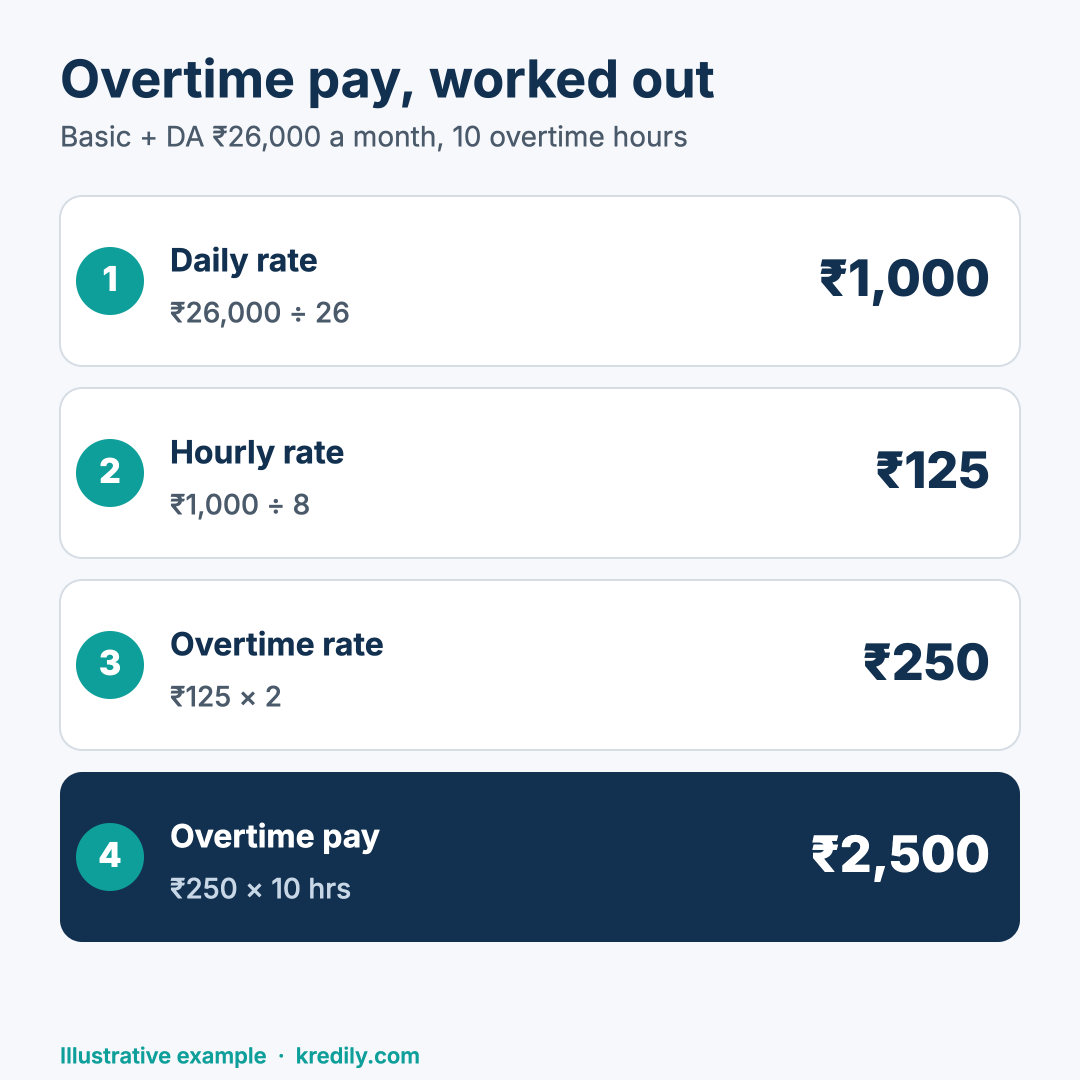
Anjali, a hypothetical store supervisor, earns basic plus DA of ₹26,000 a month. In October she worked 10 hours of overtime.
| Step | Working | Result |
|---|---|---|
| Daily rate | ₹26,000 ÷ 26 | ₹1,000 |
| Ordinary hourly rate | ₹1,000 ÷ 8 | ₹125 |
| Overtime hourly rate | ₹125 × 2 | ₹250 |
| Overtime pay | ₹250 × 10 hours | ₹2,500 |
So her October pay includes ₹2,500 of overtime on top of regular wages. Note that her HRA and other allowances do not enter the calculation, unless they push past the 50% wage rule.
Example 2: a daily-rated worker
Raju, a hypothetical loader, earns ₹800 a day for an 8-hour day. One day he works 11 hours.
| Step | Working | Result |
|---|---|---|
| Ordinary hourly rate | ₹800 ÷ 8 | ₹100 |
| Overtime hours | 11 − 8 | 3 hours |
| Overtime pay | ₹100 × 2 × 3 | ₹600 |
So his pay for that day is ₹800 plus ₹600, which makes ₹1,400.
Overtime pay on weekly offs and holidays
Work on a weekly off is treated differently from a long weekday. Under the Code on Wages (Central) Rules, 2026, an employee who works on their rest day generally gets overtime pay for that day and a substitute rest day as well. Narrow exceptions apply, for instance for some six-day-week arrangements where the daily rate already covers the rest day.
Comp-off alone is not enough where the law requires overtime pay. A compensatory day off can be given in addition, but it does not replace the double-rate payment for covered workers.
Women and night shifts
The OSH Code allows women to work night shifts, broadly before 6 am and after 7 pm, but only with their consent. The 2026 Central Rules also require safety measures, such as safe transport and adequate security at the workplace. These conditions sit alongside the normal overtime rules, which apply to night shifts in the same way.
How to track the 144-hour quarterly cap
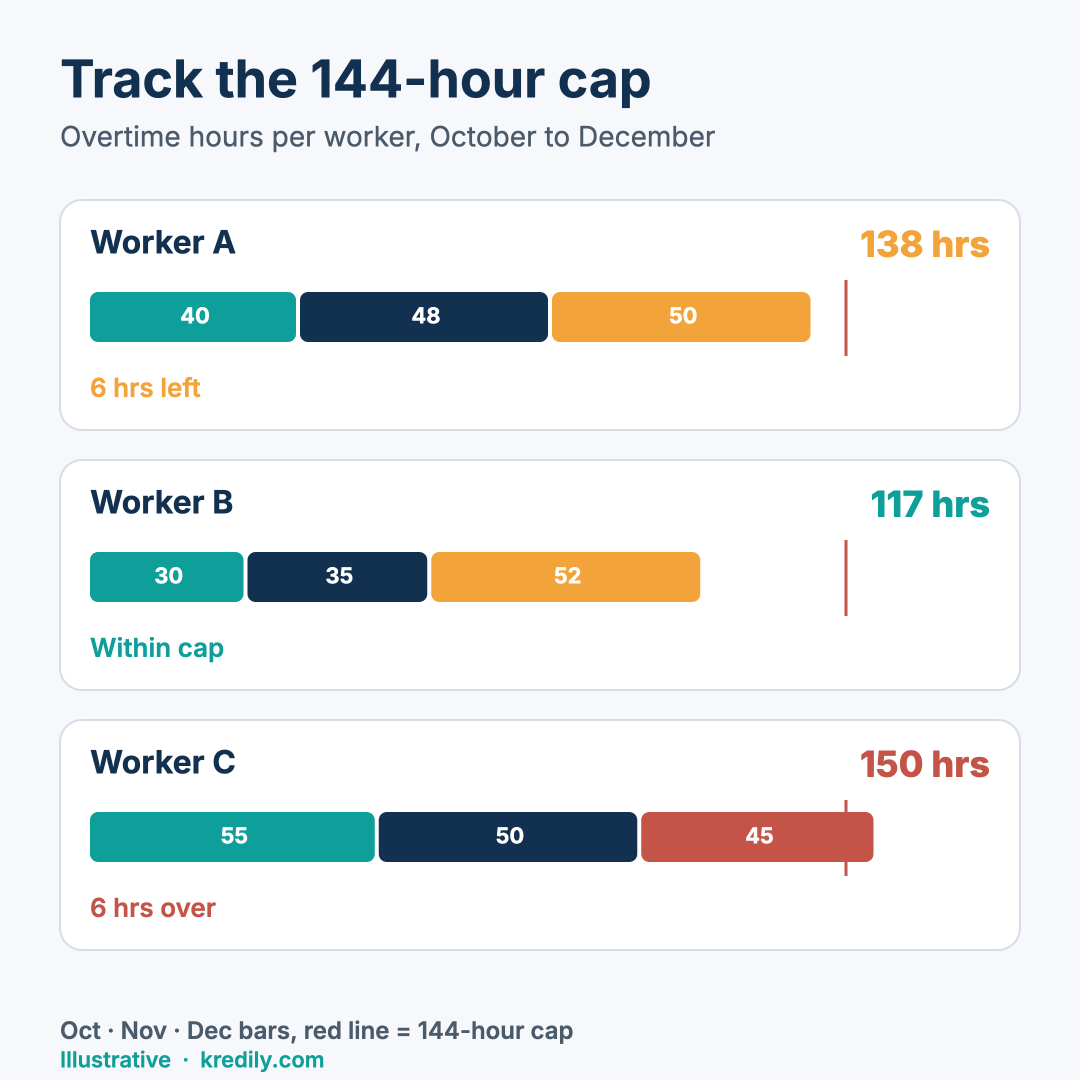
The cap works per worker, per calendar quarter. So a monthly view can hide a problem until the third month. Here is a simple example for October to December:
| Worker | October | November | December | Quarter total | Status |
|---|---|---|---|---|---|
| Worker A | 40 | 48 | 50 | 138 | 6 hours left |
| Worker B | 30 | 35 | 52 | 117 | Within cap |
| Worker C | 55 | 50 | 45 | 150 | 6 hours over the cap |
Illustrative overtime hours.
Worker C crossed the limit in December, even though no single month looked extreme. The fix is to check the running quarter total every week and stop scheduling overtime once someone nears 144 hours.
Overtime pay and tax
Overtime pay is fully taxable as salary. So add it to the employee’s income for that month and update the TDS on salary projection. Heavy overtime late in the year can push TDS up sharply in the last few months if you do not adjust early.
Overtime pay in practice: three common setups
A factory with daily-rated workers. Overtime is counted per day beyond 8 hours. So a worker on an 11-hour shift earns 3 hours of overtime that day, even if the week ends under 48 hours.
A retail store. State Shops and Establishments rules often allow a 9-hour day, but the 48-hour week still applies. So a sales associate working six 9-hour days does 54 hours, which means 6 hours of overtime that week.
An IT or BPO operation. Agents and technicians are usually covered workers, while team managers often are not. Night shifts also bring the extra consent and safety conditions for women employees.
Overtime, records and the rest of payroll
Every overtime hour has to show up in three places. First, in the muster roll, which records the hours. Second, in the salary register, which records the overtime pay. Third, on the employee’s salary slip.
Overtime also interacts with other rules, because the wage base is shared:
- Minimum wages. The ordinary rate can never fall below the minimum wage, so overtime is never less than twice the minimum.
- Wage payment dates. Overtime is paid with the wages for that period, by the 7th of the next month for monthly wages.
- PF. Overtime pay is generally excluded from PF wages, so it does not raise the PF contribution.
Common overtime pay mistakes
- Using gross salary as the base. That overpays, since basic plus DA is the usual base.
- Using basic alone. That can underpay, though, when the 50% rule adds allowances back.
- Not recording overtime. Unrecorded hours then become back pay claims later.
- No written consent. Overtime needs the worker’s agreement, so keep a record of it.
- Ignoring the quarterly cap. Track overtime hours by quarter, not just by month.
- Paying overtime late. It belongs in the same wage period’s pay.
Overtime pay compliance checklist
- Fix normal hours and spread-over for each shift within your state’s rules.
- Record actual hours every day, including overtime.
- Get the worker’s consent before overtime, and keep it on file.
- Track overtime hours by quarter against the 144-hour cap or your state’s limit.
- Calculate pay at twice the ordinary rate, using basic plus DA under the 50% rule.
- Pay overtime with the same wage period’s wages.
- Show overtime hours and pay on the wage slip.
For the wider picture, see our payroll statutory compliance guide.
Prefer to automate it? Kredily’s attendance management system records shifts and overtime hours, and Kredily payroll software turns them into overtime pay.
Frequently asked questions
What are the legal working hours in India in 2026?
Normal work is capped at 48 hours a week. Daily-rated workers have a normal working day of 8 hours, while state rules may allow other employees up to 9. The total spread-over, including breaks, can run up to 12 hours under the Central Rules.
How is overtime calculated in India?
Divide monthly basic plus DA by 26 to get the daily rate, then by 8 for the hourly rate. Double it, then multiply by the overtime hours. For example, ₹26,000 a month gives ₹250 an hour for overtime.
What is the overtime rate in India?
At least twice the ordinary rate of wages, under the OSH Code, 2020 and the Code on Wages, 2019.
What is the maximum overtime allowed in a quarter?
Under the OSH (Central) Rules, 2026, overtime cannot exceed 144 hours in a quarter. States can set a lower limit for establishments under their rules.
Can an employer force an employee to work overtime?
No. Overtime under the OSH Code requires the worker’s consent.
Is overtime pay included in PF wages?
No. Overtime pay is generally excluded from wages for PF, so PF contributions do not change because of overtime.
Do managers get overtime pay?
Usually not under the OSH Code’s overtime provisions, because people employed mainly in managerial or administrative roles generally fall outside the definition of “worker”. Their hours and any extra pay follow the employment contract and company policy.
Can comp-off replace overtime pay?
Not for covered workers where the law requires overtime pay. A compensatory day off can be given as well, but the double-rate payment is still due.
Is overtime pay taxable?
Yes. Overtime pay is salary income, so it is fully taxable and goes into the monthly TDS calculation.
How we checked this guide
We relied on legal analyses of the OSH (Central) Rules, 2026 and the Code on Wages (Central) Rules, 2026 by law firms and global advisers, and read them against the text of the codes. State rules for working hours and overtime are still being finalised in several states, so the guide points out where your state’s rules may differ.
Sources and notes
- Code on Wages, 2019, India Code.
- OSH (Central) Rules, 2026: 48-hour week, overtime at twice the ordinary rate and the 144-hour quarterly cap, as summarised by Nishith Desai Associates and Mondaq.
- 8-hour day for daily-rated workers and overtime wages, as summarised by KPMG.
- Spread-over of up to 12 hours and the consent requirement, as summarised by LawSikho.
- Rest day work and substitute rest days under the Code on Wages (Central) Rules, 2026, as summarised by Lexology.
- Night shift conditions for women under the OSH (Central) Rules, 2026, as summarised by Mondaq.
This guide is for general information. It is not legal advice. For decisions about your own workforce, speak to your labour consultant.