


Checked against the Code on Wages, 2019 and the Code on Wages (Central) Rules, 2026.
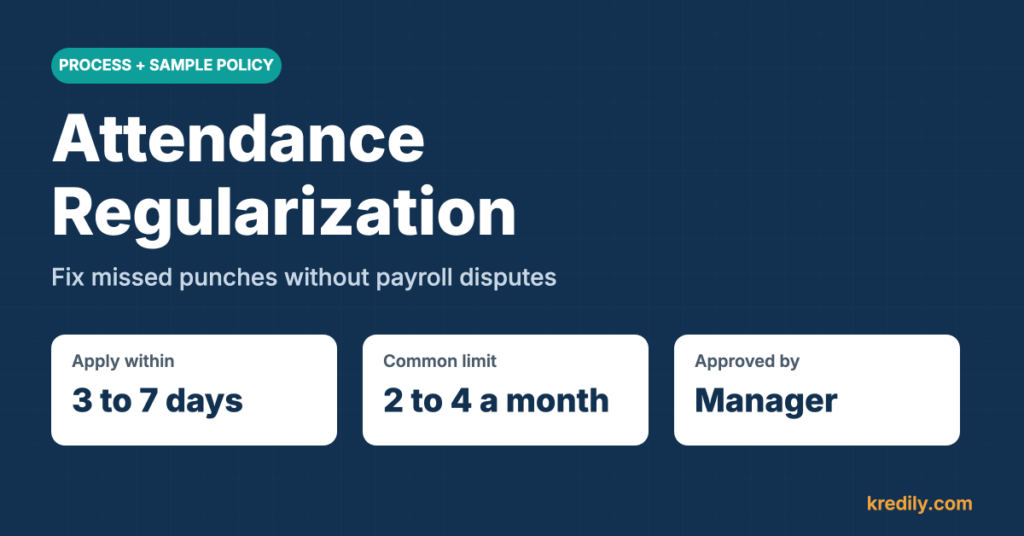
Attendance regularization is the process an employee uses to correct a wrong or missing attendance record, and a manager then approves or rejects. The usual cases are a forgotten punch, a biometric or app failure, client visits and work from home. A clear attendance regularization policy fixes these quickly, keeps payroll accurate and stops the same correction from turning into a monthly argument.
Most companies get the idea right but the rules wrong. Requests arrive after payroll closes, managers approve everything without looking, and nobody can explain later why a day changed from absent to present. This guide covers how the process should work, what to put in your policy, and a sample policy you can adapt.
Attendance regularization at a glance
| Point | What good practice looks like |
|---|---|
| What it is | A request to correct an attendance record, approved by a manager |
| Common reasons | Missed punch, device or app failure, client visit, work from home, on-duty travel |
| Who approves | The reporting manager; HR for exceptions |
| Time limit to apply | Usually within 3 to 7 days, and always before the payroll cut-off |
| Monthly limit | Many companies allow 2 to 4 requests a month |
| Effect on pay | An approved request removes loss of pay for that day |
| Record keeping | Keep the original punch, the request, the reason and the approver |
What is attendance regularization?
Attendance regularization means correcting an attendance entry that does not reflect what really happened. Say an employee worked a full day but forgot to punch out. The system shows a half day or an absence. Regularization lets them flag the gap, give a reason, and have their manager confirm it.
It is not the same as applying for leave. Leave covers days the employee did not work. Regularization covers days they did work, but the record says otherwise.
The term “regularization” is used across Indian HR and payroll systems, so it is the word your employees will search for and see in their app.
Why attendance regularization matters
Attendance feeds directly into salary. A wrong absence becomes a loss-of-pay deduction, and a wrong present day becomes an overpayment. So the regularization process is really a payroll accuracy process.
It matters legally as well. Under the Code on Wages, every employer must keep an attendance register-cum-muster roll, and electronic records are allowed. The Code also lets employers deduct wages for absence from duty, but only in proportion to the actual absence. If attendance records are wrong, deductions can be wrong too. A clean regularization trail lets you show an inspector why each correction happened.
Then there is trust. Employees who lose pay because of a failed fingerprint scanner feel cheated. A fair, quick process prevents that.
Common reasons for attendance regularization
| Reason | Example | Typical evidence |
|---|---|---|
| Missed punch | Forgot to check out after a long day | Manager confirmation, system logs |
| Device or app failure | Biometric scanner down, app crashed, no network | IT ticket, screenshot |
| Client or field visit | Spent the day at a customer site | Visit report, travel claim |
| On-duty travel | Travelled for a meeting or training | Travel booking, approval email |
| Work from home | Worked remotely with prior approval | WFH approval, login records |
| Late arrival with reason | Delayed by an official errand | Manager confirmation |
The reason should always match the evidence. “Forgot to punch” every week is a habit, not an exception, and your policy should treat it that way.
How the attendance regularization process works
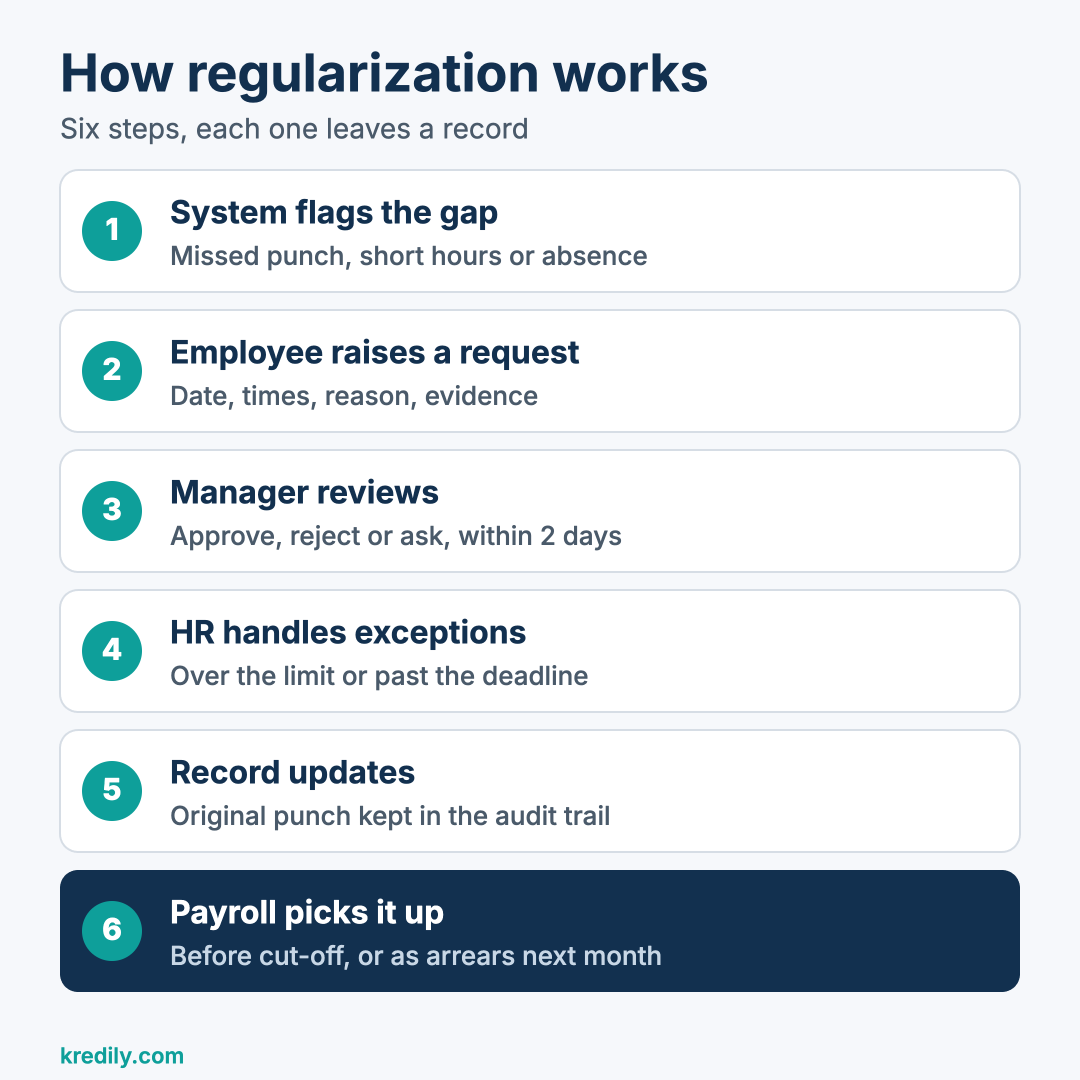
A good process has six steps, and each one leaves a record.
- The system flags the gap. Missing punches, short hours or absences show up on the employee’s attendance view.
- The employee raises a request. They pick the date, the correct in and out times, and a reason, and attach evidence if needed.
- The manager reviews it. They approve, reject or ask for more details, ideally within two working days.
- HR handles exceptions. Requests beyond the monthly limit, or older than the time limit, go to HR.
- The record updates. Once approved, the day changes in the attendance register, and the original entry stays in the audit trail.
- Payroll picks it up. Approved changes before the cut-off flow into that month’s salary. Later ones go into the next month as arrears.
What to include in an attendance regularization policy
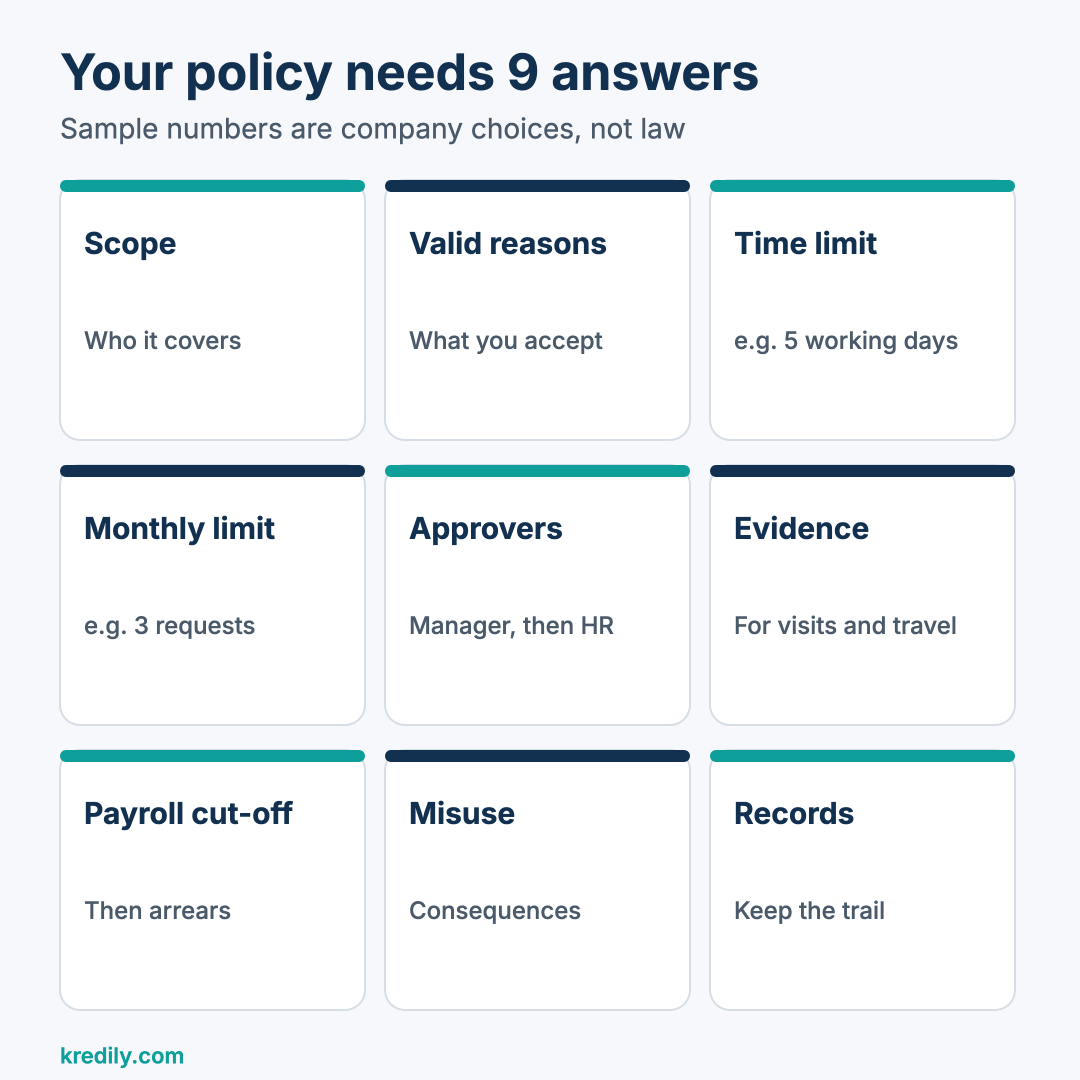
Your policy should answer every question an employee or manager might ask, so nobody has to guess.
| Policy element | What to decide |
|---|---|
| Scope | Which employees, locations and shifts the policy covers |
| Valid reasons | The reasons you accept, and those you do not |
| Time limit | How many days after the date an employee can apply |
| Monthly limit | How many requests each employee can raise in a month |
| Approval chain | Who approves, and who handles exceptions |
| Evidence | When proof is required, such as for client visits |
| Payroll cut-off | The date after which changes move to next month |
| Misuse | What happens when someone abuses the process |
| Records | How long you keep requests and approvals |
The limits are company choices, not legal requirements. No law fixes how many regularizations an employee can make. So set numbers that fit how your team works. A field sales team will need more flexibility than an office team that badges in at one door.
Sample attendance regularization policy
You can adapt this sample for your company. Replace the numbers to suit your team.
1. Purpose. This policy explains how employees can correct attendance records that do not reflect the time they actually worked.
2. Scope. It applies to all employees whose attendance is recorded through [Company]’s attendance system.
3. Valid reasons. Requests may be raised for a missed punch, a device or app failure, an approved client visit, on-duty travel, or approved work from home.
4. Time limit. Employees must raise a request within 5 working days of the date concerned, and before the monthly payroll cut-off.
5. Monthly limit. Each employee may raise up to 3 regularization requests a month. Further requests need HR approval.
6. Approval. The reporting manager will review each request within 2 working days. HR will decide requests outside the time or monthly limits.
7. Evidence. Client visits and travel must be supported by a visit report, booking or approval email.
8. Payroll. Requests approved before the cut-off will be reflected in that month’s salary. Later approvals will be adjusted in the following month.
9. Misuse. Repeated or false requests may lead to the request being rejected and to disciplinary action under company rules.
10. Records. All requests, reasons and approvals are stored in the attendance system and retained as part of attendance records.
How to stop misuse
Regularization only works if people trust it and do not game it. A few controls make a big difference:
- Limit requests, so the process stays for genuine exceptions.
- Require a reason every time, and evidence for field work.
- Review patterns monthly. Look for the same employees, the same days or the same excuse repeating.
- Keep the original punch. Never overwrite it, so the audit trail stays complete.
- Fix the root cause. If one scanner fails every week, replace it rather than approving the same requests forever.
Mobile attendance with geo-fencing removes many requests at the source. Staff can check in from a client site, so they do not need to regularize later. Our comparison of biometric and face recognition attendance explains the options.
Regularization, payroll and LOP
The link to pay is where most disputes start. If a request is approved before the payroll cut-off, the loss of pay for that day disappears from the same month’s salary. If it is approved after the cut-off, you refund the deducted amount as arrears in the next month.
Hours matter too. If a regularized day includes work beyond normal hours, it can create overtime. So regularization should capture actual in and out times, not just “present”. Our guide to working hours and overtime pay explains how those hours turn into pay.
Every approved change should flow into the muster roll and the salary register, so your records match what you paid.
Common attendance regularization mistakes
- No time limit, so requests for last quarter keep arriving.
- Approving everything without checking reasons or patterns.
- Overwriting the original punch, which destroys the audit trail.
- Changes after payroll closes with no arrears process.
- Marking days “present” without times, which hides overtime.
- Using regularization instead of leave, for days the employee did not work.
Attendance regularization checklist
- Write a short policy with reasons, time limit, monthly limit and approvers.
- Set a payroll cut-off and an arrears process for late approvals.
- Make the request form capture date, times, reason and evidence.
- Ask managers to decide within 2 working days.
- Keep the original record and the full approval trail.
- Review regularization patterns every month.
- Fix devices or locations that trigger repeat requests.
Want regularization requests, approvals and payroll in one place? Kredily’s attendance app lets employees raise requests from their phone and managers approve them in a tap, with approved changes flowing straight into payroll. Start free on Kredily
Frequently asked questions
What does attendance regularization mean?
It means correcting an attendance record that does not match the time an employee actually worked, such as a missed punch or a device failure. The employee raises a request and their manager approves or rejects it.
What is the difference between regularization and leave?
Regularization corrects the record for a day the employee worked. Leave covers a day they did not work. Using regularization in place of leave misstates attendance.
How many times can an employee regularize attendance in a month?
There is no legal limit. It is a company policy decision, and many companies allow 2 to 4 requests a month, with HR approval needed beyond that.
What is the time limit for attendance regularization?
Most companies allow 3 to 7 days after the date, and always before the payroll cut-off. Requests approved after the cut-off are usually paid as arrears next month.
What reason should I give for attendance regularization?
Give the real reason and keep it specific: for example, “Forgot to punch out, left at 6:30 pm”, “Biometric device not working, IT ticket raised”, or “At client site in Whitefield for the full day”.
Can a manager reject an attendance regularization request?
Yes. A manager can reject a request with no valid reason or evidence. If rejected, the day stays as recorded, which may mean loss of pay.
Is attendance regularization legal in India?
Yes. It is an internal process for keeping attendance records accurate, which supports the employer’s duty to keep correct attendance and wage records under the Code on Wages.
How we checked this guide
We based the legal points on the Code on Wages, 2019 and the record-keeping provisions of the Code on Wages (Central) Rules, 2026. The policy limits and timelines are common practice, not legal requirements, and the guide says so wherever it suggests a number.
Sources and notes
- Code on Wages, 2019, on wage records and deductions for absence from duty, India Code.
- Code on Wages (Central) Rules, 2026, rule 51 and Form IX attendance register-cum-muster roll, with electronic records permitted, as summarised by BDO India.
This guide is for general information. It is not legal advice. Adapt the sample policy with your HR or legal adviser.