


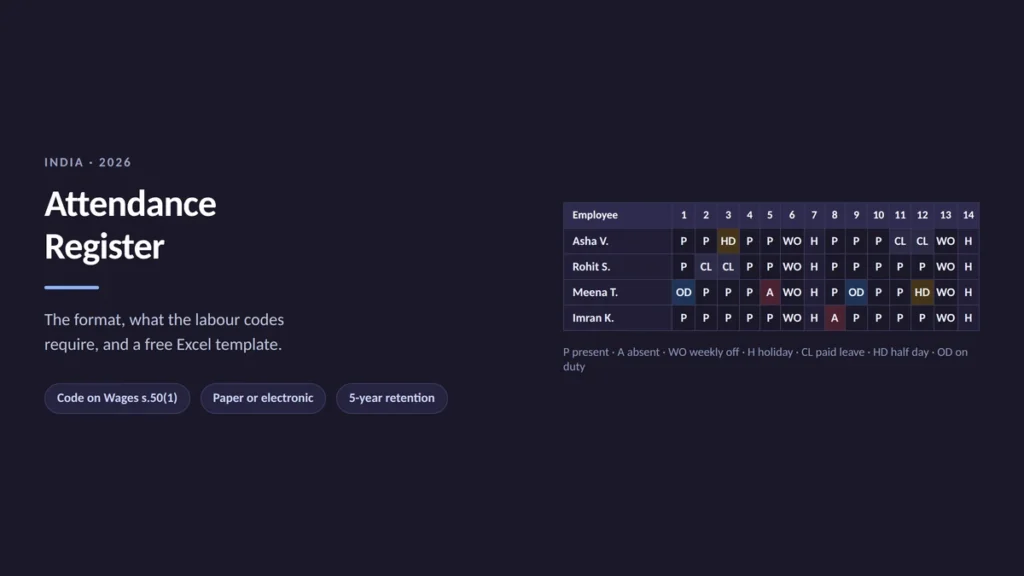
An attendance register is the employer’s dated record of each employee’s presence, working hours and leave. Under Section 50(1) of the Code on Wages, 2019, in force since 21 November 2025, every covered employer must maintain a register with details of persons employed, muster roll and wages. Below you will find the register format with each column explained and the legal position after the labour codes, along with a free Excel template ready to use. It also opens in Google Sheets.
Is an attendance register the same as a muster roll?
For most employers, yes. A muster roll is the older statutory term for a daily roll-call record kept at the workplace, historically prescribed for factories, mines and contract labour. An attendance register is the broader office name for the same record.
The new labour codes treat them as one document. The Ministry of Labour and Employment’s compliance handbook for employers under the four codes describes the requirement as an “attendance register cum muster roll”. One register does both jobs, so a single dated record of attendance and hours per employee covers you.
The distinction survives mainly on site work. A contractor on a construction site keeps a daily muster roll per site, because wages there are typically calculated daily and inspections happen at the site. Statutory muster-roll forms for that setting also carry columns an office register usually skips, such as father’s or husband’s name (the wording the older prescribed forms use) and a thumb-impression field. Workers supplied through a contractor sit on that contractor’s muster roll; your own register covers the people you employ directly. If you engage contract labour, confirm in the contract who maintains which record.
What the law requires after the labour codes
Most guides on this topic still cite the Factories Act, the Contract Labour Act or the Minimum Wages Act. Those acts were subsumed when the four labour codes came into force on 21 November 2025, so the register obligation now flows from the codes.
Code on Wages, 2019, Section 50(1): “Every employer of an establishment to which this Code applies shall maintain a register containing the details with regard to persons employed, muster roll, wages and such other details in such manner as may be prescribed.”
Section 50(2) adds a display obligation: a notice on the notice-board showing the abstract of the Code, category-wise wage rates of employees, wage period, day or date and time of payment of wages, and the name and address of the Inspector-cum-Facilitator having jurisdiction. Inspection sits with the Inspector-cum-Facilitator, appointed and empowered under Section 51. The one carve-out is Section 50(4): employers of not more than five persons in agriculture or domestic work are exempt from these record-keeping duties — the register, the displayed notice and wage slips — though they must still show reasonable proof that wages were paid.
Occupational Safety, Health and Working Conditions Code, 2020, Section 33 (“Maintenance of registers, records and filing of returns”) requires establishments to maintain registers covering prescribed particulars, attendance among them, in prescribed form, electronically or otherwise, and to file returns with the Inspector-cum-Facilitator. The MoLE handbook describes this register as the attendance-cum-muster-roll and confirms both electronic maintenance and electronic filing of the annual return. The OSH Code text is on India Code.
For most employers the biggest change is consolidation. The four labour codes cut the registers an employer maintains from 84 under the old acts to 8, and prescribed forms from 181 to 73, according to the Ministry of Labour and Employment’s employer compliance handbook (2026). The attendance register survived the cut because it is the source record: wage registers, overtime registers and PF/ESI workings all start from who was present.

The codes also changed retention. The repealed Payment of Wages Act required wage records to be kept for three years, and that figure still circulates in older guides. Attendance records under the labour codes must be preserved for five years and may be kept electronically, per the MoLE compliance handbook (2026). Where you see both figures quoted, five is the current one. Non-maintenance or improper maintenance of records is also a distinct offence under Section 54(2) of the Code on Wages, carrying a fine that can extend to ₹10,000.
| Question | Position under the codes | Source |
|---|---|---|
| Must I keep an attendance register? | Yes — register with persons employed, muster roll and wages | Code on Wages, s.50(1) |
| Paper or electronic? | Either; electronic maintenance is expressly permitted | MoLE compliance handbook, 2026 |
| How long do I keep records? | Five years | MoLE compliance handbook, 2026 |
| Who inspects it? | The Inspector-cum-Facilitator for your establishment | Code on Wages, s.51 |
| What if I don’t maintain it? | Fine up to ₹10,000 for non-maintenance or improper maintenance of records | Code on Wages, s.54(2) |
| Anyone exempt? | Only employers of ≤5 persons in agriculture or domestic work | Code on Wages, s.50(4) |
Biometric and app-based attendance fall within the electronic position the handbook confirms: a system producing a dated, per-employee record of presence and hours, retrievable on demand, functions as an electronic register on the handbook’s reading. One qualification: the rules now being notified under the codes may prescribe specific fields or certification for electronic records, so anchor your setup to the data and treat any prescribed format as a layout to render into.
What about your state’s Shops and Establishments Act?
If your state’s S&E rules prescribe an attendance or muster-roll form for your establishment type, start from that form. It will capture most of the same data the codes’ register needs — and do confirm against the register forms your state notifies under the codes as they arrive.

The codes did not replace state S&E law. Labour is a concurrent subject, and S&E acts are state statutes with their own register requirements. Maharashtra, for example, prescribes Form Q, a combined muster-roll-cum-wage-register, under its Shops and Establishments Rules, 2018. Other states prescribe their own forms, and several prescribe none; your state labour department’s website is the place to check. Where no state form exists, the column format below is a sound default.
Where rule-making stands
The codes have been in force since November 2025, and the final central rules — the Code on Wages (Central) Rules, 2026 and the Occupational Safety, Health and Working Conditions (Central) Rules, 2026 among them — were notified on 8 May 2026. Those central rules govern establishments in the central sphere, such as mines, railways and banking. Most private establishments answer to their state government instead, and state rules are still arriving on their own timelines, which is why the prescribed register formats can still shift for many employers. The obligation to keep the register is settled either way. Our labour codes guide tracks the transition in detail.
The attendance register format, column by column
The columns decide whether the register can answer questions later, whether they come from payroll or from an inspector. This set covers what the statutory record needs and what payroll consumes:
| Column | Why it exists |
|---|---|
| Employee ID and full name | Ties the record to the employee register (the master list of employees, another of the codes’ eight registers) and to PF/ESI accounts |
| Father’s / spouse’s name | Standard on statutory muster-roll forms; essential for site and contract labour, optional in an office register |
| Designation and department | Lets the register be read against actual deployment |
| Date | One entry per employee per day; the register is a daily record |
| Time in / time out | The hours evidence overtime and wage calculations rest on |
| Total hours | Derived from times; the basis for spotting overtime |
| Overtime hours | Recorded separately because it is paid separately |
| Attendance mark | P, A, WO, H, CL and the rest; the code payroll reads |
| Attestation | Employee signature on paper, or the login/biometric event in a system. In an owner-maintained spreadsheet, a monthly printed sign-off does this job (step 6 below) |
| Remarks | Late marks, half-days, on-duty outside office |
Do salaried office staff need the time columns? Where hours are fixed and overtime cannot arise, a marks-only register plus your standard working hours is common practice. The moment overtime is possible, you need the times: the overtime record is separate and paid separately, and it can only be derived from hours actually worked. When unsure, record times.
The standard marks, so every reader of the register interprets it identically:
| Mark | Meaning |
|---|---|
| P | Present |
| A | Absent (unauthorised or unpaid) |
| WO | Weekly off |
| H | Paid holiday |
| CL / SL / EL | Casual, sick or earned leave (paid categories) |
| HD | Half day |
| OD | On duty away from the workplace — working time, counted like a P in payable days |
Keep the marks aligned with your leave management categories. A register that writes “L” for four different kinds of leave forces payroll to guess.
A filled week looks like this — illustrative entries, with the Present column counting P and OD, and HD as half:
| Employee | 1 | 2 | 3 | 4 | 5 | 6 | 7 | Present |
|---|---|---|---|---|---|---|---|---|
| KR-014 · Asha V. | P | P | HD | P | P | WO | H | 4.5 |
| KR-022 · Rohit S. | P | CL | CL | P | P | WO | H | 3 |
| KR-031 · Meena T. | OD | P | P | P | A | WO | H | 4 |

Download the template, or build the sheet yourself
The free Excel template has all of this pre-built: a monthly grid for up to 100 employees with the marks list enforced, automatic monthly totals and payable days, exception highlighting, an optional in/out times sheet that computes hours and overtime, and a legend explaining which cells to edit. It opens in Google Sheets as well. Copy the sheet each month and it becomes a running register.
Building your own instead takes six decisions:
- One sheet per month. Column A for employee ID, column B for name, then one column per calendar day. Freeze panes after the name column.
- Restrict what can be typed. Add data validation on the day columns with the list P, A, WO, H, CL, SL, EL, HD, OD. This keeps stray entries like “p”, “present” and “PP” out of the data, where they silently break the formulas in step 3.
- Total the month with formulas. One count column per mark: presents
=COUNTIF(C2:AG2,"P"), absences=COUNTIF(C2:AG2,"A"), and the same pattern for OD, WO, H and HD; paid leave is=COUNTIF(C2:AG2,"CL")+COUNTIF(C2:AG2,"SL")+COUNTIF(C2:AG2,"EL")(three COUNTIFs added together work in every Excel version). Then payable days:=P + OD + paid leave + WO + H + HD*0.5, each term pointing at its count cell. (Note the sample week’s Present column above is a presence count — P plus OD, half for HD. Payable days add paid leave, weekly offs and holidays on top.) - Make exceptions visible. Conditional formatting: red fill on A, amber on HD, so a month’s problems are readable at a glance.
- Protect the sheet and name an owner. Lock everything except the marking range and keep one person accountable for entries. A register anyone can silently edit is far easier to challenge in a dispute.
- Close the month with an attestation step. Export to PDF, have employees (or at minimum their managers) sign the printed month, and archive both files. This gives the spreadsheet the attestation a paper register gets from signatures, and it completes the archive.

Record in/out times on a second sheet when you need them, and let the marks sheet summarise. Starting mid-month? Begin the register from today rather than reconstructing earlier weeks from memory; backfill only what a document trail supports, such as approved leave applications, and let payroll for the transition month lean on whatever record you were keeping before.
What 10,000+ support conversations taught us about attendance
Kredily’s support team has handled more than 10,000 conversations with Indian SMBs since 2023. For this page we analysed a scrubbed sample of nearly 5,000 substantive chat conversations from that pool, including pricing and pre-sales questions. Attendance came up in 809 of them, more than any other HR topic except payroll (1,081). Counts are at conversation level: a conversation can span topics, roughly a fifth resisted topic classification, and questions about configuring our own product are tallied separately. Some of these questions arrive in Hindi.
The register itself is rarely the problem in those conversations. The joins are. Three patterns recur in the questions we field. Regularisation: an employee marked absent was on approved leave, the fix happens by hand at payroll time, usually days after the month has closed, and the register and the payslip now disagree. Remote and field staff: a physical register cannot see a sales rep, so attendance becomes a WhatsApp message somebody must remember to transcribe from a month-old chat thread. Month-end reconciliation: hours in the register that do not match wages paid — worth taking seriously, because the s.50(1) register spans muster roll and wages in a single record, so a mismatch between them shows on the face of your own documents.
A spreadsheet narrows these gaps without closing them. Past a certain size, or as soon as people work outside one office, the manual transcription between check-in, leave and payroll is where errors concentrate. Kredily’s free attendance tracker removes that layer at no cost: it connects attendance directly with leave management and with payroll, for loss-of-pay and overtime. If you are evaluating options more broadly, the criteria that matter are in our guide to choosing an attendance management system.
Where registers go wrong
In practice, the failures repeat themselves:
- Not written daily. A register backfilled weekly from memory has gaps, and they cluster exactly where disputes arise.
- Overtime worked but never recorded. If in/out times show long days while the overtime column stays empty, the record contradicts itself.
- Leave marks with no trail — CL, SL or EL entries with no application or approval behind them.
- Register and payslip that disagree. Payable days on the payslip should be derivable from the register, row by row. This is the reconciliation failure described above, caught too late.
- Retention lapses, meaning last year’s registers were discarded against a five-year requirement.
The remedy in each case is the same routine: write the record daily, derive pay from it mechanically, archive at month close.
Frequently asked questions
Is an Excel attendance register legally valid? Yes. A spreadsheet is an electronic record, and the codes accept electronic registers (the retention section above carries the handbook source). What matters is that it stays up to date, holds one row per employee per day, and can be produced when asked.
Is biometric attendance mandatory? No central provision makes biometric capture mandatory for private establishments generally. The obligation is to keep the record — biometric devices are simply one way of keeping it electronically.
How long must attendance records be kept? Five years. A register you close in 2026 must still be retrievable in 2031, so archive the working file and the signed month-close PDFs together; the retained record then carries its attestation with it.
Do small businesses need an attendance register? Almost all do. The Code does not scale the record-keeping duty to headcount; the only exemption written into the record-keeping section itself is Section 50(4), for employers of five or fewer persons in agriculture or domestic work. An office of eight is covered.
What is the difference between an attendance register and a wage register? The attendance register records presence and hours; the wage register records what was paid and how it was calculated. Under Section 50(1) they are parts of one combined record.
Which format should I use — the codes’ format or my state’s S&E form? Check your state first: a prescribed state form (Maharashtra’s Form Q, for instance) governs your establishment. Where a state form and the codes’ register ask for different fields, keep the superset — a register can always carry more columns than the form demands, while a missing prescribed field is a gap an inspector can query. If your state prescribes nothing, use the column set on this page.
If the register above is more upkeep than you want, Kredily’s attendance tracker builds the daily attendance record for you automatically, free.
Written by Devendra Khandegar, Founder & CEO, Kredily. Kredily builds free HR and payroll software for Indian SMBs. The support-conversation analysis cited above is Kredily’s own aggregate data (2023–2026); no individual customer information was used. This page is general information on record-keeping requirements, not legal advice; for decisions that turn on your specific establishment or state, consult a labour law practitioner.