


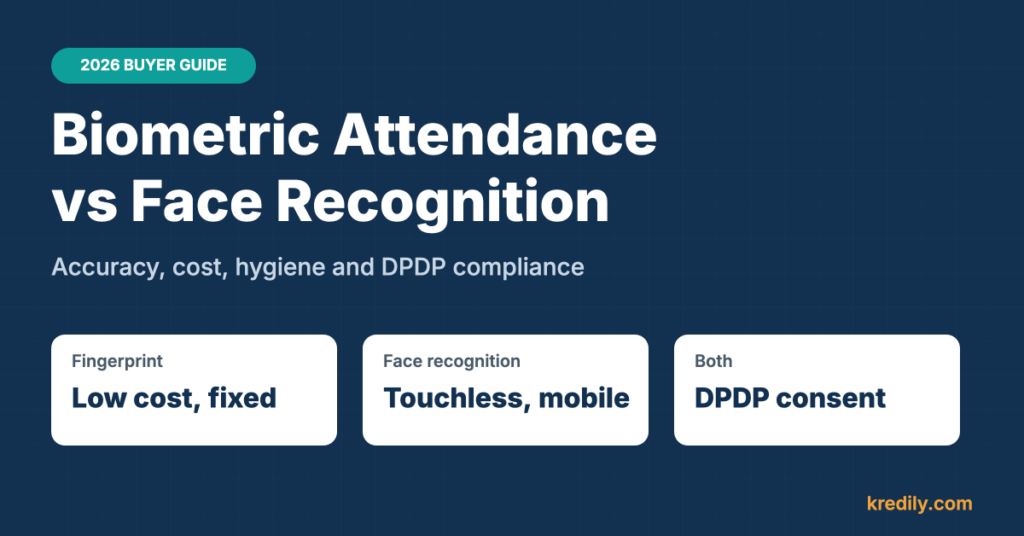
A biometric attendance system identifies employees by a physical trait, most often a fingerprint or a face, and records when they start and finish work. The real choice for most Indian businesses in 2026 is between a fingerprint scanner and face recognition. Fingerprint devices cost less and work well in clean, fixed offices. Face recognition is touchless, faster at busy entrances and works on phones for field staff, but it costs more per device.
Both kinds of biometric attendance collect biometric data. So both now come with clear duties under India’s data protection law. This guide compares the two on accuracy, speed, cost, and compliance, and helps you pick the right one for your workplace.
Fingerprint vs face recognition at a glance
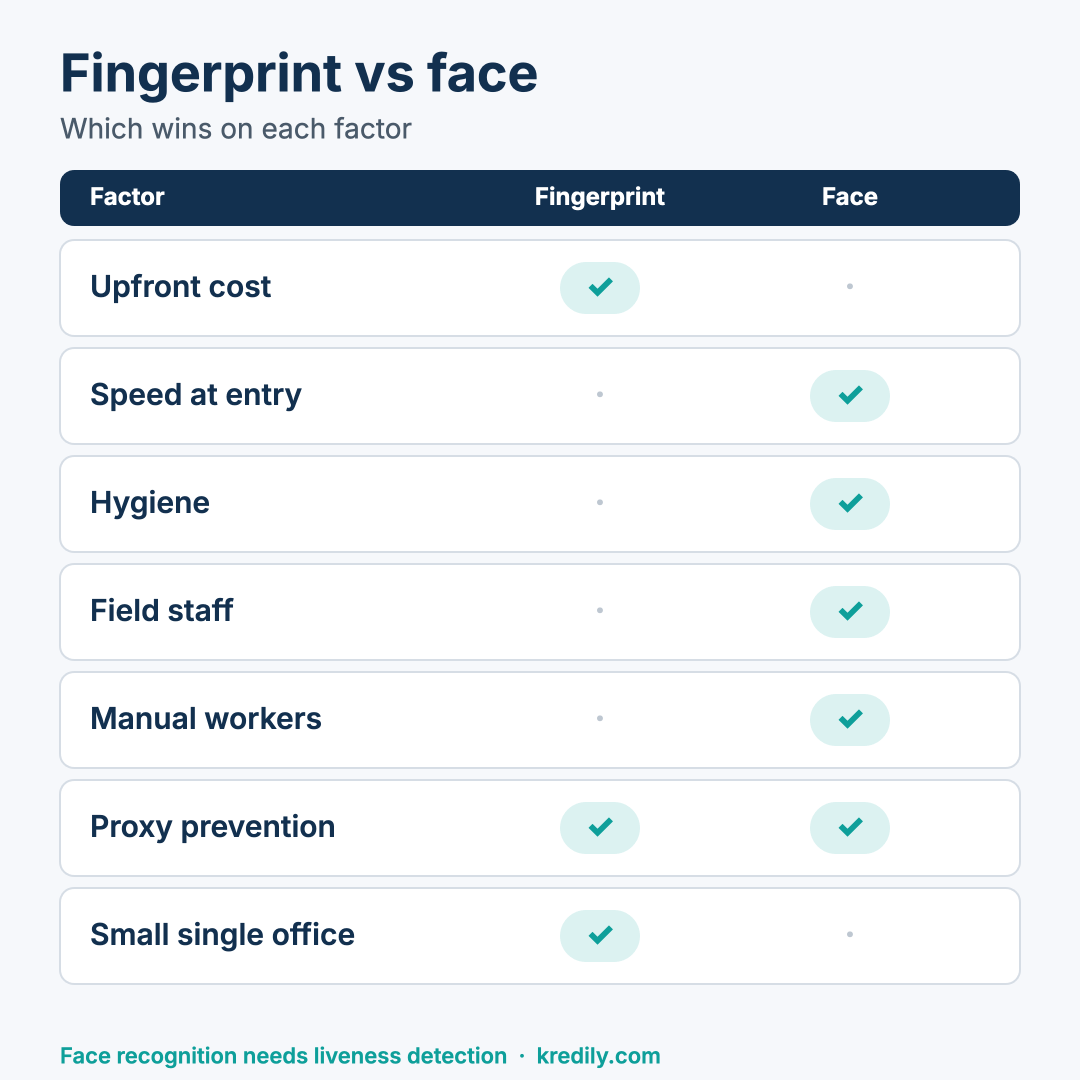
| Factor | Fingerprint biometric | Face recognition |
|---|---|---|
| How it works | Finger placed on a scanner | Face scanned by a camera or phone |
| Contact | Touch-based | Touchless |
| Speed at the entrance | About one to two seconds per person | Often under a second, even at a walk-up |
| Works for field staff | No, needs a fixed device | Yes, through a mobile app with geo-fencing |
| Problem cases | Worn, cut, dirty or wet fingers | Poor lighting, masks, very similar faces |
| Proxy prevention | Strong | Strong, with liveness detection |
| Upfront cost | Lower per device | Higher per terminal; app-based options avoid hardware |
| Data law | Biometric personal data under DPDP | Biometric personal data under DPDP |
What is a biometric attendance system?
A biometric attendance system uses something unique about each person to mark attendance. Instead of a card, a PIN or a signature, the system checks a fingerprint, a face, or sometimes an iris. Because no one else can use your finger or face, it removes most “buddy punching”, where one employee marks attendance for another.
Each check-in becomes a timestamped record. Good systems then pass that record on to leave, overtime and payroll, so HR does not retype attendance every month.
How fingerprint attendance works
A fingerprint attendance machine stores a mathematical template of each employee’s fingerprint, not a picture of it. When someone places a finger on the scanner, the device compares it with the stored templates and logs the match.
Where it works well:
- Offices and shops with one fixed entrance.
- Teams that sit in one place every day.
- Businesses that want the lowest upfront cost.
Where it struggles:
- Manual workers with worn, cut or calloused fingertips.
- Dusty, oily or wet environments, such as factories, kitchens and construction sites.
- Large shift changes, where a queue forms at the scanner.
- Hygiene concerns, since everyone touches the same surface.
How face recognition attendance works
Face recognition attendance maps the features of a face, such as the distance between the eyes, and turns them into a template. The employee simply looks at a camera. The system then matches the face and records attendance.
It comes in two forms:
- Face recognition terminals. A wall-mounted device at the entrance, much like a fingerprint machine but touchless.
- Mobile face recognition. Employees take a selfie in an attendance app. The app checks their face and their GPS location against a geo-fence.
The second form matters a lot for Indian businesses with sales, delivery or field teams. A fingerprint machine cannot follow staff to a client site, but a phone can.
Modern systems also use liveness detection, which checks that a real person is in front of the camera rather than a printed photo or a video. Without it, face recognition is much easier to fool.
Biometric attendance compared: fingerprint vs face
Accuracy
Both methods are accurate in the right conditions. Fingerprint scanners struggle most with damaged or dirty fingers, which is common among manual workers. Face recognition, on the other hand, struggles most with very poor lighting and with masks or heavy coverings. So the better choice depends on your environment, not on a single accuracy number.
Speed
Face recognition is usually faster, especially at busy shift changes, because staff do not need to stop and place a finger. That said, a single fingerprint check is also quick. The difference matters most when hundreds of people arrive at once.
Hygiene
Face recognition is fully touchless. Fingerprint scanners, by contrast, are touched by every employee, many times a day. For healthcare, food handling and shared factory floors, that is a real consideration.
Proxy prevention
Both stop one employee marking attendance for another. Face recognition needs liveness detection to stay secure. Fingerprint systems should use scanners that reject fake or lifted prints.
Remote and field staff
This is the clearest difference. Fingerprint systems need a fixed device. Face recognition can work through a mobile app with geo-fencing, so it covers staff who never come to a single office.
Maintenance
Fingerprint sensors wear out and need cleaning. Face terminals need sensible placement away from strong backlight. App-based face recognition needs no hardware at all, only phones that staff already carry.
Biometric attendance cost comparison
Hardware prices vary widely by brand and features, so treat these as broad ranges and get quotes for your exact setup.
| Option | What you pay for | Typical cost pattern |
|---|---|---|
| Fingerprint machine | One device per entrance, plus software | Lowest upfront cost per entrance |
| Face recognition terminal | One terminal per entrance, plus software | Higher; SME-grade terminals reported at about ₹15,000 to ₹22,000 each |
| Mobile face recognition app | Software subscription only | No hardware cost; pricing per employee or a free plan |
The device is rarely the biggest cost. Lost time from queues, payroll errors from bad data, and manual reconciliation usually cost more than the hardware over a year. So compare the full cost, including how the system connects to payroll.
Biometric attendance and India’s data protection law
Fingerprints and face templates are biometric personal data. In India, that brings them under the Digital Personal Data Protection Act, 2023 and the DPDP Rules, 2025, which the government notified in November 2025.
The DPDP Rules come into force in phases. According to recent analysis, the core duties on notice, consent, security safeguards, breach reporting and data principal rights take effect on 13 May 2027. That gives employers time to prepare, but biometric systems take months to fix. So it makes sense to set them up correctly now.
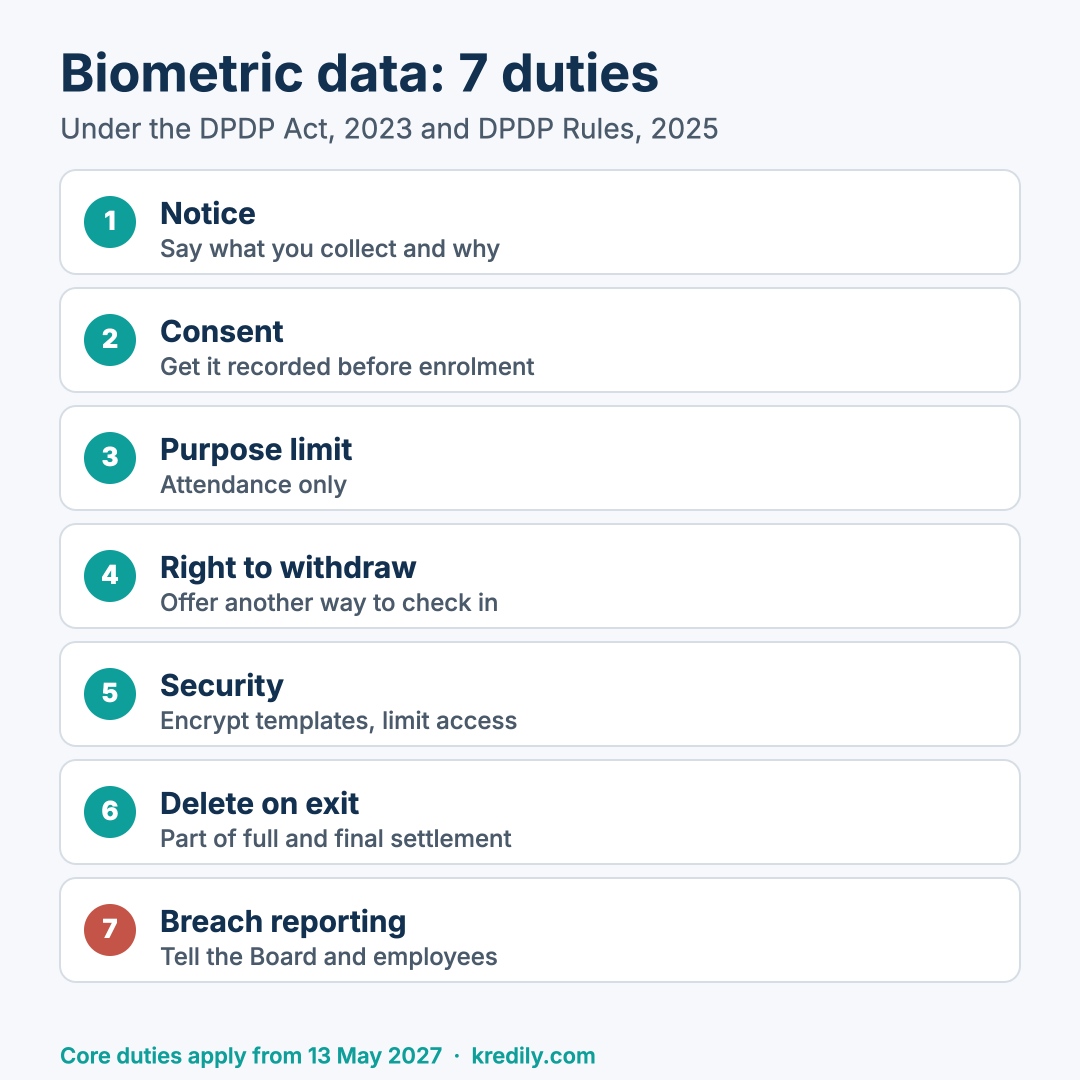
What the law expects from an employer using biometric attendance:
- A clear notice. Tell employees what biometric data you collect, why, and how long you keep it.
- A valid basis, usually consent. Many legal advisers recommend explicit, recorded consent for biometrics.
- Purpose limitation. Use attendance biometrics only for attendance, not for unrelated monitoring.
- The right to withdraw. If an employee withdraws consent, stop processing their biometric data and offer an alternative way to mark attendance.
- Security safeguards. Encrypt templates, limit access and choose vendors with strong security.
- Deletion on exit. Delete an employee’s biometric template when they leave, ideally as part of the full and final settlement.
- Breach reporting. Report a personal data breach to the Data Protection Board and the affected employees.
The penalties for failing to protect personal data are severe, running up to ₹250 crore for serious security failures. So treat biometric data with the same care as bank details.
Which biometric attendance method should you choose?
| Your workplace | Better fit | Why |
|---|---|---|
| Small office, one entrance, low budget | Fingerprint | Low cost, simple setup |
| Factory, warehouse or construction site | Face recognition terminal | Works with worn or dirty hands, touchless |
| Hospital, kitchen or food unit | Face recognition | Hygiene |
| Sales, delivery or field teams | Mobile face recognition with geo-fencing | No fixed device needed |
| Several branches or sites | Mobile or cloud face recognition | One system across locations |
| Large shift changes | Face recognition terminal | Faster, no queue at a scanner |
Many businesses end up with a mixed biometric attendance setup: a face terminal at the main site, and mobile face recognition for staff who work outside it. In that case, make sure both feed the same attendance and payroll system.
How to roll out a biometric attendance system
- Map how people actually work. Count entrances, shifts, sites and field staff.
- Choose the method for each group, using the table above.
- Write a short biometric policy and notice covering purpose, retention and the alternative for anyone who withdraws consent.
- Collect consent before you enrol anyone, and keep a record.
- Pilot with one team for two weeks and fix enrolment and lighting issues.
- Connect it to payroll, so attendance, LOP and overtime flow through without spreadsheets.
- Delete templates on exit, and review access to biometric data every quarter.
Common biometric attendance mistakes
- Buying hardware before checking the workforce. A fingerprint machine is a poor fit for field staff or manual workers.
- Skipping consent and notice. That creates legal risk under the DPDP regime.
- No liveness detection on face recognition, which lets photos through.
- Attendance that never reaches payroll. Manual re-entry brings back the errors you wanted to remove.
- Keeping templates forever. Delete them when an employee leaves.
Biometric attendance and labour law records
Whichever biometric attendance method you choose, the output must support your legal records. Under the labour codes, employers keep an attendance register-cum-muster roll, and electronic records are allowed. A good biometric system produces this for you. See our guides to the muster roll and to working hours and overtime pay, since overtime depends on accurate hours.
For a wider look at the market, our guide to the best attendance apps in India compares seven options.
Want face recognition, geo-fencing and payroll in one place? Kredily’s attendance app connects attendance straight to payroll for teams in the office and in the field. Start free on Kredily
Frequently asked questions
Which is better, fingerprint or face recognition attendance?
It depends on your workplace. Fingerprint machines cost less and suit small, clean offices with one entrance. Face recognition is touchless, faster at busy entrances, works for manual workers and, through a mobile app, covers field staff. Most growing businesses find face recognition the more flexible choice.
Is face recognition attendance legal in India?
Yes, when it is done properly. Face templates are biometric personal data under the DPDP Act, 2023, so employers should give a clear notice, obtain valid consent, limit the use to attendance, secure the data and delete it when an employee leaves.
Can an employee refuse biometric attendance?
An employee can withdraw consent to the processing of their biometric data. The employer should then stop processing it and offer another way to mark attendance, such as a mobile check-in with geo-fencing or a supervised register.
How much does a face recognition attendance machine cost in India?
Reported prices for SME-grade face recognition terminals are about ₹15,000 to ₹22,000 per device, plus software. Mobile face recognition apps avoid hardware costs altogether.
Can face recognition be fooled by a photo?
Basic systems can be. Systems with liveness detection check for a real, live person and reject photos and videos, so always ask vendors about it.
Does fingerprint attendance work for factory workers?
Often poorly. Worn, cut or dirty fingertips cause failed scans, which slows shift changes. Face recognition usually works better on factory floors and sites.
Is a biometric attendance system mandatory in India?
No law requires private employers to use biometrics. However, every employer must keep accurate attendance records, and biometrics is one reliable way to do it.
What happens to biometric data when an employee leaves?
The employer should delete the employee’s biometric template once it is no longer needed for its stated purpose, ideally as part of the full and final settlement.
How we checked this guide
We compared fingerprint and face recognition systems using recent independent analysis of the Indian market and legal commentary on the DPDP Act, 2023 and the DPDP Rules, 2025. Hardware prices vary by brand, so we give ranges and recommend getting quotes. Data protection timelines are phased, and we will update this guide as the rules take effect.
Sources and notes
- DPDP Rules, 2025 notified in November 2025, and the phased start of notice, consent, security and data principal rights on 13 May 2027, as reported by Kredily.
- Employees’ right to withdraw consent and the duty to stop processing biometric data, as summarised by King Stubb & Kasiva.
- Facial recognition data as biometric personal data requiring a valid legal basis, secure storage and purpose limitation, as reported by The People’s Board.
- Reported price range for SME-grade face recognition terminals and liveness detection practice, from EZHRM.
- Face verification versus identification and the DPDP framework for facial recognition, from HyperVerge.
This guide is for general information. It is not legal advice. For decisions about biometric data, speak to your legal adviser.