


Last updated: 10 November 2026. Checked against the Code on Wages, 2019 and the central VDA order effective 1 October 2026.
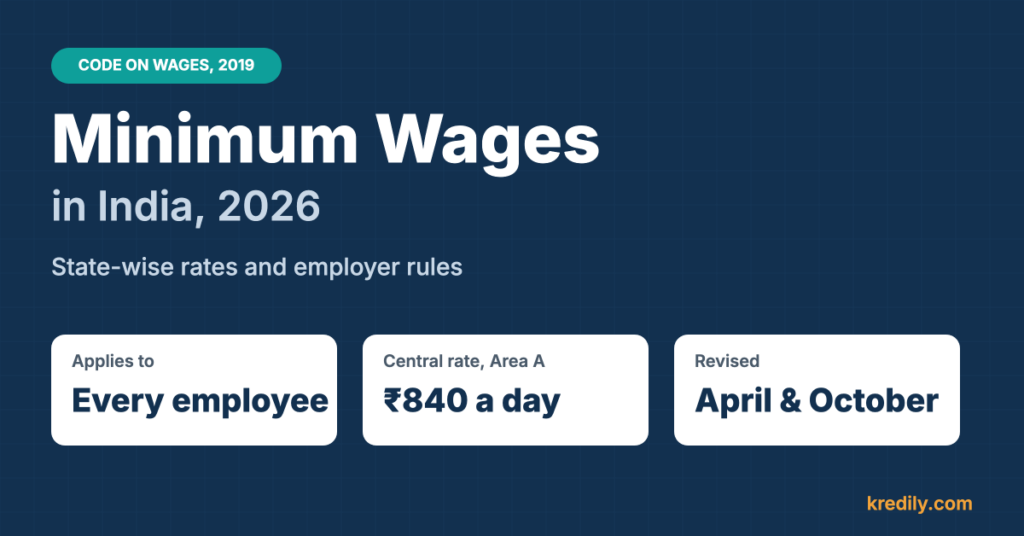
Minimum wages are the lowest pay an employer in India can legally give for a day’s work. In 2026, they come from the Code on Wages, 2019, which applies to every employee from your very first hire. The exact figure depends on four things: who sets the rate (Centre or state), the worker’s skill level, the area of work, and the dearness allowance in force that month.
Getting it wrong is easy. Rates differ across states, change twice a year in most places, and now sit inside a new law. This guide explains how minimum wages work in 2026, gives the latest central rates, and links to our state-by-state pages.
Minimum wages in India at a glance
| Point | 2026 position |
|---|---|
| Law | Code on Wages, 2019, in force from 21 November 2025 |
| Who it covers | Every employee, in every establishment |
| Who sets the rate | The Centre for central-sphere work; the state government for everything else |
| Rate depends on | Skill level, area or zone, type of work, and current VDA |
| Revision | VDA usually revised twice a year, often in April and October |
| Central unskilled rate, construction (Area A) | ₹840 a day from 1 October 2026 |
| National floor wage | Provided for in the Code; amount not yet notified |
| Penalty for underpaying | Fine up to ₹50,000, more for repeat offences |
What are minimum wages?
Minimum wages are a legal floor, not a guideline. No agreement, offer letter or employee consent can bring pay below the notified rate. If an employee agrees to less, the employer still owes the difference.
Until November 2025, the Minimum Wages Act, 1948 set these rules, and it applied only to listed “scheduled employments”. The Code on Wages changed that. Minimum wages now apply to all employees, whatever the industry, and the old schedule-based gaps are gone. Our glossary entry on the Minimum Wages Act explains the old regime.
How minimum wages work under the Code on Wages
The floor wage
Section 9 of the Code on Wages lets the Centre fix a statutory national floor wage, and no state may set its minimum wages below it. The Code on Wages (Central) Rules, 2026, notified on 8 May 2026, set out how that floor is fixed and revised.[1] As of November 2026, however, the Centre has not yet notified the floor wage amount itself. The Labour Ministry began the exercise in mid-2026.[2]
Until a figure is notified, the only national benchmark is the older, advisory National Floor Level Minimum Wage of ₹176 a day, in place since June 2017.[3] A rise to ₹178 was announced in 2019, but sources differ on whether it was ever formally notified. Either way, almost every state rate is far higher, so in practice your state’s notified rate is the number that binds you.
Skill categories
Rates rise with skill. Most notifications use four grades: unskilled, semi-skilled, skilled and highly skilled. Some states add clerical or supervisory grades. Classify each role by the work actually done, not the job title.
Area or zone
Rates also vary by location. The Centre uses Area A (large metros), Area B and Area C. States use their own zones, often based on city size or municipal limits. The same job can carry a different rate in a city and in a nearby town.
Variable dearness allowance (VDA)
Most minimum wages have two parts: a basic rate and a variable dearness allowance linked to inflation. The Centre revises VDA every April and October. Many states also revise twice a year, though the months differ. That is why a rate you checked in March may be short by November.
Central or state rate
The Centre sets minimum wages for central-sphere work. That covers railways, mines, oil fields, major ports, central PSUs, banks and their contractors. For almost every private factory, shop, office or site, the state government sets the rate. So most small and mid-sized businesses follow their state’s notification.
Central minimum wages from 1 October 2026
The Labour Bureau revised central VDA with effect from 1 October 2026. Here are the unskilled daily rates for the two most common categories.
| Work | Area A | Area B | Area C |
|---|---|---|---|
| Construction, sweeping and cleaning, loading and unloading (unskilled) | ₹840 | ₹704 | ₹565 |
| Agriculture (unskilled) | ₹537 | ₹491 | ₹486 |
Daily rates including VDA. Higher skill grades carry higher rates.
At 26 working days, ₹840 a day works out to ₹21,840 a month. Remember, though, that these central rates only apply to central-sphere establishments.
State-wise minimum wages in 2026
Each state notifies its own rates, zones and revision dates. We keep a page for each major state, updated when the state issues a new notification.
| Region | State pages |
|---|---|
| South | Karnataka, Tamil Nadu, Telangana, Andhra Pradesh |
| West | Maharashtra, Gujarat, Rajasthan |
| North | Delhi, Haryana, Punjab, Uttar Pradesh, Uttarakhand |
| Central and East | Madhya Pradesh, Chhattisgarh, Jharkhand |
If you run payroll in more than one state, check each one separately. A single company-wide minimum almost never matches every state.
How to find the right minimum wage for an employee
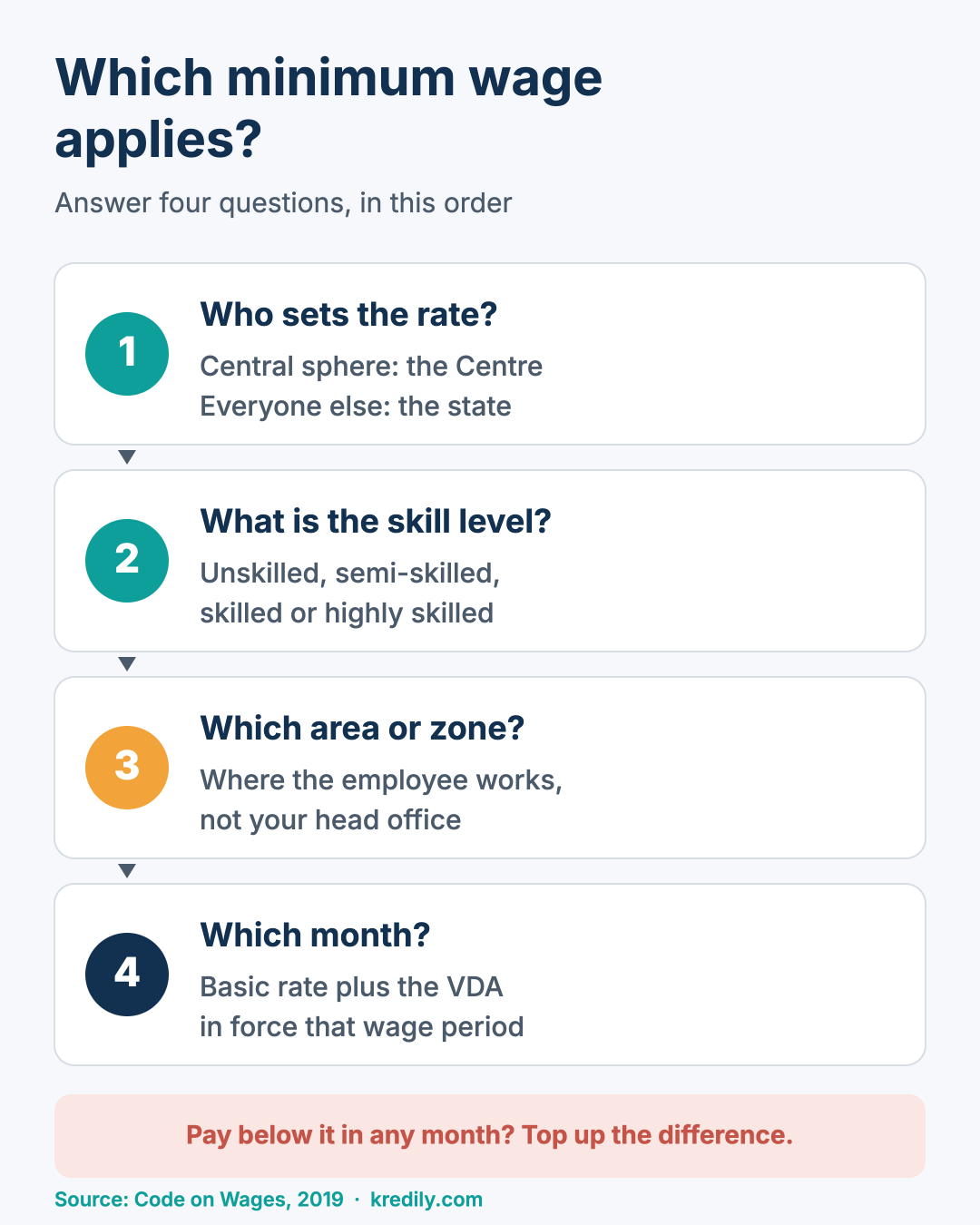
Work through four questions, in this order:
- Who sets the rate? If your establishment is in the central sphere, use the central notification. Otherwise, use your state’s.
- What is the skill level? Match the actual work to unskilled, semi-skilled, skilled or highly skilled.
- Which area or zone? Use the zone where the employee works, not your head office.
- Which month? Apply the basic rate plus the VDA in force for that wage period.
Then compare that figure with the employee’s wages. If wages fall short in any month, top them up.
Daily, monthly and overtime rates
Notifications usually quote a daily rate. To convert a daily rate to a monthly one, most states multiply by 26, so a ₹600 daily rate becomes ₹15,600 a month. Check your state’s notification, because a few quote monthly rates directly.
Overtime is separate. Under the Code on Wages, hours beyond the normal working day must be paid at no less than twice the ordinary rate of wages. So an employee on the minimum wage earns double that rate for each overtime hour.
Minimum wages and the rest of your payroll
The minimum wage is not a standalone number. It feeds into several other calculations:
- Statutory bonus. Bonus is calculated on the higher of ₹7,000 and the minimum wage. So a mid-year revision changes the bonus too. See our statutory bonus guide.
- The 50% wage rule. Under the Code, wages for PF, gratuity and bonus include any excess when allowances cross half of total pay. Our New Labour Codes guide shows how it works.
- PF. PF is calculated on wages up to the ₹25,000 ceiling, so a minimum wage hike can raise PF contributions too.
For the full picture of how these fit together, read our payroll statutory compliance guide.
Penalties for paying below minimum wages
Under section 54 of the Code on Wages, paying an employee less than the amount due can lead to a fine of up to ₹50,000. A repeat offence within five years can bring imprisonment of up to three months, a fine of up to ₹1 lakh, or both.
The fine is only part of it. The employee can also claim the shortfall, and the arrears for a whole team can be large.
Five minimum wage mistakes employers make
- Missing the mid-year revision. VDA changes in April and October in many places, but payroll often keeps last season’s rate.
- Using head office rates for branch staff. The rate follows where the employee works.
- Classifying by job title. A “supervisor” doing unskilled work is paid at the unskilled rate, and the reverse also applies.
- Counting HRA towards the minimum. The minimum wage is usually basic plus dearness allowance, so other allowances may not count.
- Ignoring contract workers. The principal employer can be liable if a contractor pays below the minimum wage.
Minimum wages checklist for every payroll run
- Confirm whether each establishment is central sphere or state sphere.
- Check for any new notification since last month.
- Map every role to a skill level and every location to a zone.
- Compare each employee’s wages with the applicable rate, month by month.
- Pay overtime at twice the ordinary rate.
- Recalculate statutory bonus if the minimum wage changed during the year.
- Collect wage proof from contractors.
Prefer to automate it? Kredily payroll software runs payroll with statutory compliance built in, so rate changes are easier to track across states.
Frequently asked questions
What is the minimum wage in India in 2026?
There is no single national figure. Each state sets its own minimum wages by skill level and zone, and the Centre sets rates for central-sphere work. For example, the central rate for unskilled construction work in Area A is ₹840 a day from 1 October 2026.
Is there a national minimum wage in India?
Not yet as a binding figure. The Code on Wages allows the Centre to notify a statutory national floor wage, but as of November 2026 the amount has not been notified. The old advisory floor of ₹176 a day from 2017 is far below every state rate, so employers should follow their state’s notification.
Do minimum wages apply to all employees?
Yes. Under the Code on Wages, 2019, minimum wages apply to every employee in every establishment, not just to listed industries as under the old Act.
How often are minimum wages revised?
The Centre revises VDA twice a year, in April and October. Most states also revise at least once a year, often twice, but the months vary.
How do I convert a daily minimum wage into a monthly wage?
Most states multiply the daily rate by 26 working days. So ₹600 a day becomes ₹15,600 a month. Check your state’s notification in case it quotes a monthly rate.
What is the penalty for paying less than the minimum wage?
Under the Code on Wages, a fine of up to ₹50,000. A repeat offence within five years can lead to imprisonment of up to three months, a fine of up to ₹1 lakh, or both. The employee can also claim the unpaid difference.
Is overtime paid on the minimum wage?
Yes. Overtime must be paid at no less than twice the ordinary rate of wages, so an employee on the minimum wage earns double that rate for every overtime hour.
How we checked this guide
We read the Code on Wages, 2019 directly and checked the central rates against the VDA order effective 1 October 2026. State rates change on different dates, so this guide links to state pages instead of quoting one national figure. We update this page when the Centre or a major state issues a new notification.
Sources and notes
- Code on Wages (Central) Rules, 2026, G.S.R. 343(E), Ministry of Labour and Employment, 8 May 2026 (copy of the Gazette notification). See also Lexology’s summary of the Rules.
- Status of the statutory floor wage under section 9: no amount notified as of November 2026, with the Labour Ministry starting the fixation exercise in mid-2026. Reported by EmployerRecords and LawSikho.
- National Floor Level Minimum Wage of ₹176 a day, effective June 2017, as announced by the Ministry of Labour and Employment. This was an advisory benchmark under the old Minimum Wages Act.
- Code on Wages, 2019, sections 9 (floor wage), 14 (overtime) and 54 (penalties), India Code.
- Central minimum wages from 1 October 2026: Labour Bureau VDA order, File No. 6/1/2026-VDA, dated 30 September 2026, published by the Office of the Chief Labour Commissioner (Central). Rates cross-checked with SGCMS’s summary of the order.
This guide is for general information. It is not legal advice. For decisions about your own payroll, speak to your labour consultant.