


Checked against the OSH Code, 2020, the Income-tax Act, 2025 and CBDT Notification 31/2023.
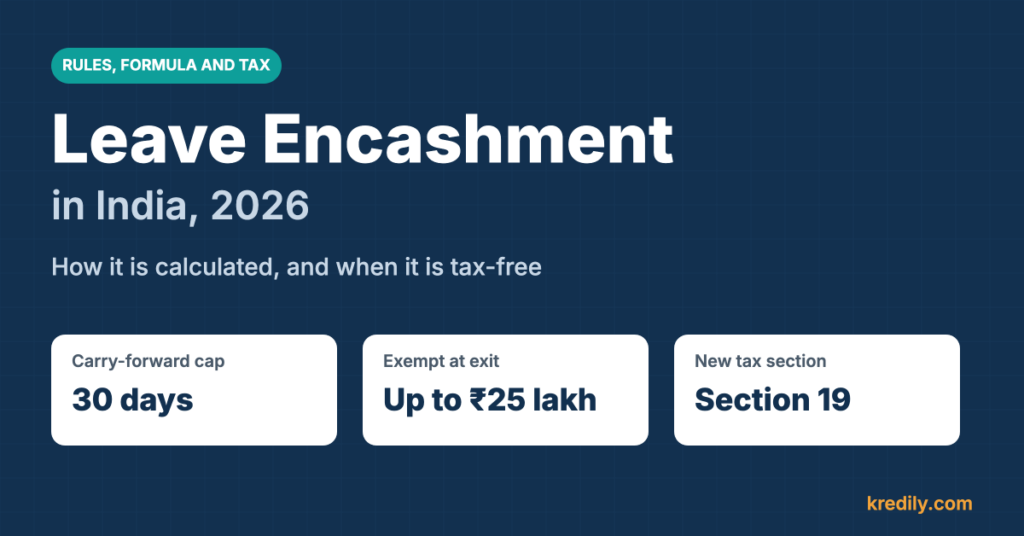
Simply put, leave encashment is the cash an employee receives for earned leave they have not used. It happens in three situations: at the end of the year, when a leave balance crosses the carry-forward cap, and when the employee leaves the company. The amount is usually leave days multiplied by a daily wage of basic plus DA. Tax depends on timing. Leave encashment during service is fully taxable, while the amount received at retirement or resignation is exempt up to ₹25 lakh for private sector employees.
The labour codes made leave encashment more common. Under the OSH Code, employers must now pay out earned leave above 30 days at year end instead of letting it lapse. So employers need a clear policy and a correct formula, and employees need to know how the tax works.
Leave encashment at a glance
| Point | Rule in 2026 |
|---|---|
| What can be encashed | Unused earned or privilege leave (casual and sick leave usually cannot) |
| Carry-forward cap for workers | 30 days under the OSH Code |
| Above the cap | Must be encashed at the end of the calendar year |
| On resignation or retirement | Unused earned leave is paid in the full and final settlement |
| Usual formula | (Basic + DA) ÷ 26 or 30 × leave days |
| Tax during service | Fully taxable as salary |
| Tax at retirement or resignation | Private sector: exempt up to ₹25 lakh; government: fully exempt |
| Tax law | Section 19 of the Income-tax Act, 2025 (earlier section 10(10AA)) |
What is leave encashment?
Leave encashment means converting unused paid leave into money. Instead of taking the days off, the employee receives their daily wage for them.
In practice, it usually applies only to earned leave, also called privilege or annual leave. Casual leave and sick leave normally lapse at year end and cannot be encashed, unless the company policy says otherwise.
Leave encashment happens at three points:
- During service, at year end. When a balance crosses the carry-forward cap, or when the policy lets employees encash leave each year.
- On resignation or termination. The employer pays unused earned leave in the full and final settlement.
- On retirement. The employer pays out the accumulated balance, often as a large lump sum.
Leave encashment rules under the labour codes
The OSH Code, 2020 changed leave rules for workers across India. Three rules matter for encashment:
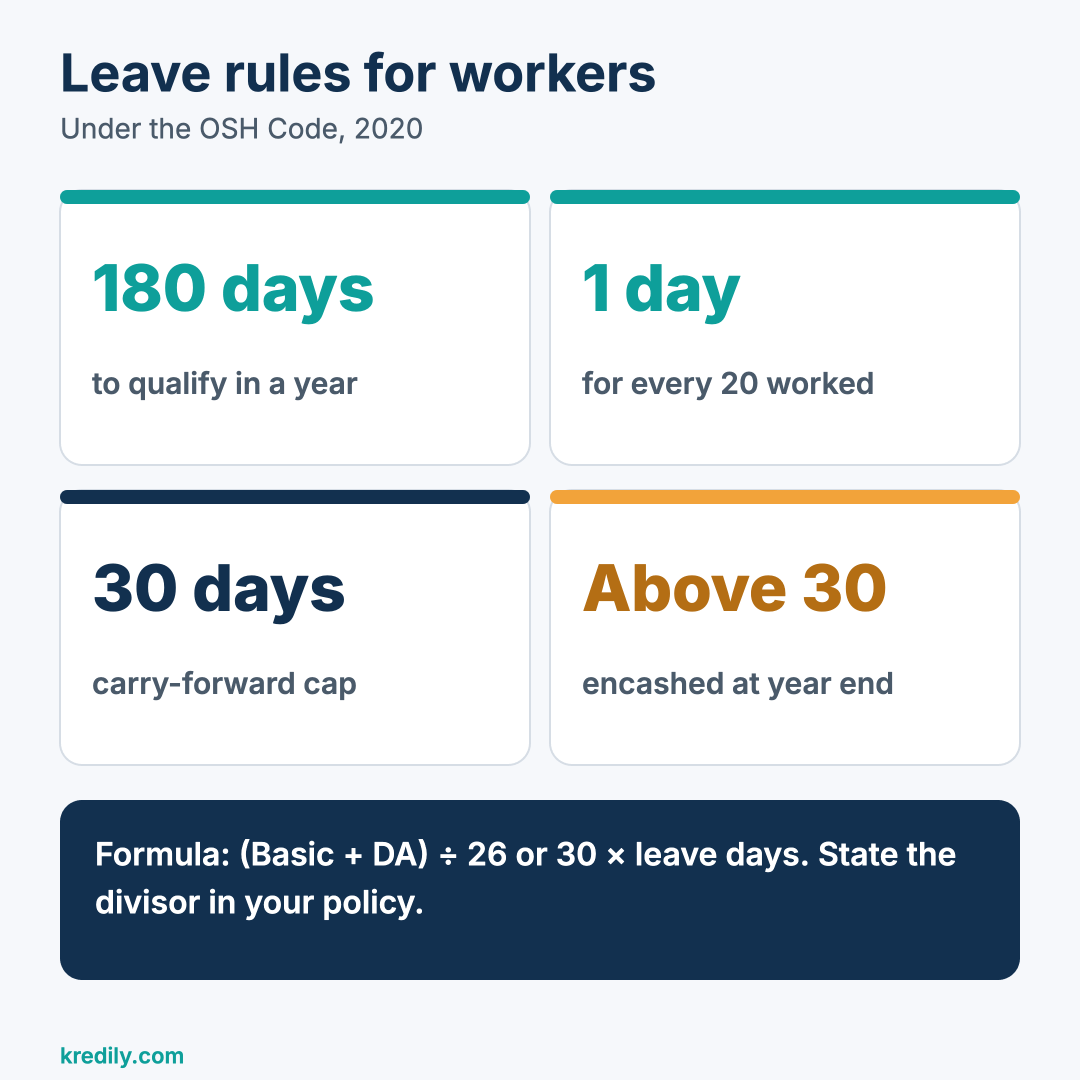
- Eligibility. A worker who has worked at least 180 days in a calendar year is entitled to annual leave, earning one day for every 20 days worked.
- Carry-forward cap. Workers can carry up to 30 days of unused leave into the next calendar year.
- Compulsory encashment. Employers must encash leave above 30 days at the end of the calendar year. Workers can also choose to encash their leave at year end rather than carry it forward.
So for covered workers, leave can no longer simply lapse above the cap. Employers have to pay for it.
Managers and senior staff who fall outside the definition of “worker” follow their company leave policy and their state’s Shops and Establishments rules instead. Many companies apply the same 30-day cap to everyone for simplicity.
How to calculate leave encashment
The basic formula is simple:
Leave encashment = daily wage × number of leave days encashed
Where the daily wage is usually:
Daily wage = (Basic + DA) ÷ 26 or 30
Companies use either 26 (working days) or 30 (calendar days) as the divisor, and the leave policy should state which. Under the labour codes, employers calculate encashment for workers on wages as defined in the Code on Wages, so check that excluded allowances do not cross half of total pay.
Example 1: year-end encashment
Rahul’s basic plus DA is ₹30,000 a month. At the end of 2026, his earned leave balance is 36 days. The cap is 30 days, so his employer must encash 6 days. His company divides by 30.
| Step | Working | Result |
|---|---|---|
| Daily wage | ₹30,000 ÷ 30 | ₹1,000 |
| Days above the cap | 36 − 30 | 6 days |
| Leave encashment | ₹1,000 × 6 | ₹6,000 |
He receives the ₹6,000 with his salary, and it is fully taxable because he received it during service.
Example 2: encashment on resignation
Priya resigns with 22 days of unused earned leave. Her basic plus DA is ₹52,000 a month, and her company divides by 26.
| Step | Working | Result |
|---|---|---|
| Daily wage | ₹52,000 ÷ 26 | ₹2,000 |
| Leave encashment | ₹2,000 × 22 | ₹44,000 |
The ₹44,000 goes into her full and final settlement. Because she received it on resignation, it qualifies for the tax exemption explained below.
Is leave encashment taxable?
It depends on when you receive it and who your employer is.
| Situation | Tax treatment |
|---|---|
| During service (year-end or annual encashment) | Fully taxable as salary, for all employees |
| Government employee at retirement | Fully exempt |
| Private sector employee at retirement or resignation | Exempt up to the lowest of four limits, with a ₹25 lakh lifetime ceiling |
| Encashment received by a legal heir after death | Not taxable as salary |
The exemption for non-government employees was earlier in section 10(10AA) of the Income-tax Act, 1961. From 1 April 2026, it sits in section 19 of the Income-tax Act, 2025, with the same ₹25 lakh limit. The exemption is available under both the old and the new tax regime.
The four-limit test for private sector employees
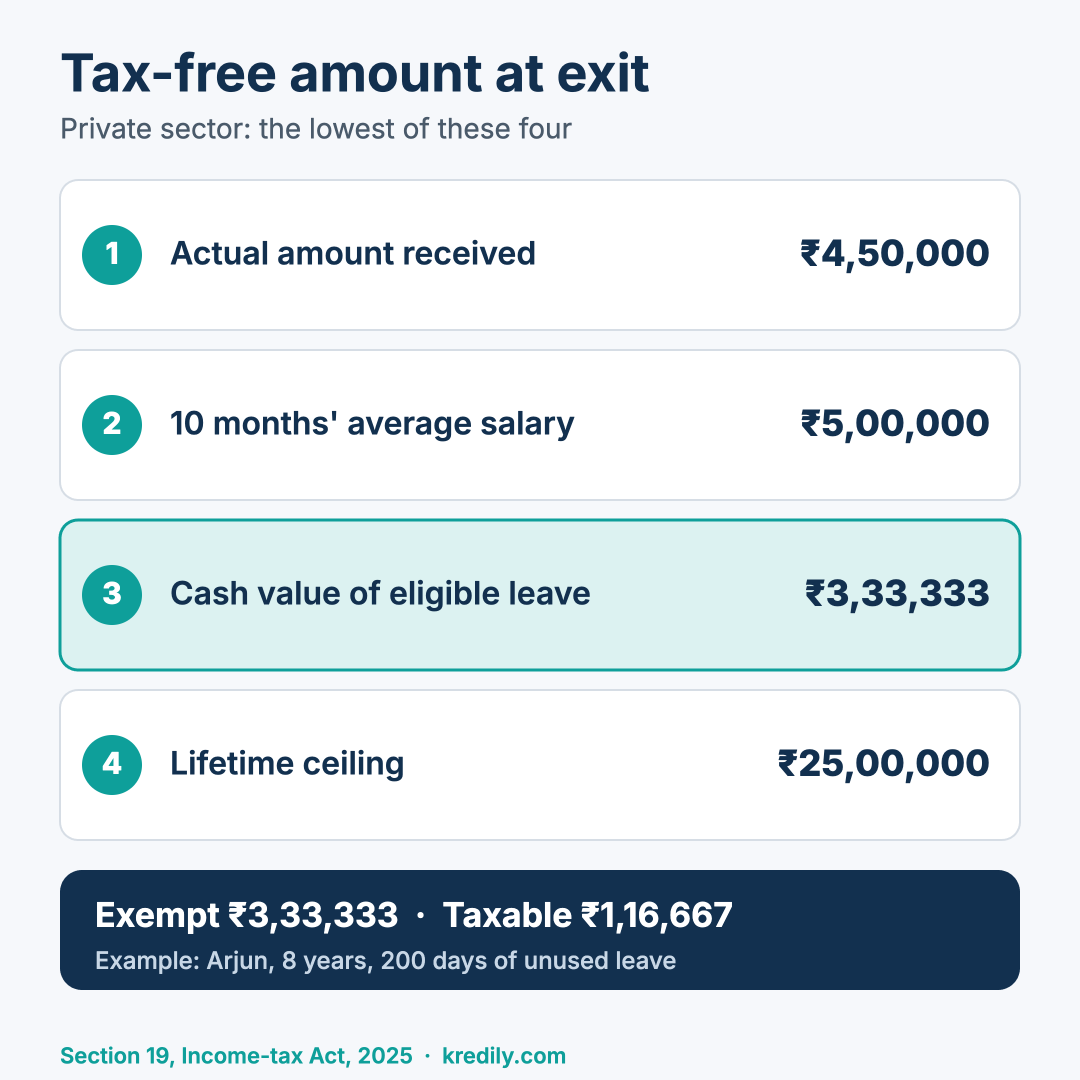
When a private sector employee receives leave encashment at retirement or resignation, the exempt amount is the lowest of these four:
- The actual leave encashment received.
- 10 months’ average salary.
- Cash equivalent of unused leave, counting at most 30 days of leave for each completed year of service.
- ₹25 lakh, reduced by any leave encashment exemption claimed earlier from any employer.
Here, “salary” means basic pay, DA that forms part of retirement benefits, and any commission based on a fixed percentage of turnover, averaged over the last 10 months of service.
Example 3: tax on encashment at resignation
Arjun resigns after 8 completed years. He has 200 days of unused earned leave, which is within the limit of 30 days for each year of service (240 days). His company pays him ₹4,50,000 as leave encashment. His average monthly salary (basic plus DA) for the last 10 months is ₹50,000, and he has never claimed this exemption before.
| Limit | Working | Amount |
|---|---|---|
| 1. Actual amount received | ₹4,50,000 | |
| 2. 10 months’ average salary | ₹50,000 × 10 | ₹5,00,000 |
| 3. Cash equivalent of eligible leave | 200 days × (₹50,000 ÷ 30) | ₹3,33,333 |
| 4. Lifetime ceiling | Nothing claimed earlier | ₹25,00,000 |
| Exempt amount | Lowest of the four | ₹3,33,333 |
So ₹3,33,333 is tax-free and the remaining ₹1,16,667 is taxable as salary. The gap arises because his company pays encashment on a wider wage base than the average salary the tax rule uses.
Leave encashment and TDS
Employers deduct TDS on the taxable part of leave encashment along with salary. For year-end encashment, the full amount is added to that month’s taxable salary. For encashment at exit, the employer applies the exemption first and deducts TDS only on the balance. The amount also shows in Form 130, the salary TDS certificate that replaced Form 16 under the new Income-tax Act. Our guide to TDS on salary explains the monthly calculation.
What to include in a leave encashment policy
| Policy element | What to decide |
|---|---|
| Eligible leave | Usually earned leave only |
| Carry-forward cap | 30 days for workers under the OSH Code |
| Year-end encashment | Compulsory above the cap; optional below it, if you allow it |
| Formula | Basic + DA, divided by 26 or 30 |
| Exit encashment | Paid in the full and final settlement |
| Maximum on exit | Any cap must still respect statutory rights |
| Timing | Year-end payout month and settlement timelines |
| Records | Leave balances and encashment in the leave and wage registers |
Also, check one point carefully: some older policies cap encashment on exit at 15 or 20 days. For workers covered by the OSH Code, a cap cannot override the statutory carry-forward and encashment rules.
Common leave encashment mistakes
- Letting leave lapse above 30 days instead of encashing it for workers.
- Using gross salary as the base, which overpays. Basic plus DA is the usual base.
- Using basic alone when the 50% wage rule adds allowances back.
- Not stating the divisor (26 or 30), which causes disputes.
- Claiming tax exemption on year-end encashment, which is fully taxable.
- Missing it in the full and final settlement, which delays the exit payout.
Leave encashment checklist
- Track earned leave balances for every employee, month by month.
- At year end, encash any balance above 30 days for covered workers.
- State the formula and divisor in the leave policy.
- Include unused earned leave in every full and final settlement.
- Apply the four-limit test for exemption at exit, and deduct TDS on the rest.
- Show encashment in Form 130 and the salary register.
For the rest of your leave rules, see our HR leave policy guide, and for the full exit process, our guide to full and final settlement.
Want leave balances and encashment calculated automatically? Kredily tracks earned leave, applies your encashment rules and adds the payout and TDS to payroll and the full and final settlement. Start free on Kredily
Frequently asked questions
What is leave encashment?
It is the cash paid to an employee for unused earned leave, usually calculated as leave days multiplied by a daily wage of basic plus DA.
How is leave encashment calculated?
Divide monthly basic plus DA by 26 or 30 to get the daily wage, then multiply by the number of leave days being encashed.
Is leave encashment taxable?
During service, it is fully taxable. At retirement or resignation, government employees are fully exempt, while private sector employees are exempt up to the lowest of four limits, with a ₹25 lakh lifetime ceiling.
What is the leave encashment exemption limit in 2026?
₹25 lakh for non-government employees, under section 19 of the Income-tax Act, 2025 (earlier section 10(10AA)). The limit applies across all employers over a lifetime.
Is leave encashment mandatory under the new labour codes?
For workers covered by the OSH Code, leave above the 30-day carry-forward cap must be encashed at the end of the calendar year. Employers also normally pay out unused earned leave on exit.
Can casual leave or sick leave be encashed?
Usually not. Most companies allow encashment of earned leave only, unless their policy says otherwise.
Is leave encashment exempt under the new tax regime?
Yes. The exemption at retirement or resignation is available under both the old and the new tax regime.
When is leave encashment paid on resignation?
It is paid in the full and final settlement. Under the Code on Wages, employers must pay dues on separation within two working days.
How we checked this guide
We checked the leave rules against legal analyses of the OSH Code, 2020, and the tax rules against the Income-tax Act, 2025 and CBDT Notification 31/2023, as summarised by tax and legal publications. We present company policy choices such as the divisor as options, not legal requirements.
Sources and notes
- Annual leave eligibility, the 30-day carry-forward cap and year-end encashment under the OSH Code, as summarised by EY India and Mondaq.
- Leave encashment exemption moving from section 10(10AA) of the 1961 Act to section 19 of the Income-tax Act, 2025, as discussed by TaxTMI.
- The four-limit test and the ₹25 lakh limit under CBDT Notification 31/2023, as summarised by Tax Garden.
- Code on Wages, 2019, on wages and payment of dues on separation, India Code.
This guide is for general information. It is not legal or tax advice. For your own case, speak to your tax adviser.