


Checked against the OSH Code, 2020 and the OSH (Central) Rules, 2026 on annual leave.
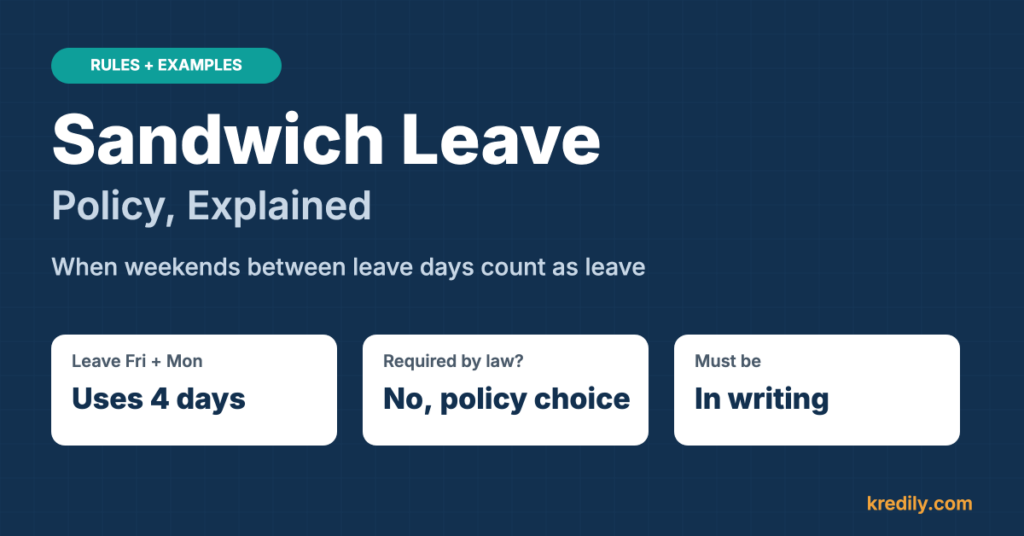
A sandwich leave policy treats the weekends or holidays that fall between two leave days as leave too. Take Friday and Monday off, for example, and the Saturday and Sunday in between count as leave, so you use four days instead of two. No Indian law requires a sandwich rule, and none bans it. It is a company policy choice, so it only applies if your leave policy says so clearly.
Employees often dislike the rule, and HR teams often apply it inconsistently. Both problems disappear when the policy spells out exactly when the rule applies, which leave types it covers, and how it affects pay. This guide covers all three, with worked examples and a sample clause you can use.
Sandwich leave policy at a glance
| Point | Common practice |
|---|---|
| What it does | Counts weekends or holidays between two leave days as leave |
| Legal status | Not required or banned by law; a company policy choice |
| Where it must appear | In the written leave policy or employment terms |
| Leave types usually covered | Casual leave, earned leave and loss of pay |
| Usually excluded | Maternity leave, and often sick leave with a medical certificate |
| When it does not apply | When the leave days are not on both sides of the break |
| Pay effect | Sandwiched days count as paid leave, or as unpaid days if the leave is LOP |
What is sandwich leave?
Sandwich leave happens when a weekly off or a public holiday sits between two days of leave, like the filling in a sandwich. Under a sandwich leave policy, the break in the middle is counted as leave as well.
Here is the simplest case. An employee applies for leave on Friday and Monday:
- Without a sandwich rule: they use 2 days of leave and get a 4-day break.
- With a sandwich rule: they use 4 days of leave, because Saturday and Sunday are counted too.
The rule exists to stop people stretching short leave into long breaks around weekends and festivals, which can leave teams short-staffed for days at a time.
Is a sandwich leave policy legal in India?
No central law requires a sandwich rule, and none prohibits it. So it is legal as a company policy, as long as it is written down and applied consistently.
Three conditions matter in practice:
- It must be in writing. Put it in the leave policy, the employee handbook or the appointment terms, so employees know before they apply.
- It must respect statutory leave. Under the OSH Code, 2020, workers who have worked at least 180 days in a calendar year earn one day of annual leave for every 20 days worked. They can carry forward up to 30 days, and any excess must be encashed at year end. A sandwich rule decides how leave is counted, but it cannot reduce these entitlements.
- It must be applied the same way to everyone. Applying it to some teams and not others invites disputes.
Some states’ Shops and Establishments rules and some company contracts add their own conditions. So check your state rules before you roll the policy out.
How sandwich leave works: examples
The rule only applies when leave falls on both sides of the non-working days.
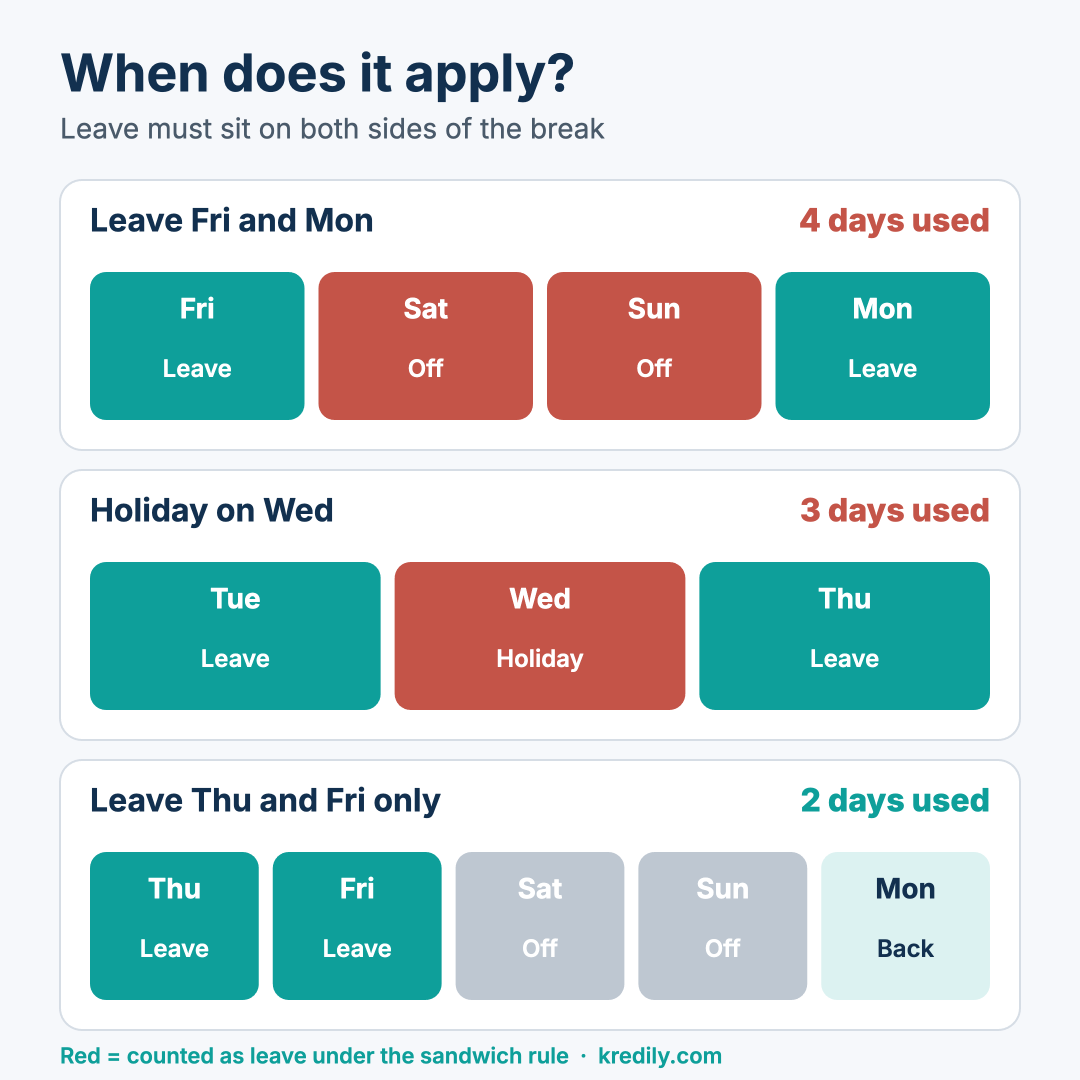
Example 1: leave on Friday and Monday
An employee takes leave on Friday and Monday. The weekend sits between them, so it is sandwiched.
| Day | Fri | Sat | Sun | Mon |
|---|---|---|---|---|
| Status | Leave | Weekly off | Weekly off | Leave |
| Counted as leave | Yes | Yes | Yes | Yes |
Leave used: 4 days.
Example 2: a holiday in the middle of the week
A public holiday falls on Wednesday. The employee takes leave on Tuesday and Thursday.
| Day | Tue | Wed | Thu |
|---|---|---|---|
| Status | Leave | Holiday | Leave |
| Counted as leave | Yes | Yes | Yes |
Leave used: 3 days.
Example 3: leave on only one side
The employee takes leave on Thursday and Friday, then returns on Monday.
| Day | Thu | Fri | Sat | Sun | Mon |
|---|---|---|---|---|---|
| Status | Leave | Leave | Weekly off | Weekly off | Present |
| Counted as leave | Yes | Yes | No | No | No |
Leave used: 2 days. The weekend is not sandwiched, because the employee is back at work on Monday.
Example 4: half days
Policies differ here, so decide in advance. A common approach is to apply the rule only when both sides are full-day leave. So a half day on Friday and full leave on Monday would not sandwich the weekend.
Sandwich leave and loss of pay
The rule matters most for pay when the leave is unpaid. If an employee has no leave balance and takes Friday and Monday as loss of pay (LOP), the sandwich rule turns the whole weekend into unpaid days too.
Here is the effect for an employee earning ₹30,000 a month, where the company calculates daily pay on a 30-day month:
| Approach | LOP days | Deduction |
|---|---|---|
| Without a sandwich rule | 2 (Friday and Monday) | ₹2,000 |
| With a sandwich rule | 4 (Friday to Monday) | ₹4,000 |
Illustrative. Daily rate = ₹30,000 ÷ 30 = ₹1,000. Your payroll may use a different day count.
Because the money difference is real, write the LOP treatment into the policy explicitly. Under the Code on Wages, deductions for absence must be in proportion to the period of absence, so make sure your policy and payroll calculation tie up. Our guide to loss of pay explains how LOP is calculated.
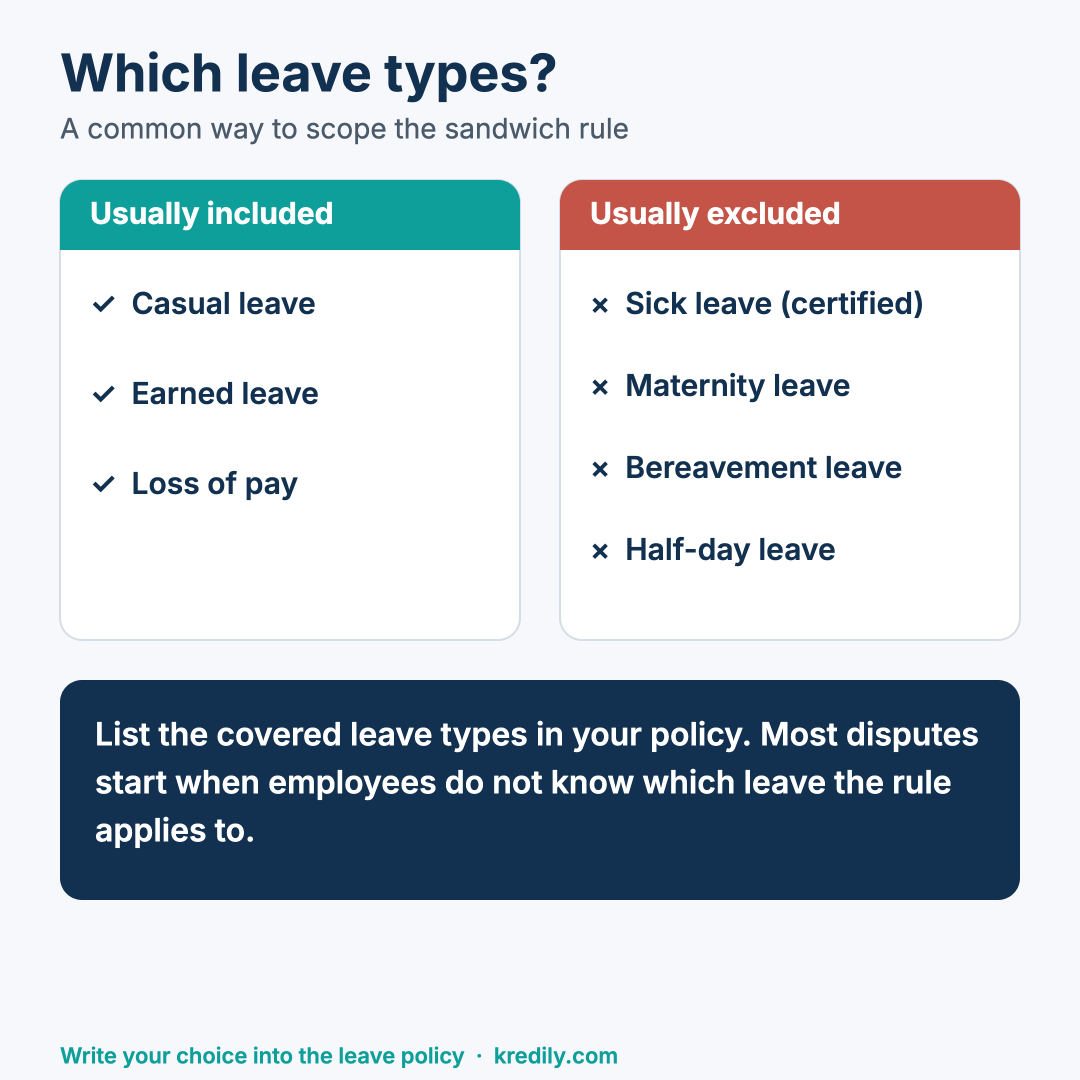
Which leave types should the sandwich rule cover?
| Leave type | Usually included? | Why |
|---|---|---|
| Casual leave | Yes | Short, planned absences are the main target of the rule |
| Earned or privilege leave | Often | Applies when long leave is split around weekends |
| Loss of pay | Often | Prevents unpaid leave being stretched for free |
| Sick leave with a certificate | Often excluded | Illness is not planned, so many companies exempt it |
| Maternity leave | Excluded | Governed by the Code on Social Security and counted in calendar days anyway |
| Bereavement or emergency leave | Usually excluded | Applying the rule here feels unfair and harms trust |
Whatever you choose, list it in the policy. Most disputes come from employees not knowing which leave types the rule covers.
Pros and cons of a sandwich leave policy
Why companies use it:
- It discourages stretching two days of leave into four days away.
- It keeps staffing steadier around weekends and festivals.
- It makes long weekends a planned choice rather than a habit.
Why some companies drop it:
- Employees often see it as unfair, which hurts morale.
- It can push people to take sick leave or skip work instead.
- It adds complexity for HR if leave is tracked manually.
Many growing companies settle in the middle. They apply the rule to casual leave and LOP only, exclude sick and emergency leave, and leave earned leave out to reward planned holidays.
Sample sandwich leave policy clause
You can adapt this clause for your leave policy.
Sandwich leave. If an employee takes leave on the working days immediately before and after a weekly off or a declared holiday, the weekly off or holiday in between will be counted as leave. This applies to casual leave and loss of pay. It does not apply to sick leave supported by a medical certificate, maternity leave or bereavement leave. Half-day leave on either side does not trigger this rule. Where the leave is loss of pay, the sandwiched days will also be treated as loss of pay.
Change the leave types and the half-day rule to match your choices, and share the policy with every employee before you enforce it.
How to roll out a sandwich leave policy
- Decide the scope. Choose the leave types it covers and the ones it excludes.
- Decide the edge cases. Half days, holidays and LOP all need a clear answer.
- Write it into the leave policy. Use plain language and add an example.
- Tell employees before it starts. Give notice, and do not apply it to leave already approved.
- Set it up in your system. Manual sandwich calculations go wrong, especially with holidays.
- Apply it consistently. Exceptions for some teams create disputes.
Our HR leave policy guide covers the other leave rules your policy needs.
Common sandwich leave mistakes
- Applying it without a written policy, which makes deductions hard to defend.
- Not saying which leave types it covers, so every case becomes an argument.
- Treating one-sided leave as sandwiched, as in Example 3 above.
- Forgetting holidays, and applying it only to weekends.
- Counting the days wrongly in payroll when the leave is LOP.
- Applying it to sick or bereavement leave without thinking about how it feels to employees.
Want sandwich rules applied automatically? Kredily’s leave and attendance app applies your leave rules, holidays and weekly offs, and passes the result straight to payroll. Start free on Kredily
Frequently asked questions
What is a sandwich leave policy?
It is a leave rule that counts weekends or holidays falling between two leave days as leave. For example, leave on Friday and Monday uses four days of leave instead of two.
Is sandwich leave legal in India?
Yes, as a company policy. No law requires or bans it, but it should be written into the leave policy, applied consistently, and must not reduce statutory leave entitlements under the OSH Code.
Does sandwich leave apply to sick leave?
It depends on the policy. Many companies exclude sick leave supported by a medical certificate, because illness is not planned.
Does the sandwich rule apply if I take leave on only one side of a weekend?
No. The rule applies only when leave falls on both sides of the weekend or holiday. Leave on Friday with a return on Monday uses one day.
How does sandwich leave affect salary?
If the leave is paid, the sandwiched days use your leave balance. If the leave is loss of pay, the sandwiched days become unpaid too, which increases the salary deduction.
Can an employer apply the sandwich rule without telling employees?
It should not. The rule must be part of a written policy that employees can see before they apply for leave. Applying it without notice invites disputes.
Does sandwich leave apply to half days?
Only if your policy says so. Many companies apply it only when the leave on both sides is a full day.
How we checked this guide
We checked the statutory leave points against legal analyses of the OSH Code, 2020 and the OSH (Central) Rules, 2026. The sandwich rule itself comes from company practice, not statute, so the guide presents it as a policy choice and gives options rather than a single required answer.
Sources and notes
- Annual leave under the OSH Code: eligibility after 180 days, one day for every 20 days worked, as summarised by Mondaq.
- Carry forward of up to 30 days and encashment of the excess at year end, as summarised by EY India and Legal 500.
- Leave carry-forward and encashment under the new labour codes, as reported by BusinessToday.
- Code on Wages, 2019, on deductions for absence from duty, India Code.
This guide is for general information. It is not legal advice. Adapt the sample clause with your HR or legal adviser.