


Last updated: 9 November 2026. Checked against the Code on Wages, 2019 and the August 2026 bonus notifications.
Statutory bonus is the minimum yearly bonus that Indian employers with 20 or more workers must pay to eligible staff. It covers anyone who earns wages of ₹21,000 a month or less and worked at least 30 days in the year. Each of them must get at least 8.33% of their bonus wages. For the year that ended on 31 March 2026, the money has to reach their bank account by 30 November 2026.
That deadline is now only weeks away, so the window for fixing errors is short.
This guide skips the history lesson. Instead, it covers who qualifies, how to work out the amount, what changed under the new law, and the mistakes that show up most often when payroll teams rush in November.
Statutory bonus at a glance
| Point | Rule |
|---|---|
| Law | Chapter IV (sections 26 to 41) of the Code on Wages, 2019, in force from 21 November 2025 |
| Applies to | Establishments with 20 or more persons on any day of the accounting year |
| Eligible employees | Wages up to ₹21,000 a month and at least 30 days worked |
| Calculation base | Actual wages, capped at the higher of ₹7,000 and the minimum wage |
| Minimum bonus | 8.33% of bonus wages or ₹100, even in a loss year |
| Maximum bonus | 20% of bonus wages, depending on allocable surplus |
| Deadline | Eight months from year end: 30 November 2026 for FY 2025-26 |
| Payment mode | Credit to the employee’s bank account |
What is statutory bonus?
Statutory bonus is a legal entitlement, not a reward for good work. Think of it as a share of the business’s surplus that the law sets aside for lower-paid employees. A minimum amount is due even when the year produced no surplus at all.
For decades, these rules sat in the Payment of Bonus Act, 1965. Parliament folded that Act into the Code on Wages, 2019, which came fully into force on 21 November 2025. Since then, bonus has lived in Chapter IV of the Code.
Most of the old structure survived. The 8.33% floor is still there, and so are the 20% cap and the eight-month deadline. What moved is the source of the numbers: ₹21,000 and ₹7,000 are no longer printed in the law, and the government now fixes them by notification.
A Diwali gift is a different matter, though. It counts towards statutory bonus only if you pay it as an advance against bonus and adjust it later.
Which businesses must pay statutory bonus?
The bonus chapter covers any establishment that employed 20 or more persons on any day during the accounting year. So a single day at 20 is enough to bring you in. Casual and part-time staff on your rolls also count towards that number.
Four points settle most edge cases:
- Branches count together. Departments and branches are one establishment for bonus purposes, unless a branch keeps its own balance sheet and profit and loss account.
- New businesses get some breathing room. For its first five accounting years after it starts selling goods or services, a new business pays bonus only in years when it makes a profit.
- Some employers sit outside the chapter. Government departments, local authorities, the RBI and LIC are excluded, and so are universities, schools and hospitals not run for profit.
- Public sector units are covered only in narrow cases. The main one is where at least 20% of their income comes from competing with private businesses.
Who is eligible for statutory bonus?
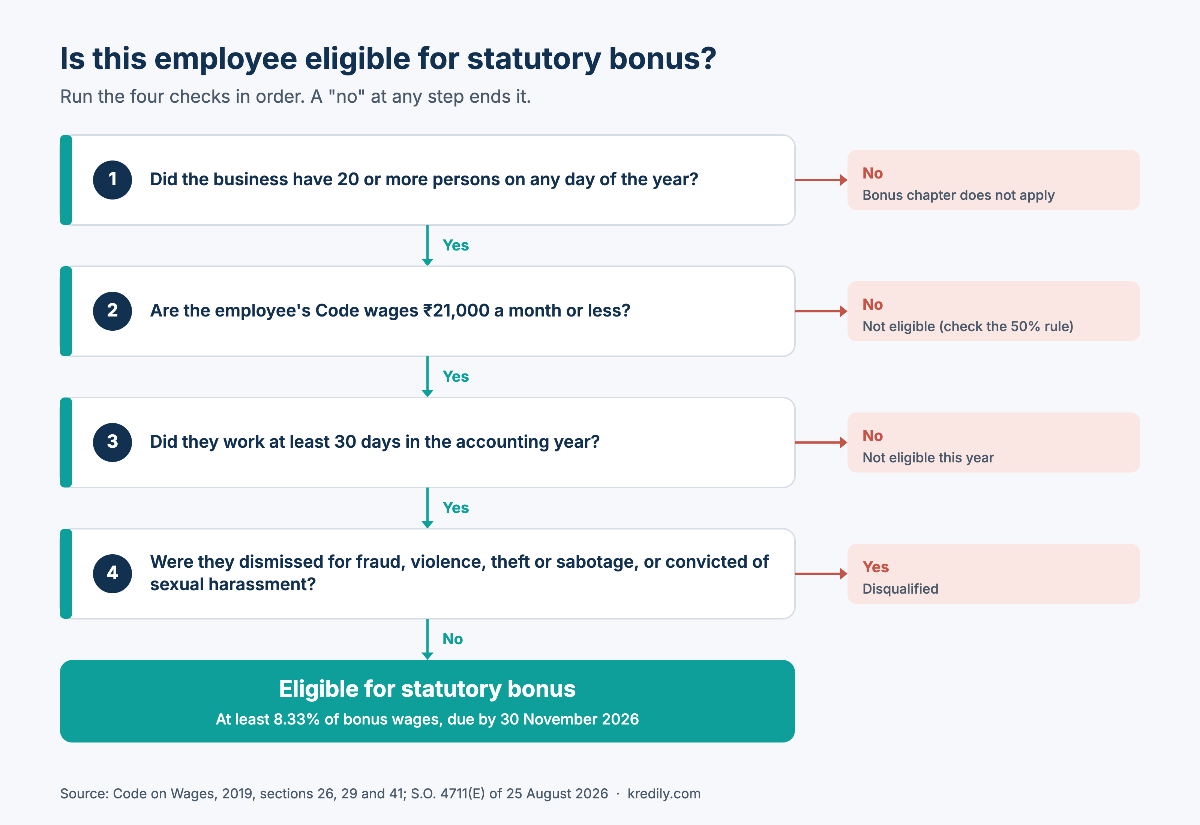
An employee qualifies when both of these are true:
- Their wages are not more than ₹21,000 a month.
- They worked at least 30 days in the accounting year.
Paid leave, paid maternity leave, lay-off and absence due to a work injury all count as days worked. So a long medical or maternity leave does not knock anyone out.
People who left during the year qualify too. Take an employee who resigned in December after eight months of work: they still earn bonus for those eight months. Pay it with the full and final settlement if the year has closed, or with everyone else’s bonus if it has not. Bonus is separate from gratuity, which has its own five-year rule.
Only dismissal can take bonus away, and only on four grounds: fraud, riotous or violent behaviour on the premises, theft, misappropriation or sabotage of company property, and a conviction for sexual harassment. That fourth ground is new; the old Act never had it. Resignation, weak performance or a notice period buyout, by contrast, do not disqualify anyone.
Wages here means Code wages, not gross salary
The ₹21,000 test runs on wages as the Code defines them. Broadly, that is basic pay, dearness allowance and retaining allowance. HRA, conveyance and overtime stay out, and so does the headline CTC figure.
There is a twist, though. When those excluded items add up to more than half of total pay, the excess goes back into wages. A salary structure with a low basic can push an employee over the limit without anyone noticing.
| Employee | Monthly gross | Basic + DA | Code wages | Eligible? |
|---|---|---|---|---|
| A | ₹30,000 | ₹15,000 | ₹15,000 | Yes |
| B | ₹40,000 | ₹16,000 | ₹20,000 | Yes |
| C | ₹46,000 | ₹19,000 | ₹23,000 | No |
Figures are illustrative.
Look at employee C. On basic pay alone, C looks eligible, but C’s allowances of ₹27,000 are ₹4,000 more than half of total pay, and that ₹4,000 gets added back. Code wages become ₹23,000, which puts C outside statutory bonus.
Our New Labour Codes guide explains this 50% rule in detail. The same wage definition now drives the new ₹25,000 PF wage ceiling.
Central or state: whose numbers apply?
The Code lets the “appropriate government” fix both the eligibility limit and the calculation ceiling. On 25 August 2026, the Centre issued two notifications, each effective from 21 November 2025:
- S.O. 4711(E) sets eligibility: employees with wages up to ₹21,000 a month get bonus.
- S.O. 4710(E) sets the calculation base. Where wages are above ₹7,000, bonus is worked out on ₹7,000 or the Central minimum wage, whichever is higher.
These two notifications apply only where the Centre is the appropriate government. That covers railways, mines, oil fields, major ports, air transport and telecom, plus banks, insurers, central PSUs and their contractors.
Most private factories, shops and offices answer to their state government instead. So check whether your state has issued its own bonus notification. Until it does, many employers keep using the familiar pair: ₹21,000 for eligibility, and the higher of ₹7,000 and the state minimum wage for calculation. It matches how the rule has worked for years, but it is a working position rather than settled law. Confirm it with your labour consultant before you run payroll.
How to calculate statutory bonus
The calculation takes four steps, and you repeat them for each employee and each month.
- Confirm eligibility. Code wages are ₹21,000 or less, and the employee worked at least 30 days.
- Find each month’s bonus wage. Use actual wages if they are ₹7,000 or less. Above that, use the higher of ₹7,000 and the applicable minimum wage.
- Add up the year. Total the bonus wages for every month the employee worked.
- Apply the rate. Pay at least 8.33% of that total, and up to 20% if your allocable surplus supports it. The bonus can never fall below ₹100.
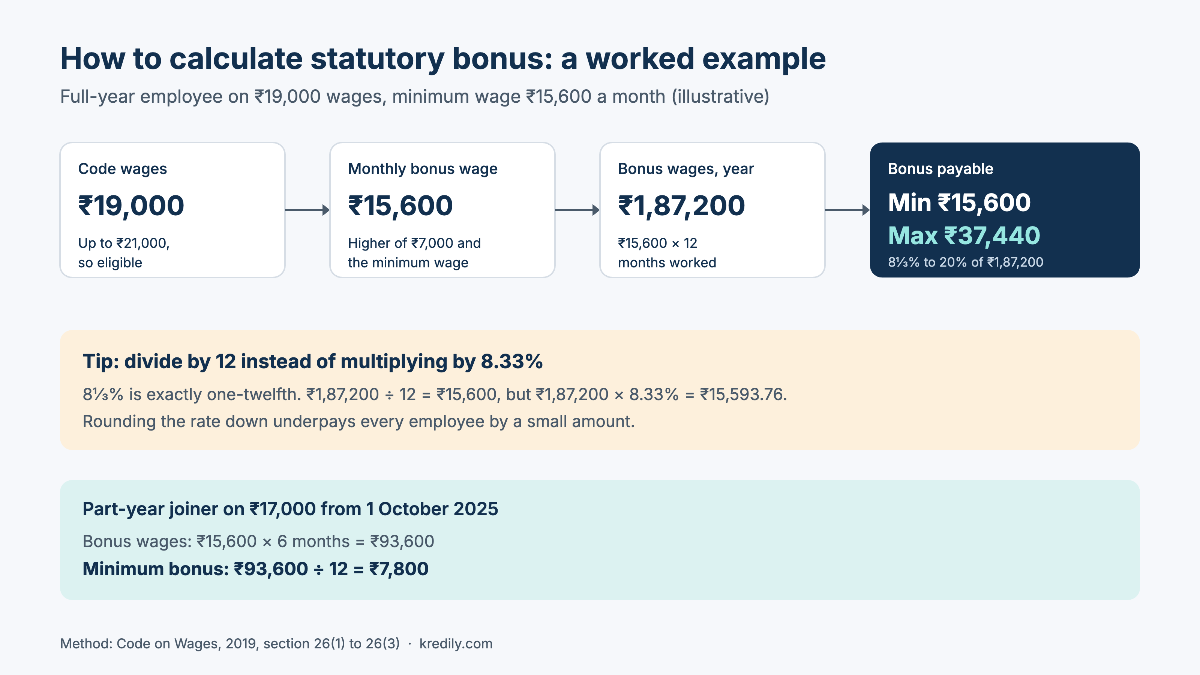
Watch the rate itself, because the law says eight and one-third per cent, which is exactly one-twelfth. Multiply by 8.33% and every payment comes out a little short: on yearly bonus wages of ₹1,87,200, the gap is ₹6.24 per employee. Dividing by 12 instead removes the problem.
Example 1: a full-year employee
Ravi is a hypothetical machine operator in a state-sphere factory. He earns wages of ₹19,000 a month and worked the whole year. For this example, assume the minimum wage for his job is ₹600 a day, or ₹15,600 a month at 26 days. In real life, use your state’s notified rate, for example from our Karnataka, Maharashtra or Tamil Nadu minimum wage pages.
| Step | Working | Result |
|---|---|---|
| Eligible? | ₹19,000 is not more than ₹21,000 | Yes |
| Monthly bonus wage | Higher of ₹7,000 and ₹15,600 | ₹15,600 |
| Bonus wages for the year | ₹15,600 × 12 | ₹1,87,200 |
| Minimum bonus | One-twelfth of ₹1,87,200 | ₹15,600 |
| Maximum bonus | 20% of ₹1,87,200 | ₹37,440 |
Minimum wages often rise mid-year when the state revises dearness allowance. If yours changed during FY 2025-26, use the rate in force for each month rather than one figure for the whole year.
Example 2: a mid-year joiner
Meena joined the same factory on 1 October 2025 at ₹17,000 a month, so she worked six months of the accounting year. Her monthly bonus wage is again ₹15,600, which makes her bonus wages ₹93,600 for the year. One-twelfth of that is ₹7,800, so that is her minimum bonus.
Loss-of-pay days reduce wages earned, and with them the bonus. Paid leave, however, does not.
Minimum bonus, maximum bonus and allocable surplus
The 8.33% minimum is due whether or not the business made a profit. Anything above it depends on the allocable surplus.
Here is the short version of that calculation. The employer starts with gross profit and deducts depreciation, direct taxes and a few other prescribed items to reach the available surplus. The allocable surplus is 67% of that figure, or 60% for a banking company. When it exceeds the total minimum bonus, the employer has to pay more, up to 20% of each employee’s bonus wages.
Good and bad years even out through two mechanisms:
- Set-on. Surplus left after paying the 20% maximum carries forward for up to four years. The carry-forward cannot exceed 20% of the total wage bill.
- Set-off. When there is no surplus, or not enough for the minimum bonus, the shortfall carries forward for up to four years and later surpluses absorb it.
Bonus linked to production or productivity is allowed by agreement or settlement, but the total, minimum bonus included, still cannot cross 20% of wages earned.
Most small and mid-sized employers pay the 8.33% minimum and stop there. But if you pay more, keep your allocable surplus working on file.
When is statutory bonus due?
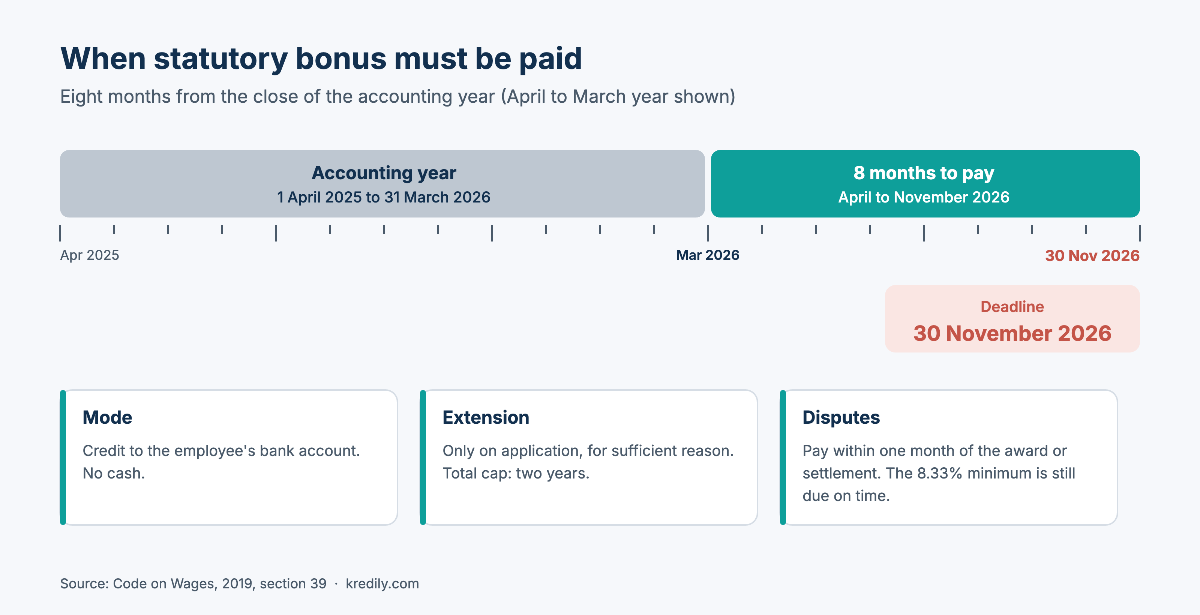
Bonus must be credited to the employee’s bank account within eight months of the close of the accounting year. For an April to March year, bonus for FY 2025-26 is due by 30 November 2026.
Cash is out, because the Code requires a bank credit. Three more rules also apply:
- Extensions. The appropriate government can extend the deadline if the employer applies and shows sufficient reason, but never beyond two years in total.
- Disputes. With a dispute pending, payment is due within one month of the award or settlement taking effect. A dispute only about a higher rate does not delay the 8.33% minimum, which is still due within the eight months.
- Diwali. No central rule ties bonus to Diwali. Some state labour departments do issue their own directions in the festive season, so check yours.
What you can adjust or deduct from the bonus
Two adjustments are allowed, both within the same accounting year:
- Advance or customary bonus. Any puja bonus, festival bonus or advance part-payment can be set against the amount due.
- Loss from misconduct. If an employee’s proven misconduct caused the employer a financial loss, that loss can come out of the same year’s bonus.
Nothing else is allowed. Recovering loans, notice pay or other dues from statutory bonus invites a claim.
Bonus is salary income for tax, so include it in that month’s TDS on salary calculation. Showing it as a separate line on the salary slip also gives you the paper trail an inspector will ask for.
Penalties for not paying statutory bonus
Section 54 of the Code sets the penalties. Paying an employee less than the amount due can lead to a fine of up to ₹50,000. A repeat within five years can bring jail for up to three months, a fine of up to ₹1 lakh, or both. Poor record-keeping carries its own fine of up to ₹10,000.
The unpaid bonus does not disappear either. The employee can still claim it, on top of any penalty.
Five statutory bonus mistakes to avoid
- Testing eligibility on basic pay alone. The 50% rule can push Code wages above ₹21,000.
- Using ₹7,000 when the minimum wage is higher. Minimum wages across India are now far above ₹7,000, so this underpays almost everyone.
- Leaving out people who resigned. Anyone with 30 days of work in the year has a right to their share.
- Rounding eight and one-third per cent down to 8.33%. Divide by 12.
- Calling a Diwali gift the statutory bonus. It counts only when recorded as an advance against bonus.
Statutory bonus checklist for November 2026
- Confirm that headcount reached 20 on at least one day in FY 2025-26.
- Recheck Code wages, with the 50% rule, for everyone near ₹21,000.
- List every employee with 30 or more days of work, leavers included.
- Pull the minimum wage for each role, month by month, especially where the state revised it.
- Decide the rate: the 8.33% minimum, or more if allocable surplus allows.
- Set off any festival advance or interim bonus already paid.
- Credit the bonus to bank accounts by 30 November 2026.
- Update the bonus register and keep your workings on file.
Bonus is still only one date among many, so our annual compliance checklist lists the rest.
Want a quick check? Run your numbers through Kredily’s free bonus calculator. Inside Kredily payroll software, eligibility tracking, the calculation ceiling and per-employee statutory bonus are handled as part of statutory compliance, free for unlimited employees on the Free Forever plan.
Frequently asked questions
Is statutory bonus mandatory in India?
Yes, for any establishment that employed 20 or more persons on any day of the accounting year. Every employee with wages up to ₹21,000 a month and 30 days of work must get at least 8.33% of bonus wages, even in a loss year.
What is the statutory bonus limit for 2026?
Employees qualify if their wages are ₹21,000 a month or less. For anyone earning above ₹7,000, the calculation uses the higher of ₹7,000 and the applicable minimum wage. The Centre restated both figures on 25 August 2026 in S.O. 4711(E) and S.O. 4710(E).
How do you calculate statutory bonus?
Take each month’s bonus wage: actual wages, capped at the higher of ₹7,000 and the minimum wage. Add up the months worked. Pay at least one-twelfth of the total (8⅓%), and up to 20% if the allocable surplus allows.
What is the last date to pay statutory bonus in 2026?
30 November 2026, for the accounting year April 2025 to March 2026. The Code gives employers eight months from the close of the accounting year.
Do employees who resigned get statutory bonus?
Yes, if they worked at least 30 days in the accounting year. They get bonus for the period they worked. Only dismissal for fraud, violent behaviour, theft or sabotage, or a sexual harassment conviction removes the right.
Does the Payment of Bonus Act, 1965 still apply?
No. The Code on Wages replaced it on 21 November 2025. Statutory bonus now comes under Chapter IV of the Code, which kept most of the old Act’s rules.
Can statutory bonus be paid in cash?
No. The Code requires a credit to the employee’s bank account, so cash payments do not count.
Do new companies have to pay statutory bonus?
Only in profit years, for the first five accounting years after they start selling. Once that period ends, the regular rules apply.
Is statutory bonus taxable?
Yes. Bonus is salary income, and the employer deducts TDS on it along with regular salary.
How we checked this guide
We read Chapter IV of the Code on Wages, 2019 and section 54 directly, rather than relying on summaries of the old Payment of Bonus Act. We then matched every limit in this guide against the two Central notifications of 25 August 2026. The worked examples use round, illustrative wages so you can follow the arithmetic, and the minimum wage in them is an assumption, not a notified rate. We update this page when the Centre or a major state issues a new bonus notification.
Sources
All figures were checked against these sources on 8 November 2026. Labour rules change often, so confirm the latest notifications before acting.
- The Code on Wages, 2019, Chapter IV (sections 26 to 41) and section 54, India Code
- Notifications S.O. 4711(E) and S.O. 4710(E), Ministry of Labour and Employment, 25 August 2026 (Gazette of India Extraordinary Nos. 4526 and 4525)
- SCC Online report on the two notifications, 26 August 2026
This article explains the law for general information. It is not legal advice. For decisions about your own payroll, speak to your labour consultant.