


A performance appraisal is one of the main tools in performance management. It helps managers judge how people are doing, set new goals and plan their growth. Yet in many companies, appraisals run late every single cycle.
In this article, we explain what a performance appraisal is, cover the 10 most common reasons it gets delayed, and show how Kredily’s HRMS helps you fix each one.
What Is a Performance Appraisal?
A performance appraisal is a formal review of an employee’s work over a set period. Usually, the employee’s direct manager carries it out. First, it looks at how well the person handles their tasks and whether they meet agreed goals. It also highlights strengths, weak spots and room for growth.
The process typically includes:
- Employee performance review: A formal look at the employee’s work.
- Employee evaluation: A closer analysis of skills, competencies and goal achievement.
- Performance review discussion: A conversation between manager and employee about feedback and future goals.
- Employee assessment: Measuring performance against set criteria.
- Performance feedback: Constructive input that helps the employee improve or keep up good work.
Done well, appraisals shape your talent strategy and keep employees aligned with company goals.
10 Common Reasons Why Performance Appraisals Get Delayed
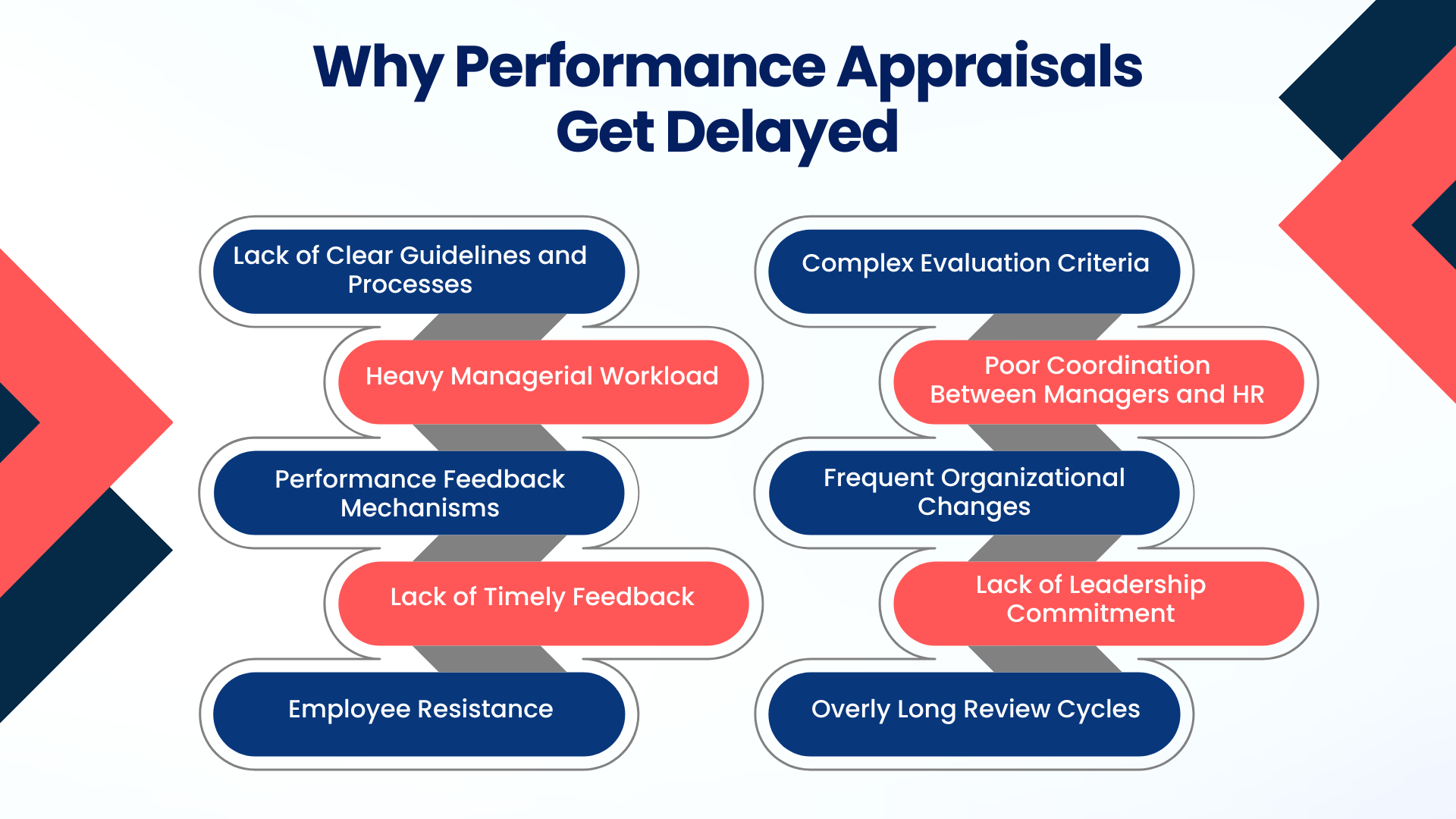
Now that the purpose is clear, let’s look at why this process so often slows down, and what you can do about it.
1. Lack of Clear Guidelines and Processes
Unclear processes are one of the biggest causes of late appraisals. If there is no standard template, managers don’t know when or how to run reviews. A structured Performance Management System solves this with set processes and templates.
How to fix it: Use an HRMS like Kredily to define appraisal steps and timelines. Automated reminders then make sure everyone knows what is due and when.
2. Heavy Managerial Workload
Managers juggle many tasks, so appraisals often slip down the list. On top of that, long and detailed review forms make this worse. As a result, employee assessment becomes a low priority.
How to fix it: An HRMS can handle routine work such as performance tracking and report generation. With Kredily, managers spend less time on admin and more time on the actual conversation.
3. Weak Performance Feedback Mechanisms
For instance, many companies review performance only once or twice a year. In between, nobody tracks progress consistently. So when review time comes, managers scramble for data and rush the evaluation.
How to fix it: Track performance continuously. Kredily’s performance management system lets managers record employee progress all year. Appraisals then become faster and the feedback is more useful.
4. Lack of Timely Feedback
Consequently, when feedback is rare, managers rely on memories from months ago. This makes appraisals slow and less accurate.
How to fix it: Hold regular check-ins and record them in Kredily. Because praise and concerns are documented as they happen, the final appraisal takes far less effort.
5. Employee Resistance
Some employees, for example, dread appraisals. In turn, they may not engage fully, and managers may avoid difficult conversations. Both lead to delays.
How to fix it: Explain the process openly and agree on how it will work. Self-assessments and 360-degree reviews in Kredily also feel less intimidating, since employees get a say.
6. Complex Evaluation Criteria
Vague or complicated criteria slow everything down. As a result, managers have to work out how to apply them to each person. Long evaluation forms also put people off finishing on time.
How to fix it: Use Kredily’s ready-made templates. They keep criteria clear, fair and linked to company goals.
7. Poor Coordination Between Managers and HR
Above all, appraisals need HR and managers to work together. When coordination breaks down, documents and reports arrive late, and reviews drag on.
How to fix it: Kredily therefore keeps both sides on the same page. Notifications and shared KPI views mean nobody is caught off guard.
8. Frequent Organisational Changes
For example, restructuring or mergers often push appraisals off the agenda. Even when they happen, they usually happen late.
How to fix it: Kredily’s flexible performance tools let you continue appraisals through change. Teams and reporting lines can be updated without restarting the cycle.
9. Lack of Leadership Commitment
When leaders don’t prioritise efforts to optimize performance management, managers follow their lead and ignore appraisals.
How to fix it: For this reason, leadership needs to be visibly involved. Kredily’s performance analytics give leaders clear reports, which helps make appraisals a company priority.
10. Overly Long Review Cycles
Annual reviews, in particular, are easy to put off. Worse still, once done, the forms often sit untouched for a year.
How to fix it: Move to quarterly or continuous reviews. Kredily helps you shift from a once-a-year review to regular feedback, which keeps people on track and reduces slippage.

Common Types of Performance Appraisal
There are several ways to run a performance appraisal, and each suits a different purpose. Kredily’s HRMS lets you use one method or, if needed, combine several. Here are the most common types.
1. 360-degree feedback: Feedback comes from managers, peers, juniors and sometimes customers. Together, this gives a complete picture of the employee’s strengths and gaps.
2. Self-assessment: Employees rate their own performance. This builds ownership and encourages reflection.
3. Management by Objectives (MBO): Managers and employees agree on individual targets linked to company goals. Performance is then judged against Key Result Areas (KRAs).
4. Rating scale: In this method, employees are scored on set parameters using a fixed scale. It is simple to run, and it also gives easy-to-compare numbers.
5. Behaviourally Anchored Rating Scale (BARS): BARS mixes qualitative and quantitative methods. In particular, it rates behaviour using specific, job-related examples.
6. Peer review: Similarly, colleagues share their view of each other’s work. This works especially well for judging teamwork, communication and collaboration.
Make Every Performance Appraisal Count with Kredily
In the end, a timely performance appraisal keeps people motivated and the business on track. Whatever method suits you, Kredily’s HRMS lets you customise the process and assess people accurately. You can try Kredily’s performance management tools for free.
Conclusion
To sum up, delays usually come from unclear processes, busy managers and infrequent feedback. Fortunately, each of these has a practical fix.
When you build these practices into your performance management system, employees get clearer goals and better support. In the end, your appraisals become a tool for growth rather than a yearly chore.
Leave a Reply