


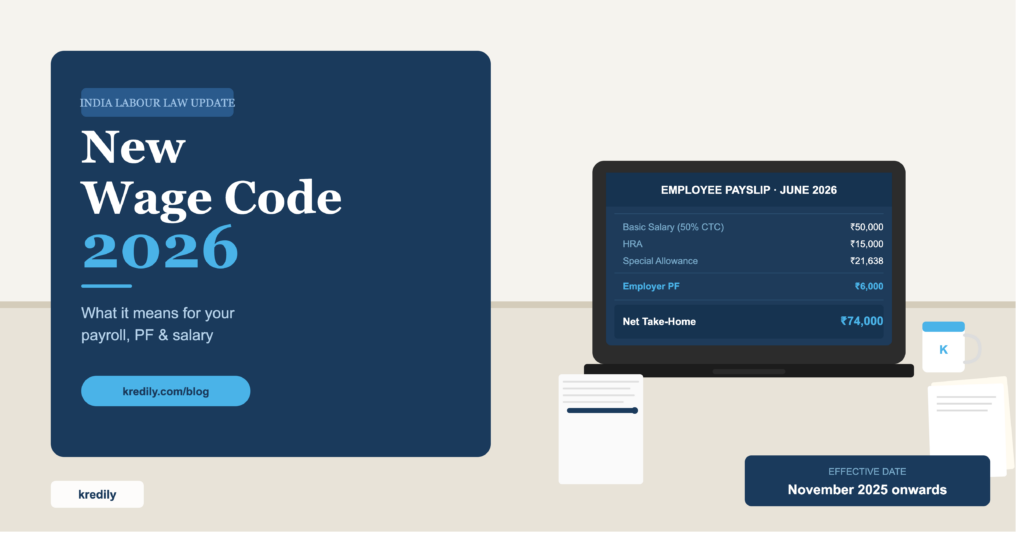
New Wage Code India 2026: What It Means for Payroll, PF & Employee Take-Home Salary
India’s four Labour Codes came into effect in late 2025. If you haven’t restructured your salary architecture yet, you’re already behind. For HR managers, payroll teams, and business owners managing payroll for 20 to 500 employees, the new wage code changes are anything but minor. They reshape how basic salary is defined, how PF and gratuity are calculated, and ultimately, what lands in your employee’s bank account every month. This guide breaks it all down without the legal jargon.
What Are the 4 New Labour Codes in India?
India’s labour law overhaul consolidated 29 central laws into four codes. Each one affects your workforce operations differently.
The Code on Wages (2019) covers minimum wages, timely payment, and the definition of “wages” itself. This is the one causing the most payroll disruption because it directly changes how salary structures are built.
The Social Security Code (2020) consolidates EPF, ESI, gratuity, maternity benefits, and other social security provisions. It introduces new definitions for what counts as a gig worker and expands social security coverage.
The Industrial Relations Code (2020) deals with trade unions, retrenchment, strike notice periods, and dispute resolution. Larger establishments, those with 300 or more employees, face different thresholds now.
The Occupational Safety, Health and Working Conditions Code (2020) governs workplace safety standards, working hours, leave, and interstate migrant workers.
For most small and mid-sized businesses, the Code on Wages and the Social Security Code are the two that directly hit your monthly payroll runs. Everything else, while important, has a lighter day-to-day operational footprint.
 100vw, 2560px” data-lazy-src=”https://kredily.com/wp-content/uploads/2026/06/infographic_4_labour_codes_india-scaled.png” data-lazy-srcset=”https://kredily.com/wp-content/uploads/2026/06/infographic_4_labour_codes_india-scaled.png 2560w, https://kredily.com/wp-content/uploads/2026/06/infographic_4_labour_codes_india-300×187.png 300w, https://kredily.com/wp-content/uploads/2026/06/infographic_4_labour_codes_india-1024×638.png 1024w, https://kredily.com/wp-content/uploads/2026/06/infographic_4_labour_codes_india-768×479.png 768w, https://kredily.com/wp-content/uploads/2026/06/infographic_4_labour_codes_india-1536×957.png 1536w, https://kredily.com/wp-content/uploads/2026/06/infographic_4_labour_codes_india-2048×1276.png 2048w” /><noscript><img alt=)
The Most Important Change: The 50% Basic Salary Rule Explained
Under the Code on Wages, the definition of “wages” has been tightened considerably. Basic pay plus dearness allowance must now equal at least 50% of an employee’s total CTC. That single requirement is what’s driving most of the payroll restructuring conversations in Indian companies right now.
This matters because, for years, companies structured salaries with a very low basic, sometimes 20 to 30% of CTC, and padded the rest with allowances such as HRA, special allowance, conveyance, and LTA. The reason was straightforward: lower basic means lower PF contributions (calculated on basic), lower gratuity, and a higher monthly take-home for employees. Everyone played along.
That structure is now non-compliant.
How Salary Structures Were Structured Before
A typical pre-wage-code salary structure for an employee on ₹1,00,000 per month CTC looked like this:
| Component | Amount (₹) | % of CTC |
|---|---|---|
| Basic Salary | 30,000 | 30% |
| HRA | 15,000 | 15% |
| Special Allowance | 40,000 | 40% |
| Conveyance Allowance | 5,000 | 5% |
| Employer PF Contribution | 3,600 | 3.6% |
| Gratuity Provision | 1,442 | 1.4% |
| Total CTC | 1,00,000 | 100% |
Employee take-home (approx): ₹79,000–₹81,000/month after deductions.
How Salary Must Be Structured Now (Post Wage Code)
With basic salary required to be at least 50% of CTC, the same salary slip structure changes significantly:
| Component | Amount (₹) | % of CTC |
|---|---|---|
| Basic Salary | 50,000 | 50% |
| HRA | 15,000 | 15% |
| Special Allowance | 21,638 | ~21.6% |
| Conveyance Allowance | 5,000 | 5% |
| Employer PF Contribution | 6,000 | 6% |
| Gratuity Provision | 2,404 | ~2.4% |
| Total CTC | 1,00,000 | 100% |
Employee take-home (approx): ₹74,000–₹76,000/month after deductions.
Same CTC. Lower take-home. More going into PF and gratuity. This is the trade-off, and it’s the conversation every HR team is having with employees right now.
 100vw, 2560px” data-lazy-src=”https://kredily.com/wp-content/uploads/2026/06/salary_comparison_old_vs_new_wage_code-scaled.png” data-lazy-srcset=”https://kredily.com/wp-content/uploads/2026/06/salary_comparison_old_vs_new_wage_code-scaled.png 2560w, https://kredily.com/wp-content/uploads/2026/06/salary_comparison_old_vs_new_wage_code-300×196.png 300w, https://kredily.com/wp-content/uploads/2026/06/salary_comparison_old_vs_new_wage_code-1024×668.png 1024w, https://kredily.com/wp-content/uploads/2026/06/salary_comparison_old_vs_new_wage_code-768×501.png 768w, https://kredily.com/wp-content/uploads/2026/06/salary_comparison_old_vs_new_wage_code-1536×1002.png 1536w, https://kredily.com/wp-content/uploads/2026/06/salary_comparison_old_vs_new_wage_code-2048×1336.png 2048w” /><noscript><img alt=)
Impact on PF (Provident Fund) Contributions
EPF is calculated as 12% of basic salary, from both the employer and employee. When basic salary goes up, PF contributions go up. It’s that direct.
How Much More Will Employers Pay Towards PF?
Using the same ₹1,00,000 CTC example:
| Old Structure (Basic ₹30,000) | New Structure (Basic ₹50,000) | |
|---|---|---|
| Employee PF (12%) | ₹3,600/month | ₹6,000/month |
| Employer PF (12%) | ₹3,600/month | ₹6,000/month |
| Annual PF difference | +₹28,800/year |
For a company with 100 employees at this salary level, that’s ₹28.8 lakh in additional PF outgo per year on the employer’s side alone. This is a real cost increase that businesses need to plan for, not something to push to the next quarter.
The upside is genuine: employees are building a significantly larger retirement corpus. Workers who stay for 10, 15, or 20 years will see materially better retirement savings under this structure. That’s worth communicating when you brief your team on the changes.
Impact on Gratuity Calculations
Gratuity is calculated based on the last drawn basic salary. Higher basic means a higher gratuity payout when an employee exits.
The standard formula remains:
Gratuity = (Last Drawn Basic + DA × 15 × Years of Service) ÷ 26
New Gratuity Calculation Example for 2026
For an employee who has completed 5 years of service:
Old structure (basic ₹30,000): Gratuity = (30,000 × 15 × 5) ÷ 26 = ₹86,538
New structure (basic ₹50,000): Gratuity = (50,000 × 15 × 5) ÷ 26 = ₹1,44,231
That’s a ₹57,693 difference in gratuity payout for a single employee over just five years of service. Multiply that across a 100-person team, and you begin to understand why HR and finance are having urgent conversations about gratuity provisioning.
There’s one more important change from the Social Security Code worth flagging: for fixed-term employees, gratuity eligibility is proposed to be reduced from the existing 5 years to 1 year of continuous service. This significantly expands gratuity liability for companies that rely heavily on contract or fixed-term hiring.
What Happens to Employee Take-Home Salary?
For most employees currently on a low basic salary structure, take-home pay will decrease. The reduction is modest, but it’s real.
The drop is typically in the range of ₹3,000 to ₹6,000 per month for mid-level employees, depending on their current salary structure. This comes from higher PF deductions on a larger basic, along with revised allowance ratios.
Employees often experience this as a pay cut, even though their CTC hasn’t moved at all. That perception gap is one of the most common causes of avoidable attrition right now. People are seeing lower bank credits and drawing their own conclusions without the full picture.
The smartest thing HR teams are doing is getting ahead of this. That means sitting employees down before the revised payslip arrives, walking through exactly what changed and why, and helping them understand the long-term picture: higher PF balance building month over month, and a larger gratuity cheque when they eventually leave. If employees find out through their bank notification first, you’ve already lost that conversation.
What Employers Must Do Right Now
The implementation window has passed. Most states had a November 2025 effective date. If you haven’t acted, the priority list is not complicated, though it does require some discipline to work through properly.
Start with a salary audit. Run a report of every employee where Basic plus DA is below 50% of CTC. That’s your non-compliant population, and those are the salary structures you need to rework first.
Once you have the list, restructure the CTC breakdowns carefully. The goal isn’t just to increase basic in isolation; you need to rework the entire component split so allowances don’t breach the 50% ceiling. Most payroll software has a salary structure template you can update globally, which saves the effort of doing it record by record.
After restructuring, recalculate PF and gratuity provisions before your next payroll run. Your PF challan amounts will change, and finance needs updated gratuity figures in the books. A good payroll system handles this automatically once the salary structure is corrected, but verify the output before you process.
Any offer letter issued going forward must also reflect the compliant structure. Continuing to issue offers with old low-basic splits creates fresh liability even after you’ve fixed existing employees. Update the offer letter template in your HR system at the same time you update salary structures.
Payslip formats need to follow suit.
An employee receiving a payslip showing non-compliant component splits is a compliance liability regardless of what’s actually being deposited. Get the payslip template updated and reconcile it against what’s going into PF.
None of this lands well if employees aren’t informed. A short, clear communication explaining why take-home has shifted and what it means for their PF and gratuity isn’t just good HR practice; it prevents the kind of quiet attrition that shows up two months later in exit interviews.
Finally, check your specific state’s notification status. Several states had delayed implementation timelines, and a handful are still working through the process. The official state labour department gazette notification is the authoritative source for your state’s effective date.
Which States Have Issued Notifications?
As of 2026, states including Himachal Pradesh, Haryana, Uttarakhand, Madhya Pradesh, and several others have issued notifications. A few states are still in the process. This is a fast-moving area. Check the official state labour department notification or consult your payroll compliance team for the current position in your state.
How HRMS Software Like Kredily Helps with Wage Code Compliance?
Restructuring salary for 50 or 200 employees manually, across offer letters, payslips, PF challans, and gratuity provisions, is where errors compound quickly. One component entered incorrectly in a spreadsheet creates a cascade across the entire payroll run, and you may not catch it until a challan mismatch triggers an EPFO query.
This is exactly the kind of operational load that HRMS software is built to absorb.
Kredily’s payroll module lets you configure compliant salary structures with built-in enforcement of the 50% basic rule, so a non-compliant CTC split won’t go undetected during setup. Revised PF and gratuity figures recalculate automatically when you update the underlying salary structure, removing the need for parallel manual workings in spreadsheets. Payslips reflect updated wage components correctly, and the payroll run itself applies current statutory rates across your entire headcount without requiring someone to verify each employee individually.
For teams that have been managing this in Excel, the margin for error is too wide when the stakes involve statutory compliance. One missed PF challan or an incorrectly computed gratuity provision, can become a legal notice. Getting onto a proper system now costs less than fixing errors after the fact.
Frequently Asked Questions
When did the new wage code come into effect in India?
The four Labour Codes received Presidential assent between 2019 and 2020. Implementation (state notifications) began in earnest through 2025, with many states having notified their rules effective November 2025. The exact effective date varies by state.
What is the 50% basic salary rule under the new wage code?
Under the Code on Wages, “wages” must constitute at least 50% of total remuneration. In practice, this means basic salary (plus dearness allowance, if any) must be at least 50% of an employee’s total CTC. Allowances collectively cannot exceed 50% of total pay.
Will employee take-home salary decrease under the new wage code?
For employees currently on low basic structures, yes, take-home will reduce modestly. The reduction comes from higher PF deductions on a larger basic. Employees’ PF balances and gratuity entitlements will be correspondingly higher, though that’s harder to feel month to month.
Does the new wage code apply to all employers in India?
It applies to establishments covered under the respective codes in states that have issued notifications. Coverage thresholds vary by code. Some apply to all establishments, others have employee-count thresholds. Check your state’s specific notification for applicability.
How do I restructure salary under the new wage code?
Start with a salary audit to identify all employees whose basic is below 50% of CTC. Then restructure the component split, update payslips and offer letters, recalculate PF and gratuity provisions, and update your payroll system. HRMS software like Kredily automates the restructuring and recalculation steps.
What is the new gratuity eligibility for fixed-term employees?
The Social Security Code proposes reducing the eligibility threshold for fixed-term employees from 5 years to 1 year of continuous service. This hasn’t been uniformly notified across all states, so verify the position in your state before adjusting your gratuity provisioning.
What happens if we don’t comply with the new wage code?
Non-compliance can attract penalties under the respective codes, including fines and potential prosecution. More immediately, incorrect PF contributions create liability with EPFO, and non-compliant payslips can trigger audits. Address this now rather than waiting for a notice to arrive.
The Bottom Line
The new wage codes are the most significant overhaul of India’s labour laws in decades. For business owners and HR teams, the practical impact is clear: salary structures need to be rebuilt, PF and gratuity costs are going up, and employees need to hear about it from you before they see a lower bank credit.
The companies handling this well are the ones that treated it as a people issue, not just a compliance task. Get the numbers right, communicate clearly, and use systems that do the heavy lifting automatically.
Kredily’s HRMS and payroll platform is built for Indian compliance, covering the new wage codes, EPF, ESI, and everything in between. If your team is still managing this in spreadsheets, now is the right time to change that.
[Try Kredily Free — Simplify Payroll Compliance Under New Wage Codes →]