
The POSH Policy stands for Prevention of Sexual Harassment at the Workplace and is a mandatory framework designed to ensure a safe and respectful work environment in India. The POSH policy exists to prevent, prohibit, and address sexual harassment at work while protecting employee dignity and rights. It applies to all organizations, including companies, startups, and employers with any number of employees, making compliance a legal responsibility—not a choice. HR teams, management, and employees must follow POSH guidelines to build trust, ensure accountability, and meet statutory obligations. Non-compliance can lead to penalties, making POSH policy implementation essential for every workplace.
Who Is Covered Under POSH & Where It Applies?
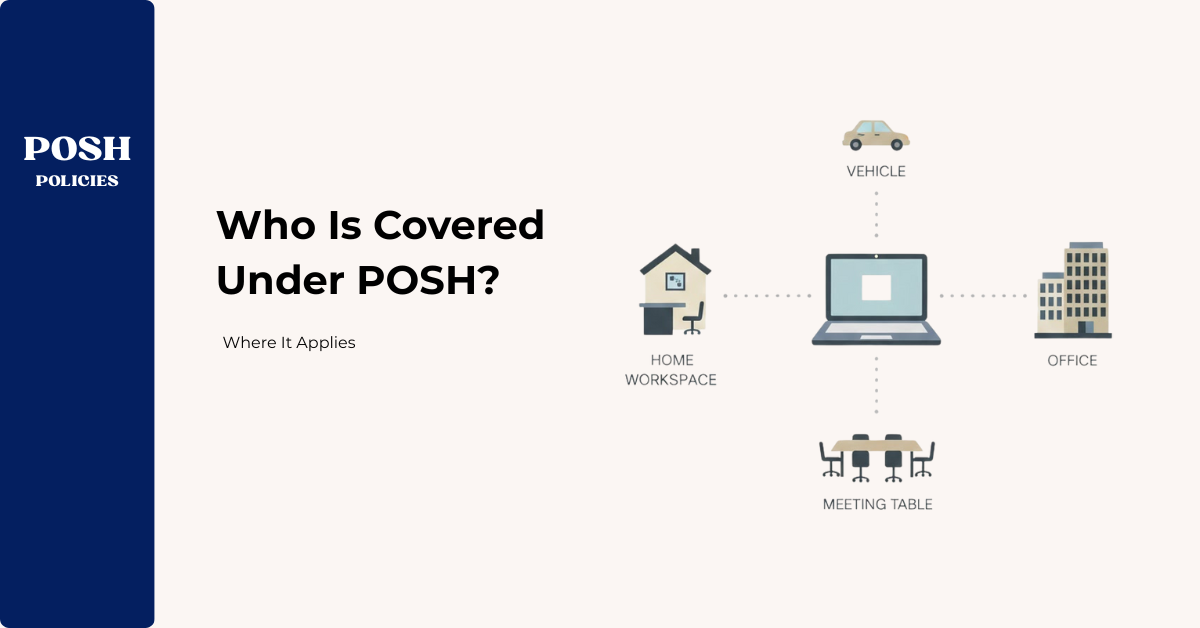
The POSH Policy is designed to protect individuals from sexual harassment across a wide range of work relationships and environments. Under POSH, protection is not limited to full-time employees alone. It extends to interns, trainees, consultants, contractual staff, temporary workers, and even vendors or clients who interact within the workplace. This broad coverage ensures that everyone associated with an organization is safeguarded, regardless of their employment status.
A key aspect of the POSH policy is its wide definition of a “workplace.” It goes beyond a physical office space and includes any location where work-related activities take place. This means POSH applies to work-from-home setups, virtual meetings, emails, chats, and other digital communication platforms used for official work.
POSH is also applicable during office events, parties, training sessions, offsite meetings, and business travel, including client visits and company-arranged transportation. Any place or situation connected to work responsibilities is covered under the POSH framework.
By clearly defining who is protected and where the policy applies, the POSH policy answers common questions such as “Does POSH apply to work from home?” and “Is POSH applicable to interns?” Understanding this scope helps organizations remain compliant while ensuring a safe, respectful, and inclusive work environment for everyone.
What Constitutes Sexual Harassment at the Workplace
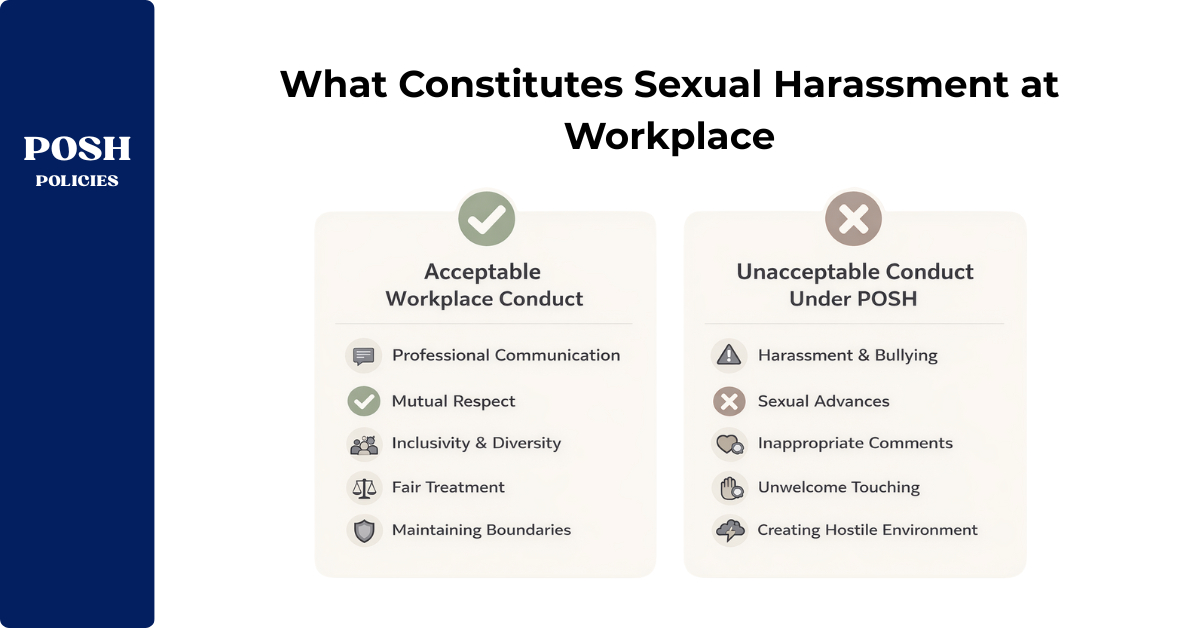
Under the POSH Policy, sexual harassment is not limited to extreme or obvious acts. It includes any unwelcome behavior of a sexual nature that makes a person feel uncomfortable, unsafe, intimidated, or disrespected at work. What matters is how the behavior is received, not how it was intended.
Sexual harassment can take many forms. Physical harassment includes unwanted touching, standing too close, blocking someone’s movement, or any physical contact that feels intrusive. Verbal harassment often shows up as sexually suggestive comments, repeated compliments with a sexual tone, personal questions about relationships, or “jokes” that cross boundaries. Visual harassment includes sharing or displaying explicit images, gestures, screen content, or messages that create an uncomfortable environment.
In modern workplaces, harassment frequently happens online. Under POSH, inappropriate emails, late-night messages, repeated DMs, offensive memes, or uncomfortable behavior during video calls are all covered — even in work-from-home or hybrid setups.
What many employees and HR teams miss are the grey areas. A behavior doesn’t need to be repeated to qualify. A single incident can be enough. Friendly intent does not cancel discomfort. Silence does not mean consent. Power dynamics — such as a manager messaging a junior employee — matter greatly.
Real-world POSH complaints often arise from situations that were dismissed as “harmless” or “casual” until they created fear, pressure, or emotional distress. Understanding these realities is critical. A strong POSH policy helps employees recognize unacceptable behavior early and gives organizations the clarity needed to act before boundaries are crossed.
Internal Complaints Committee (ICC) & Complaint Process
The POSH Policy places the Internal Complaints Committee (ICC) at the center of workplace sexual harassment prevention and redressal. For any organization with 10 or more employees, forming an ICC is mandatory, regardless of whether a complaint has ever been reported. Not having a valid ICC is treated as non-compliance under the POSH framework.
An ICC must follow strict composition rules. It should be headed by a senior woman employee as the Presiding Officer, include at least two internal members committed to women’s rights or social work, and have one external member from an NGO or with legal expertise. This external member is crucial — without them, the ICC is considered invalid, even if other members are present. If any ICC member leaves or becomes inactive, the committee must be reconstituted immediately.
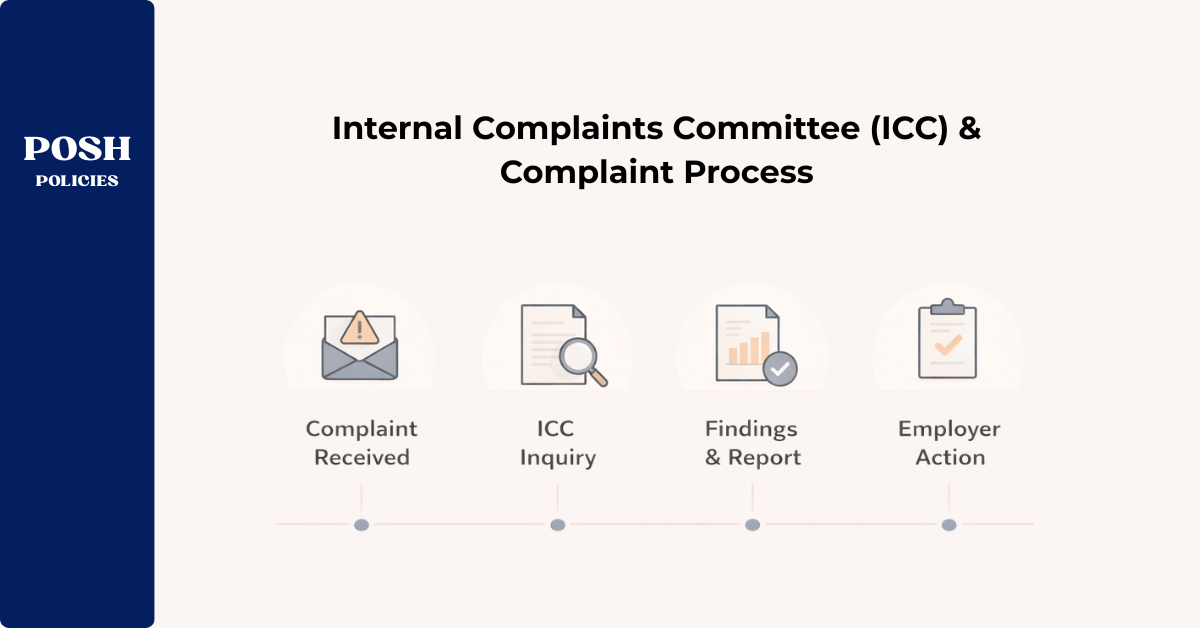
The POSH complaint process is designed to be structured, confidential, and fair to all parties involved. A complaint should ideally be submitted in writing within three months of the incident. If the complainant is unable to write, the ICC is legally required to assist in documenting the complaint. In certain situations, this timeline can be extended if justified.
Once a complaint is received, the ICC may explore conciliation, but only at the request of the complainant and without monetary settlement. If conciliation is not chosen or fails, the ICC initiates a formal inquiry. Both the complainant and the respondent are given a fair opportunity to be heard, present evidence, and bring witnesses. Throughout the process, confidentiality must be strictly maintained.
POSH timelines are critical for compliance. The inquiry must be completed within 90 days. After the inquiry, the ICC submits its report to the employer within 10 days, following which the employer must act on the recommendations within 60 days. These timelines are non-negotiable.
Employer & Employee Responsibilities Under POSH Guidelines
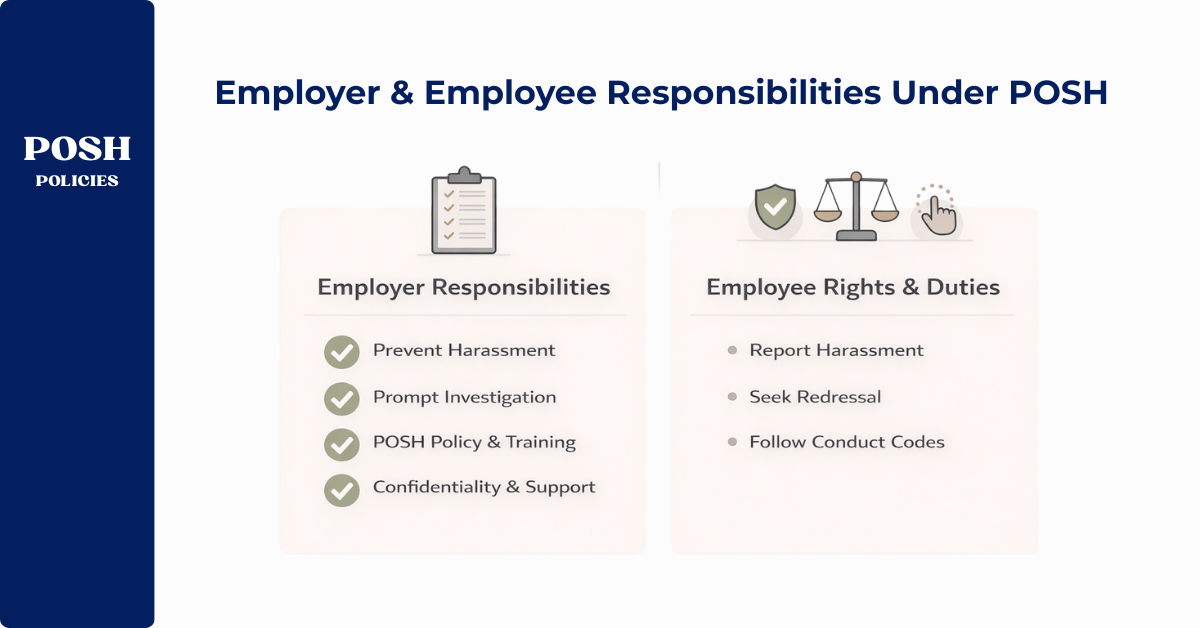
Employer Responsibilities
Under the POSH Policy, the following responsibilities are required to be fulfilled by employers:
- A written POSH policy must be drafted, approved, and communicated to all employees.
- An Internal Complaints Committee (ICC) must be constituted where the employee strength is 10 or more.
- Adequate infrastructure and independence must be provided to the ICC for conducting inquiries.
- POSH awareness programs and training sessions must be conducted at regular intervals.
- Records related to complaints, inquiries, training, and actions taken must be maintained.
- An annual POSH report must be submitted to the appropriate authority, even if no complaints are received.
- Retaliation against complainants or witnesses must be strictly prevented.
Employee Rights and Duties
Employees covered under the POSH Policy are entitled to the following rights:
- A safe and harassment-free workplace.
- The right to file a complaint without fear of retaliation.
- Fair treatment and confidentiality during the inquiry process.
Employees are also required to:
- Maintain professional conduct at all times.
- Cooperate with the ICC during inquiries.
- Respect workplace boundaries and POSH guidelines.
Confidentiality Obligations
Confidentiality must be maintained with respect to:
- Identity of the complainant and respondent.
- Details of the complaint and inquiry proceedings.
- Findings and recommendations of the ICC.
Why This Matters for HR & Leadership
Compliance with POSH responsibilities reduces legal risk, strengthens workplace culture, and demonstrates leadership accountability. Proper implementation ensures prevention, not just resolution, of workplace harassment.
POSH Penalties, Fines & Legal Consequences
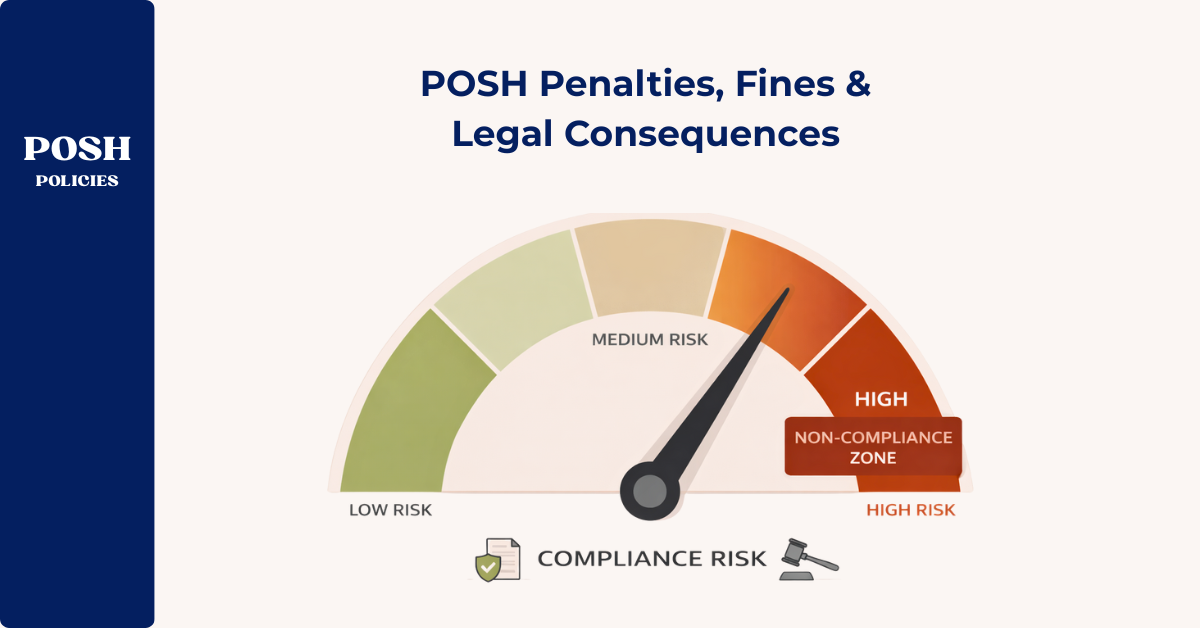
Non-compliance with the POSH Policy attracts strict legal and regulatory consequences. Penalties are imposed not only to enforce compliance but also to ensure accountability and workplace safety. Failure to adhere to POSH requirements is treated as a serious violation under Indian law.
Penalties for Non-Compliance under POSH Policy
Where a POSH policy is not implemented, or an Internal Complaints Committee is not constituted as required, a monetary penalty of up to ₹50,000 may be imposed. Non-compliance also includes failure to conduct POSH training, absence of proper documentation, or non-submission of mandatory reports. Even procedural lapses are considered violations.
Consequences of Repeat POSH Violations
In cases of repeated non-compliance, stricter action may be taken. Higher fines may be imposed, and authorities may recommend cancellation, suspension, or non-renewal of business licenses, registrations, or approvals. Continued disregard for POSH obligations may also invite increased scrutiny and inspections.
Penalties for False Complaints under POSH Guidelines
The POSH framework allows action to be taken against false or malicious complaints, provided malicious intent is conclusively established. Disciplinary action may be recommended against the complainant in such cases. However, it is clarified that inability to substantiate a complaint does not automatically imply falsity, and genuine complaints remain protected.
Reputational and Business Impact of POSH Non-Compliance
Beyond statutory penalties, non-compliance with POSH requirements poses significant reputational risks. Legal proceedings, regulatory actions, and negative publicity can adversely impact employer branding, employee trust, and business relationships. For this reason, POSH compliance is not only a legal necessity but also a critical component of organizational risk management.
Strict adherence to the POSH Policy ensures legal protection, safeguards organizational reputation, and reinforces a culture of accountability and respect.
Common POSH Mistakes & Compliance Hacks
Several organizations assume POSH compliance is achieved once a policy is drafted. In practice, many violations occur due to overlooked procedural requirements rather than intent. Understanding these common mistakes helps prevent compliance gaps.
One of the most frequent errors is that the Internal Complaints Committee exists but is invalid. An ICC without a properly appointed Presiding Officer or with inactive members does not meet POSH requirements. In particular, the absence of an external member renders the ICC non-compliant, even if internal members are present.
Another critical lapse is that the mandatory annual POSH report is not filed. This report must be submitted to the appropriate authority every year, even when no complaints have been received. Failure to file is treated as non-compliance.
Summing up
The POSH Policy is a mandatory compliance requirement that safeguards workplace dignity and accountability. Proper implementation, valid ICC constitution, regular training, and accurate documentation are essential, regardless of whether complaints are received. Consistent adherence to POSH requirements protects employees, reduces legal risk, and strengthens organizational trust.