What Is ATS? (Applicant Tracking System)
An ATS (Applicant Tracking System) is software that helps HR teams manage and streamline the hiring process from job posting to final offer.
Instead of handling resumes through emails, spreadsheets, and multiple job portals, an A It centralizes everything into one structured system. It collects applications, organizes candidate data, tracks hiring stages, and improves collaboration between recruiters and hiring managers.
For Indian companies dealing with high application volumes and growing teams, an It brings clarity, speed, and consistency to recruitment — without removing the human element from hiring decisions.
How an Applicant Tracking System Works (Step-by-Step)
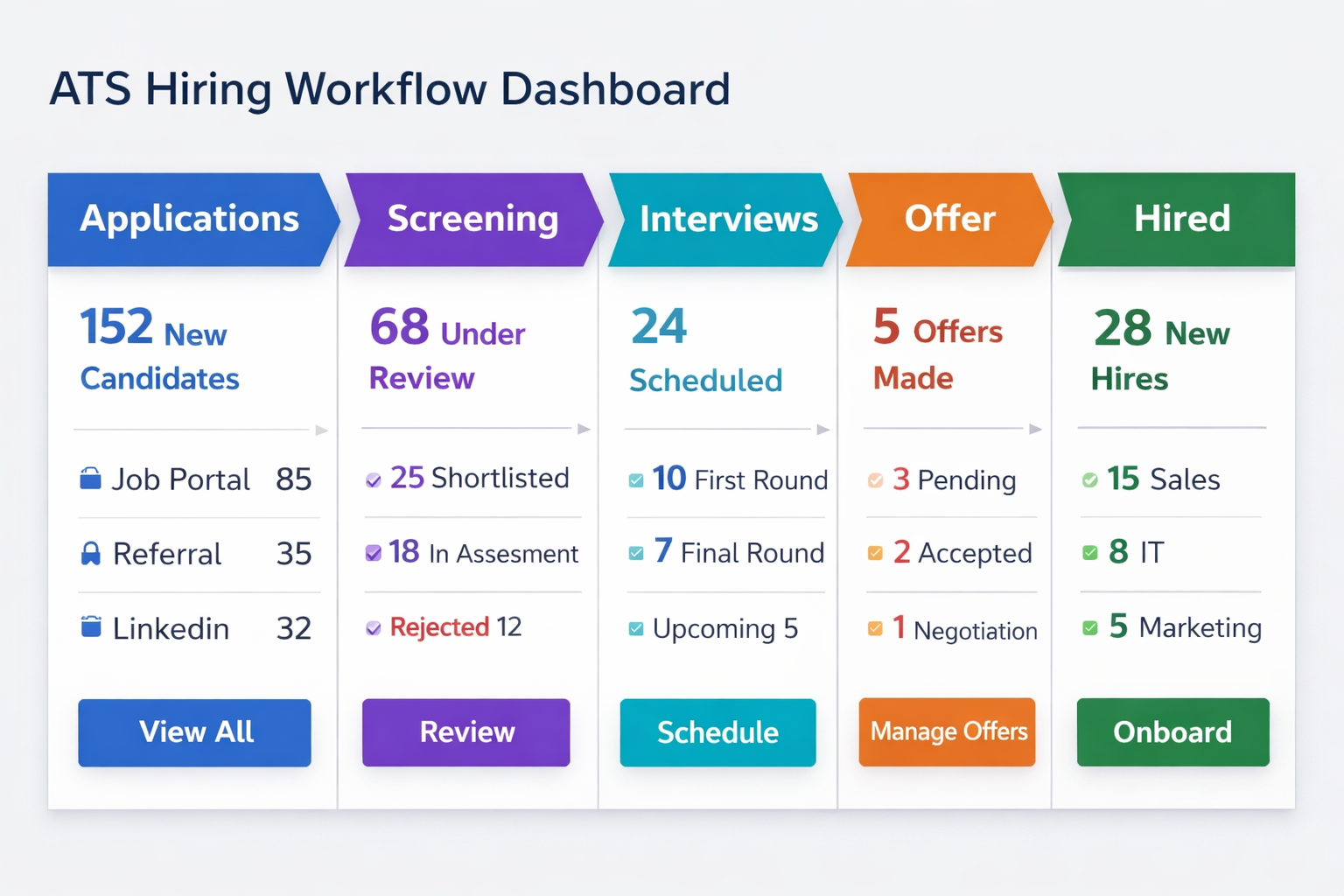
An ATS structures recruitment into clear, manageable stages.
1. Job Creation and Approval
HR creates the job inside the ATS with role details, requirements, and approval workflows before publishing.
2. Resume Collection from Multiple Sources
Applications from career pages, job portals, and referrals are automatically gathered into one centralized dashboard.
3. Resume Parsing and Profile Creation
It reads resumes and extracts skills, experience, and qualifications into searchable candidate profiles.
4. Screening and Shortlisting
Recruiters filter candidates based on predefined criteria, reducing manual sorting and saving time.
5. Interview Scheduling and Feedback
Interview coordination, panel feedback, and evaluation notes are recorded inside the system.
6. Offer Management and Hiring Closure
Final selection, offer rollout, and documentation are tracked within the ATS.
This structured approach ensures hiring remains organized and transparent.
Key Features of an ATS in HR
A modern ATS includes:
Resume Parsing and Candidate Database
Automatically converts resumes into structured profiles and stores them in a searchable database.
Multi-Channel Job Posting
Publish job openings across career pages and portals from one system.
Hiring Pipeline Tracking
Visual dashboard showing candidate status from application to offer.
Interview Scheduling & Collaboration
Coordinate interview panels and capture structured feedback.
Candidate Communication Tracking
Manage application updates and communication centrally.
Recruitment Analytics
Track time-to-hire, source effectiveness, and hiring performance.
Compliance and Data Security
Secure storage of candidate records and audit-ready documentation.
Benefits of Using ATS for HR Teams
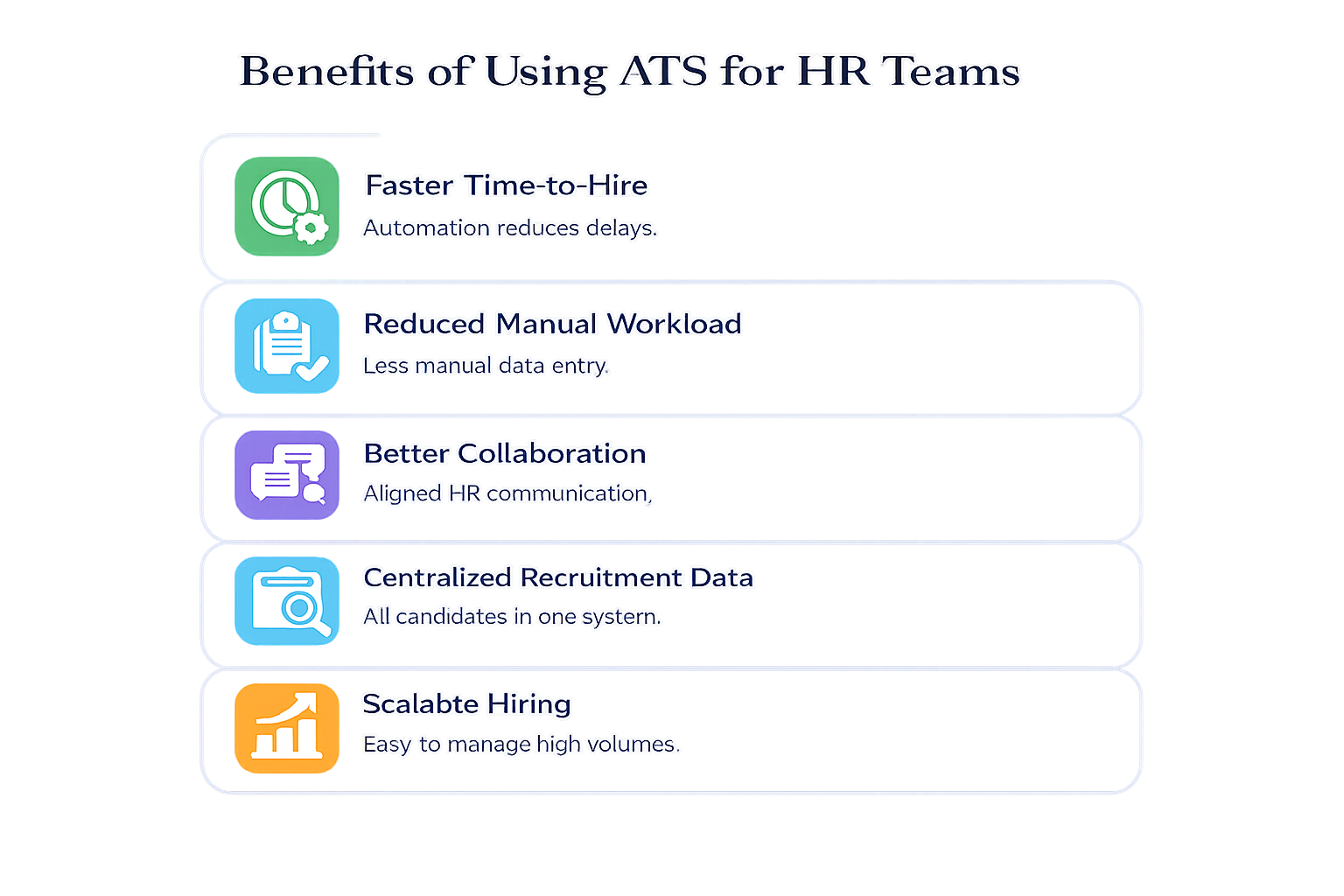
Faster Time-to-Hire
Automation reduces screening and coordination delays.
Reduced Manual Workload
No more managing resumes across multiple tools.
Better Collaboration
Hiring managers and recruiters stay aligned in one system.
Centralized Recruitment Data
Access past candidate records and hiring insights easily.
Scalable Hiring
Handle high application volumes without operational chaos.
If your organization is also working on structured HR processes like maintaining an Employee Database or improving your HR Handbook, an ATS becomes a foundational system that connects recruitment with broader HR operations.
Benefits of ATS for Candidates
An ATS improves not only recruiter productivity but also the candidate experience. Applicants receive clearer communication, faster responses, and a more transparent hiring journey. Each stage — application, screening, interview, and offer — follows a predictable flow rather than an uncertain waiting period.
Standardized evaluation also supports fairness. Candidates are assessed against role-based criteria instead of subjective factors, helping build trust in the hiring process.
Advanced & Latest ATS Technology (2025 Trends)
The Applicant Tracking System has evolved far beyond basic resume management. In 2025, modern platforms are built with intelligent technology that helps HR teams in India hire faster, smarter, and more consistently—while keeping the process human-centric.
AI-Powered Resume Screening
AI-driven Applicant Tracking platforms can now analyze resumes beyond keyword matching. They understand skills, experience relevance, and role alignment, helping recruiters quickly identify suitable candidates without manually reviewing every application.
Machine Learning–Based Candidate Ranking
Using historical hiring data, machine learning models rank candidates based on patterns linked to successful hires. This allows HR teams to prioritize profiles more accurately and make better shortlisting decisions.
Recruitment Automation Workflows
Automation streamlines repetitive recruitment tasks such as application routing, interview triggers, follow-ups, and status updates. These workflows reduce delays and ensure consistency across hiring stages.
Chatbots for Candidate Engagement
AI chatbots integrated within this platforms assist candidates by answering queries, sharing application status, and guiding them through the process. This improves responsiveness and reduces recruiter workload.
Predictive Hiring Analytics
Advanced solutions offer predictive insights such as expected time-to-hire, hiring bottlenecks, and talent demand forecasting. These analytics support proactive workforce planning rather than reactive hiring.
Bias-Reduction and Structured Hiring Tools
Structured evaluations, standardized screening criteria, and anonymized profiles help reduce unconscious bias. This makes hiring fairer and more aligned with role-based decision-making.
Cloud-Based and Mobile-First ATS Platforms
Modern Applicant tracking systems are cloud-native and mobile-friendly, allowing recruiters and hiring managers to access hiring data anytime, anywhere—ideal for remote and distributed teams in India.
Together, these latest technologies position recruitment as a strategic, data-driven function, helping organizations stay competitive in India’s evolving talent market.
Is ATS Required for Indian Companies?
This is not legally mandatory, but it has become increasingly necessary as hiring complexity grows. Companies managing multiple openings or high application volumes find manual processes inefficient and difficult to scale.
For startups and growing businesses, adopting an ATS early helps build consistent hiring practices. Instead of reacting to recruitment challenges, organizations operate with a defined structure that supports long-term growth.
How to Build a Scalable Hiring Process
Hiring today is no longer about reacting to open positions — it’s about building a system that works consistently, even as demands change. An Applicant Tracking System brings structure to recruitment, helping teams move from scattered efforts to clear, repeatable processes.
Throughout this guide, we’ve explored how modern platforms shape hiring — from organizing applications and improving collaboration to enabling data-backed decisions and fair evaluations. When implemented thoughtfully, doesn’t just speed up hiring; it improves hiring quality and confidence.
For growing organizations, especially in India’s competitive talent market, the question is no longer whether hiring needs structure — it’s how soon that structure becomes essential. Teams that invest early in the right systems gain clarity, move faster, and create better experiences for both candidates and recruiters.
A well-chosen System becomes the foundation of sustainable recruitment — one that supports growth without chaos and helps organizations hire with intent, not urgency.
Conclusion
Hiring today requires speed, coordination, and clear visibility across teams. An Applicant Tracking System brings structure to recruitment, helping organizations move from scattered efforts to a reliable process. By organizing applications, supporting collaboration, and improving decision-making, an ATS enables companies to hire confidently and efficiently.
For Indian businesses competing in a fast-moving talent market, implementing the right recruitment system is less about automation and more about creating a stable foundation for growth.
FAQ’s
What does ATS stand for in HR?
It stands for Applicant Tracking System, software used to manage and streamline recruitment processes.
Does an ATS automatically reject resumes?
No. The system filters and organizes applications, but final decisions are always made by recruiters.
Is an ATS useful for small companies?
Yes. Even smaller organizations benefit from structured hiring as they grow and manage more applicants.
How does ATS improve hiring efficiency?
It centralizes candidate data, automates repetitive tasks, and provides clear visibility into each hiring stage.
Can ATS reduce hiring bias?
Structured screening criteria and standardized evaluations help ensure fairer candidate assessment.