



What is a Letter of Recommendation?
Introduction
A letter of recommendation, because this conveys an individual’s capabilities, personality, and accomplishments from an existing person, can be proof of capability, personality, and accomplishments that a future employer can rely on. Generally, a resume would need to accompany an application when applying for a job, college, scholarship, or any similar type of process that involves evaluation.
The letter by and large is composed by a familiarly acquainted person who dons the hat of the narrator and puts forward specific descriptions as well as gives interpretations about the applicant’s capabilities. They might have been your boss, school teacher, mentor, or friend. This letter is written to help the candidate in their application by identifying their best features, achievements, work ethics, and other information that will assist them in passing through the recruitment process.
A strong letter of recommendation should clearly state the writer’s position, their relationship with the candidate, the duration of their acquaintance, and specific examples of the candidate’s traits and accomplishments that demonstrate their suitability for the role or opportunity. It should maintain a professional tone and format, use formal salutations, and convey a positive endorsement of the candidate.
Importance of Letters of Recommendation
- Validation of Abilities: At its best, letters of recommendation provide corroboration of one’s acquired skills, specialization, and achievements. It gives real-world scenarios, where it demonstrates what the candidate has done, and how much of a positive difference that made.
- Credibility and Trustworthiness: A letter of recommendation makes another party endorse the concerns of your own words, and raises the weight of your words. When a certain high-profile person or entity that is trustworthy backs up someone’s abilities, the sustainability of the candidate increases so much in the eyes of employers, academic institutions, or other stakeholders
- Insight into Character and Work Ethic: Impressions that can be gathered from these letters sometimes give a clear picture of one’s character along with their potential work ethic, coordination skills, and overall attitude at work. They can highlight character traits like leadership, teamwork, initiative, dependability, and professionalism which are very important characteristics that are considered for most interview opportunities.
- Differentiation and Competitive Edge: In competitive fields like employment or university applicants where a strong candidate profile is a significant deciding factor, a letter of recommendation may assist candidates to get noticed out of the masses. Positive and specific recommendations that display the reasons why an applicant just excels at something or more than other candidates do can distinguish him/her and bring advantages to the person being recommended.
- Contextual Information: Recommenders can give their recommendations a broader perspective by emphasizing the profundity of the candidate’s accomplishments with the information that they have about them. They are no doubt ready to illustrate challenges and look at the part the individual took in overcoming them, his course of growth, and how he has handled situations, giving the committee evidence from all the angles of capabilities that cannot be seen in one resume and transcript.
- Networking and Professional Relationships: The letter of recommendation gathering process contributed extensively to further developing and maintaining professional connections at the same time with possible colleagues or potential recruiters. It signifies that the guy is a relation man who can at some point keep up and maintain the network necessary for career moves and advancements.
- Confirmation of Fit: By serving the purpose of verifying culture and adherence to values, a letter of recommendation for the roles or programs is useful to confirm if the candidate fits well on the board, the team, or the institution.
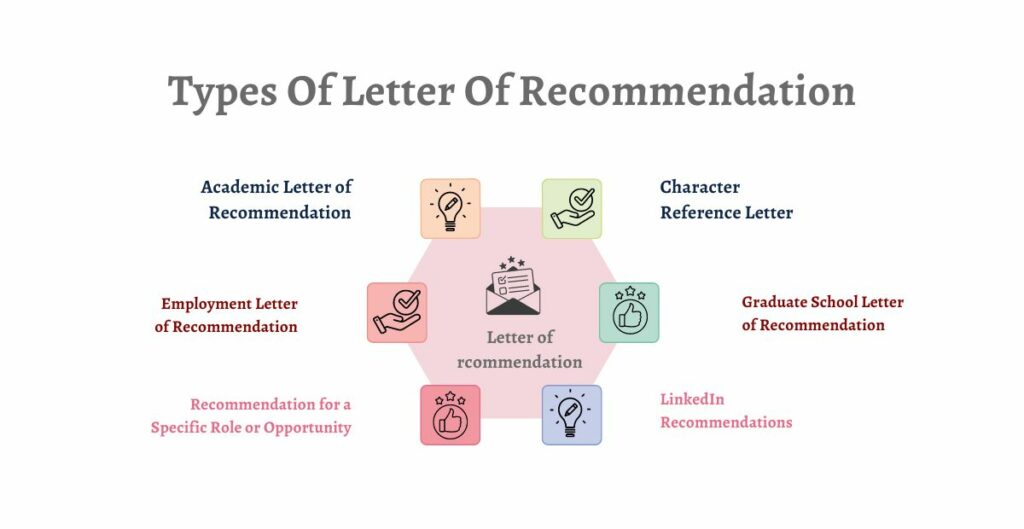
Types of Letters of Recommendations
- Educational Recommendation Letter:
This letter is written by a teacher, professor, or academic advisor for students applying to colleges, universities, graduate programs, or fellowship opportunities. It highlights academic performance, subject knowledge, learning ability, and the student’s potential to succeed in higher education. - Professional Recommendation Letter:
Usually provided by a former employer, manager, or senior colleague, this letter focuses on the individual’s work experience, key skills, achievements, and professional conduct. It is commonly required during job applications or promotion evaluations. - Personal Character Reference Letter:
A personal character reference is written by someone who knows the individual well and can speak about their values, integrity, and personal traits. This may include a friend, coworker, neighbor, community leader, or mentor who can share insights beyond academic or professional credentials. - Graduate Program Recommendation Letter:
This letter supports applications to postgraduate or doctoral programs and is typically written by a professor, research supervisor, or professional mentor. It assesses the applicant’s readiness for advanced studies, research capabilities, analytical skills, and potential contribution to their chosen field. - Recommendation for a Specific Role or Opportunity: In certain instances, a letter of recommendation could be created according to position, internship opportunity, or program. Such description should be given to the candidate’s functional and experiential abilities and qualities that conform to what is required by the jobs or opportunities available.
- LinkedIn Recommendations: A letter of recommendation is the reference for a traditional job opening a similar conduit in the conference of networking sites. This is written testimonials on a person’s LinkedIn profile by their peers, supervisors, or customers that endorsed him or her for the set skills, qualifications, and work ethic.
Examples of Letters of Recommendation
Example 1
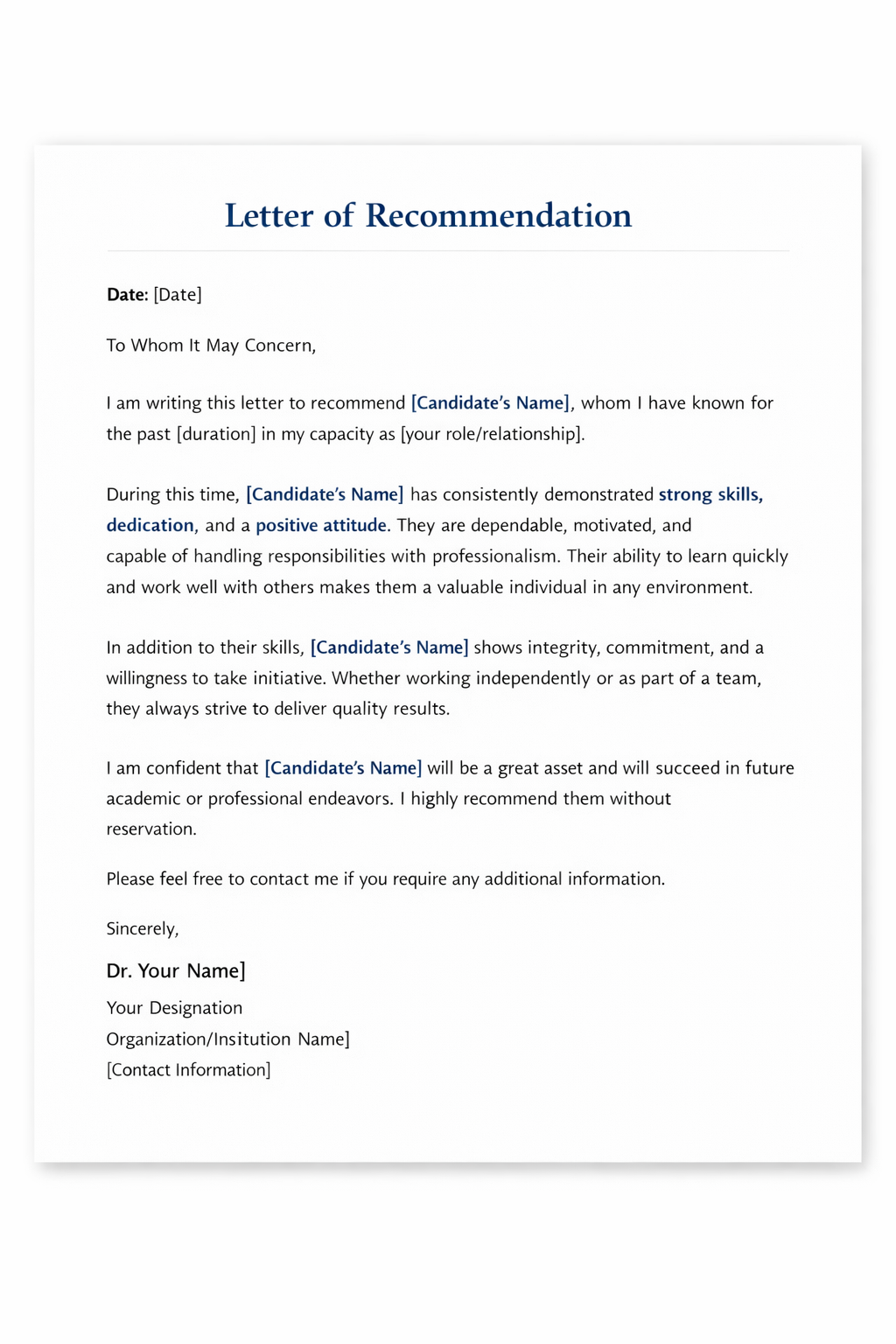
Example 2
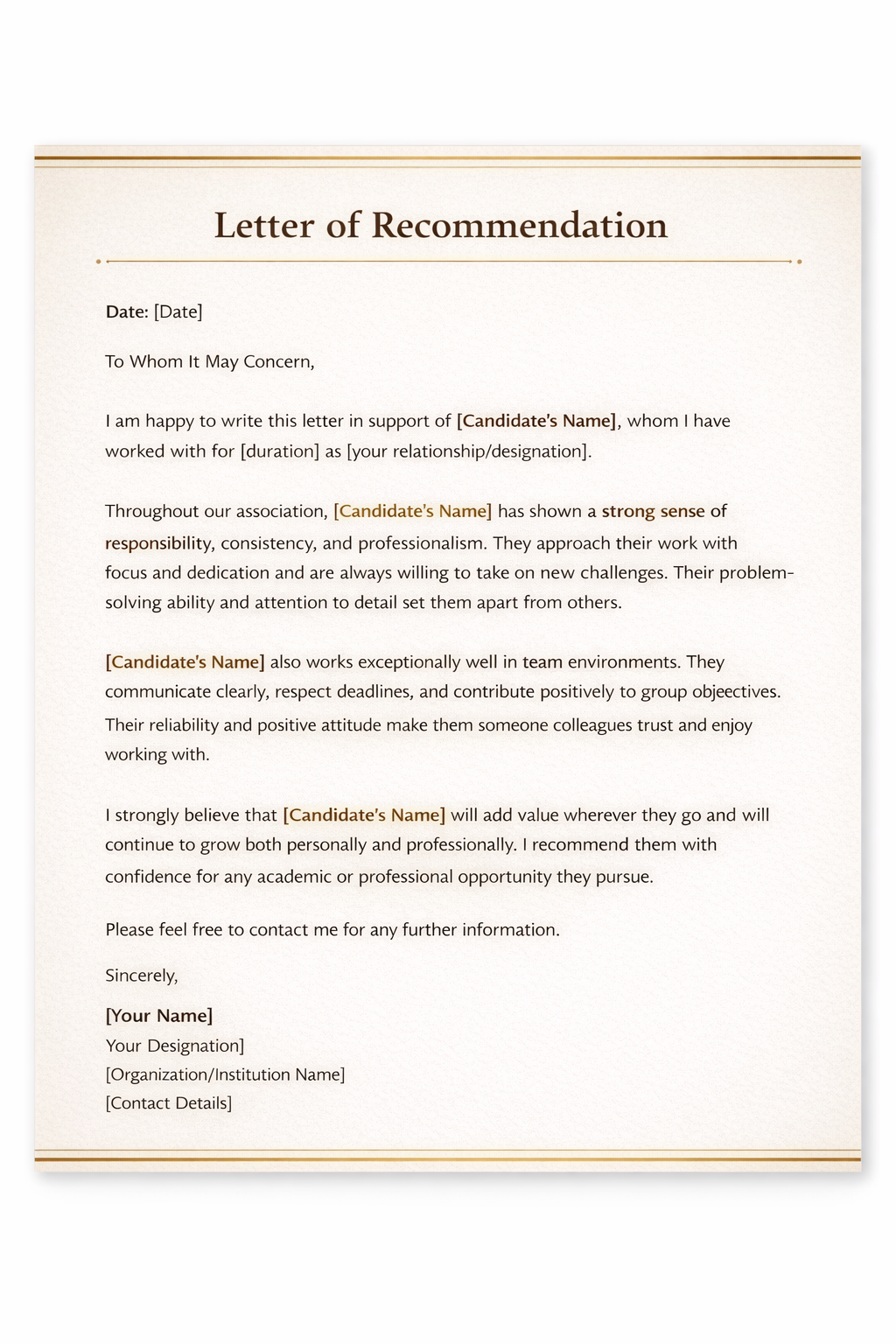
Letter of recommendation samples
-
Sample Employment Letter of Recommendation:
[Your Name]
[Your Title]
[Your Company/Organization]
[Your Address]
[City, State, Zip Code]
[Email Address]
[Phone Number]
[Date]
[Recipient’s Name]
[Recipient’s Title]
[Recipient’s Company/Organization]
[Recipient’s Address]
[City, State, Zip Code]
Dear [Recipient’s Name],
Kindly allow me to advocate on behalf of [Employee’s Name] for any job vacancy. During my one-year employment period at [Your Company/Organization], I have been honoured to be the supervisor of [Employee’s Name], who is the [Employee’s Position]. As such, I can say for sure that [Employee’s Name] is a reliable employee who performs well, has great professionalism, and is a remarkable person overall.
The [Employee’s Name] has been an outstanding selection of our team, which has always shown considerable creativity and character and has come up with better approaches to meet the targets. They are equipped with [list the skills or qualities such as good teamwork] which played a role in [name the projects or accomplishments such as team building training program design for corporate] success.
Apart from [Employee’s Name] excellent technical skills they also have excellent communication skills, adaptability, and a positive attitude, making [Employee’s Name] an enjoyable person to be around and a reliable team player. They have made a massive impact that reaches as far as [provide details including any leadership positions, certification programs, or unique tasks they have led and been a part of].
In this regard, I am strongly convinced that in any task [Employee’s Name] will show the same hard work, professionalism, and positive attitude. I am a true testimony that the job done is excellent with a high level of professionalism.
Be happy to hear from you by sending an email at [Your Email Address] or calling [Your Phone Number], if you need any further information and feedback regarding [Employee’s Name].
I am suggesting that [Employee’s Name] be considered for this position as he/she has all the qualifications needed to perform the job requirements effectively. They will get the job done and why this is certain: it will become valuable to your organization.
Best regards,
[Your Name]
[Your Title]
Letter of recommendation templates
1. For the CEO or Co-Founder position
Dear [Recipient Name],
I endorse with confidence [Applicant’s Name] for the Chief Executive Officer/ Founder position for your organization. [Candidate Name] has proven to be a great leader, a creative thinker, and a competent manager to us during his/her work period with the company. Regretfully our
The current system doesn’t allow us to hire him, but I still believe [Candidate Name] would meet all the requirements of this position.
[Candidate Name] drove us through the stages of prominence, deployed strategies, and motivated staff under his/her supervision. [Her/his] creativity, diligence, and far-seeing spirit will deliver [a/the] huge value to your company.
Please don’t hesitate to be in touch for additional information.
Sincerely,
[Your Full Name]
[Your Title]
2. For a Software Engineer position
Dear [Recipient Name],
I am writing to strongly recommend [Candidate’s Name] for the role of Software Engineer at [Company Name]. Having worked closely with [Candidate’s Name] for the past [X] years in my role as [Your Title] at [Your Company], I have had the opportunity to directly observe their technical expertise, problem-solving ability, and professional integrity.
Throughout our collaboration, [Candidate’s Name] has consistently demonstrated a high standard of performance and ownership. Some notable contributions include:
Performance Optimization: Played a key role in optimizing Project X by improving system efficiency and reducing server load, resulting in approximately a 30% improvement in application performance and a noticeably smoother user experience.
Quality and Stability Improvements: Took a detail-oriented approach to debugging and issue resolution, contributing to a 25% reduction in software defects and improved overall system reliability and uptime.
Agile Project Execution: Successfully delivered projects within defined timelines while working in an agile development environment, maintaining strong coordination across cross-functional teams.
Technology Adoption and Innovation: Proactively explored and implemented [specific technology], leading its integration into the existing tech stack and enabling the team to adopt more scalable and future-ready solutions.
Beyond technical proficiency, [Candidate’s Name] brings a growth-oriented mindset, collaborates effectively with team members, and approaches challenges with initiative and accountability. I am confident they would be a valuable addition to your engineering team and contribute meaningfully toward achieving organizational goals.
Please feel free to contact me at [Your Email Address] or [Your Phone Number] should you require any additional information.
Warm regards,
[Your Name]
[Your Title]
[Your Company]
3. For a new intern
Dear [Recipient’s Name],
I am happy to suggest (name) for the position of the team member in your organization. Within this period, the intern at [Your Company], [Intern’s Name], excelled in all key skills, exhibited special efforts, and undoubtedly, held themselves to the highest standards.
[Intern’s Name] stands out for:[Intern’s Name] stands out for:
Fast Learner: An intern’s name proved himself to be a very quick learner and was ready to learn new skills unhesitatingly.
Proactive: They did not wait for the assignments and they usually had different input. They led various tasks and they actively participated in the accomplishment of the projects.
Team Player: I would recommend [Intern’s Name] for a position because they have integrated into our group consequently and had a primarily constructive impact on our group projects.
Attention to Detail: [Intern Name] has been an invaluable contributor to our team with their contributions characterizing accuracy and precision.
To sum up, the intern is a hard-working, reliable, and capable team member with great potential to influence other team members positively. If there are questions that I haven’t answered or extra bits of information needed, please do not hesitate to send me an email at [Your Email Address] or call me at [Your Phone Number]
[Your Name]
[Your Title]
[Your Company]
Who needs a Letter of recommendation?
- College or University Applications: Top school students submit letters of recommendation to their colleges or universities while they finish up the application process which is sometimes seen through their course teachers, counselors, or mentors. The letters in this context serve as insightful tools for admission officers whose job is to evaluate students’ academic merits, personal qualities, and prospects of leaving a mark on campus.
- Graduate School Applications: Typically individuals pursuing graduate degrees in the fields of master’s, doctoral, or professional ones usually need letters of reference to be obtained from teachers or research mentors, although this is not the only case. Such letters of recommendation are of paramount importance for the assessment process, they speak on the ability of the candidate to perform well academically, to build up their research, and for graduate studies.
- Job Applications: As part of the job-seeking process, job seekers could be required to provide a letter of recommendation for reference from past employers, supervisors, or colleagues. Such letters from previous employers will serve to reveal to prospective employers the candidate’s general attitude to work, the skills gained and applied, the achievements made, and finally the suitability for the job.
- Scholarship Applications: When students are competing, it is an important factor because it can often be the source of letters of recommendation by teachers, counsellors, and community leaders. These reference letters of recommendation stand behind the application of the applicant by informing that the applicant is either academically successful, extraordinarily gifted, dedicated in extracurricular subjects, or financially needy
- Professional Certifications and Licenses: Industry workers seeking professional accreditations or licenses include lawyers, doctors, engineers, and accountants who may be unravelling character attestations from their colleagues, experts, and mentors through professional letters of recommendation illustrating their competence, upholding good professional ethics, and having professional experience.
- Internship or Fellowship Applications: Students or early-career job seekers looking for placements, accepting programs, research opportunities, or internships, often require a letter of recommendation where their skills, aspirations, and contributions that can be offered can be documented.
- Career Advancement: Individuals aiming for a future promotion, transfer, or new job within their current organization, could be supported if they received letters of recognition from their area managers, superiors, or seniors. Such letters assure the voter’s meritoriousness, provide information about the candidate’s leadership skills, and the appropriate level position
letter of recommendation requirements
Introduction: Commence the letter with a short presentation that would explain why you are competent to push a recommendation for a candidate who has met the criteria set by the organization.
Candidate’s Information: Give the necessary information about the applicant, their full name, and what the candidate is pursuing an application for the graduation, or position and any other information such as the duration might be helpful.
Contact Information: The recommender should include their name in full, title, name of organization/institution, postal address, phone number, and email at the beginning of the letter.
Personal Attributes: Explore the candidate’s characteristics such as their effective performance, dependability, leadership capabilities, being a team player, good communication package, and other important features for the role or program.
Qualifications and Strengths: Point out the candidate’s qualities, professional qualities, and skills that are suitable for the position they applied for. Pay special attention to their outstanding characteristics. Specific examples or anecdotes are what you should employ to help you back up your reasoning.
Comparison of Context: If you must, involve a contrast between the subject and the others whom you encountered in analogous situations. Employing these readers can grasp the candidate’s specific qualities and conduct.
Contact Information and Signature: Send your signature (if it may be a physical letter) as well as your contact information once again at the end of the letter. For the digital submissions, you are not supposed to be having the signature kind of thing but please make sure that your contact information is listed.
Format and Length: Follow whatever specific formatting instructions you are given (like font, margins, and spaces) by the recipient. The progeny of that letter must be concise and focused, usually one to two A4 pages long.
Achievements and Contributions: Bring the candidate’s specific accomplishments, initiatives, projects, or leadership skills into focus that illustrate his/her potential and abilities. Another example of tech start-up technologies involves the use of drones for applications such as filmmaking, photography, or product deliveries.
Closing Statement: Bring the letter to an end by providing a very clear and strong statement that includes the summary of your recommendation and expresses the level of confidence that you have about the candidate’s success.