What Is the Average HR Salary in India Today?
The average HR salary in India ranges from ₹2.5 lakh to ₹18 lakh per year. HR freshers typically earn ₹2.5–4.5 LPA, mid-level HR professionals earn ₹6–12 LPA, and senior HR managers or HR business partners earn ₹15–30 LPA or more. HR salary in India depends on experience, role responsibility, industry, company size, and exposure to payroll, compliance, and business decision-making.
These salary ranges are based on current hiring trends, HR salary benchmarks in India, and industry data in India as of 2026.
At a broad level, HR salaries usually fall into these ranges:
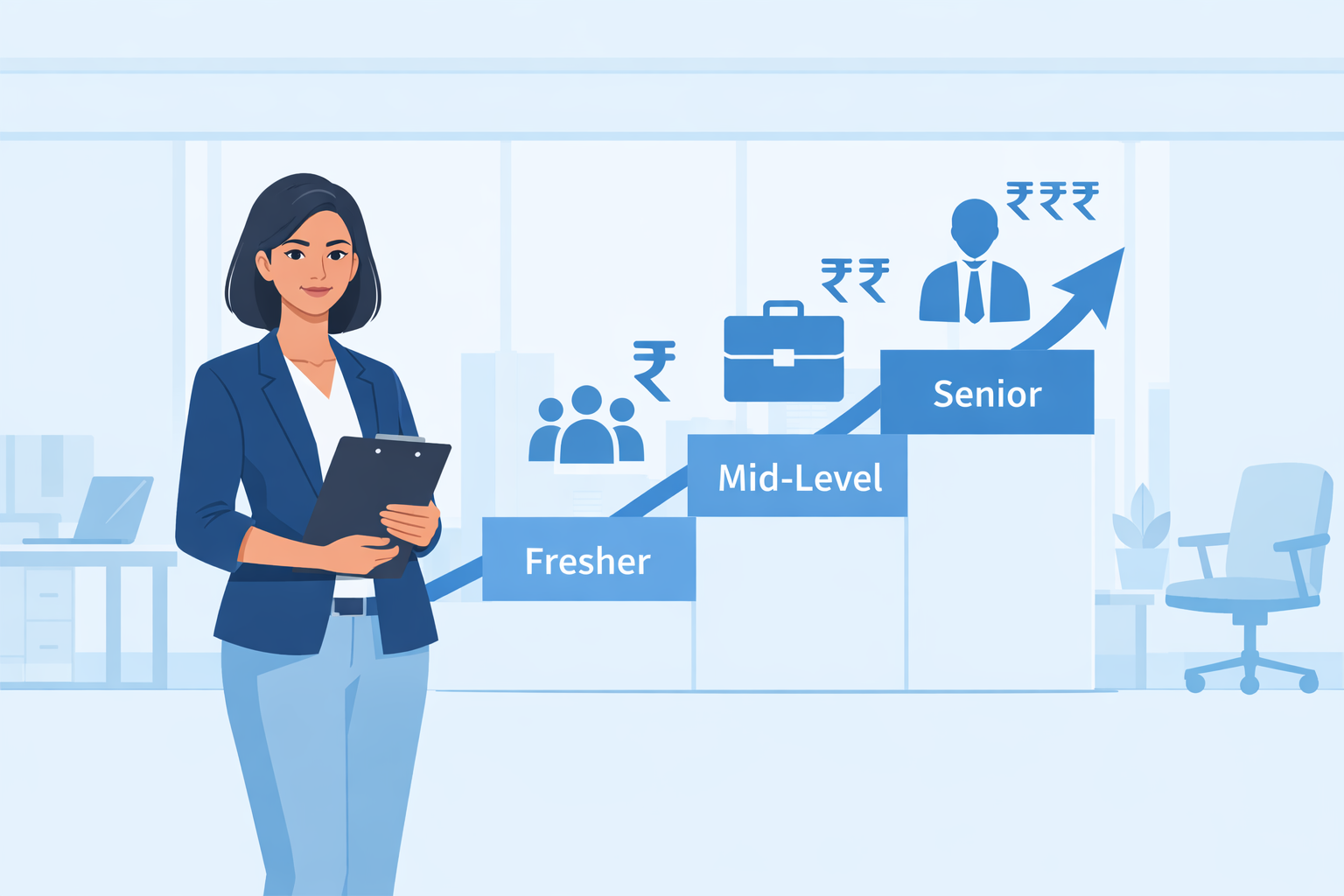
- HR freshers earn around ₹2.5–4.5 LPA
- Mid-level HR professionals earn approximately ₹6–12 LPA
- Senior HR managers and HR leaders earn ₹15–30 LPA or more
There is no single fixed HR salary because HR roles differ significantly in scope and impact. An HR executive focused on onboarding, documentation, or coordination is compensated very differently from an HR business partner involved in compensation decisions, workforce planning, compliance risk, or leadership strategy.
This wide salary range exists because HR is no longer viewed only as an operational function. Pay increases sharply as HR professionals move closer to specialized, decision-making, and business-facing roles. Responsibility, not designation alone, is what pushes HR salaries higher.
HR Salary by Experience in India: From Fresher to Senior Roles
HR Salary by Experience in India: From Fresher to Senior Roles
Salary levels in HR roles increase over time, but growth is not linear. The biggest jumps usually happen when professionals move from execution-focused work to ownership, specialization, and business-facing responsibilities.
Based on current hiring trends, this is how pay progression typically looks.
Salary for Freshers (0–1 Year Experience)
Fresh HR graduates in India usually earn between ₹2.5 to ₹4.5 LPA.
Entry-level roles are largely execution-driven. These include recruitment coordination, onboarding documentation, employee record management, attendance tracking, and basic HR operations.
At this stage, professionals are primarily learning systems, processes, and organizational workflows.
Since decision-making responsibility is minimal, compensation remains modest.
Therefore, growth at this level depends more on skill development and exposure than on tenure alone.
Salary with 2–4 Years of Experience
With 2–4 years of experience, pay levels in India typically rise to ₹4.5 to ₹7.5 LPA.
Professionals begin handling defined responsibilities independently. This includes end-to-end recruitment for specific roles, payroll input coordination, compliance support, and employee query management.
This is a critical growth phase.
Moreover, individuals who gain exposure to payroll, statutory compliance, or regular stakeholder interaction often see faster progression than those restricted to routine tasks.
Salary with 5–8 Years of Experience
Mid-level professionals generally earn around ₹7 to ₹12 LPA.
At this stage, roles become more ownership-driven. They may involve policy implementation, performance management cycles, employee relations, and team coordination.
Consequently, HR starts contributing directly to organizational outcomes rather than only supporting processes.
This shift is where income growth becomes more noticeable.
Senior-Level Salary (9+ Years of Experience)
Senior managers, business partners, and strategic roles typically earn ₹12 to ₹20+ LPA, with higher ranges seen in large enterprises and global organizations.
At this stage, compensation depends less on years of experience and more on leadership trust, business impact, decision-making responsibility, and specialization such as compensation, compliance, or workforce planning.
HR Salary by City in India: Does Location Really Matter?
Yes, location still plays a significant role in pay levels across India.
However, the gap between cities is gradually narrowing.
Earnings vary by region due to industry concentration, cost of living, and the type of companies operating in that area.
Salary in Metro Cities
In metro cities like Bengaluru, Mumbai, Delhi NCR, Hyderabad, Pune, and Chennai, earnings are generally higher due to the presence of IT companies, SaaS startups, global capability centers, and MNC headquarters.
Salary in Metro Cities
In metro cities like Bengaluru, Mumbai, Delhi NCR, Hyderabad, Pune, and Chennai, earnings are generally higher due to the presence of IT companies, SaaS startups, global capability centers, and MNC headquarters.
| City | Entry-Level HR (0–2 yrs) | Mid-Level HR (4–8 yrs) | Senior HR (10+ yrs) |
|---|---|---|---|
| Bengaluru | ₹3 – 5 LPA | ₹8 – 14 LPA | ₹18 – 25+ LPA |
| Mumbai | ₹3 – 5 LPA | ₹7.5 – 13.5 LPA | ₹18 – 24+ LPA |
| Delhi NCR | ₹3 – 4.5 LPA | ₹7 – 13 LPA | ₹17 – 23+ LPA |
| Hyderabad | ₹3 – 4.5 LPA | ₹7 – 12.5 LPA | ₹16 – 22+ LPA |
| Pune | ₹3 – 4.5 LPA | ₹7 – 12 LPA | ₹16 – 21+ LPA |
| Chennai | ₹3 – 4.5 LPA | ₹6.5 – 12 LPA | ₹15 – 20+ LPA |
| Tier-2 Cities (Avg.) | ₹2 – 3.5 LPA | ₹5 – 9 LPA | ₹12 – 16 LPA |
Tier-2 and Non-Metro Cities
In tier-2 cities, pay levels are typically 10–30% lower than metro averages.
Fresh professionals: ₹2–3.5 LPA
Mid-level roles: ₹5–9 LPA
Senior roles: fewer opportunities and often capped unless the company has national or global operations
Lower compensation is often balanced by lower cost of living, reduced competition, and better work-life balance.
Cost of Living vs Salary Reality
Higher pay in metro cities does not always translate into higher savings.
Rent, commuting, and daily expenses can significantly reduce take-home income.
In contrast, slightly lower pay in non-metro cities may offer better financial comfort.
Therefore, many professionals evaluate income together with living costs, not salary alone.
Startup vs MNC: How Company Type Impacts HR Salary
City-wise compensation also depends on company type.
Startups (mostly metro-based): faster growth, broader responsibilities, and higher pressure
MNCs and large enterprises: structured pay bands, stable increments, and stronger long-term growth
As a result, a professional in a metro-based startup may earn more than one in a tier-2 city MNC, but with very different expectations and workloads.
What Decides an HR Professional’s Salary in India?
HR salaries vary widely even among professionals with similar experience. The difference usually comes down to role scope, industry exposure, and responsibility level.
| Factor | How It Impacts HR Salary |
| Experience vs Skills | Salary increases faster when experience translates into ownership and decision-making |
| Industry Type | IT, SaaS, BFSI, and global enterprises usually pay more |
| Company Size | Larger organizations offer higher HR salaries due to complexity and scale |
| Specialization vs General HR | Payroll, compliance, C&B, and HRBP roles pay more than general HR |
| Payroll & Compliance Exposure | Legal accountability increases compensation |
| HR Technology Exposure | Experience with HRMS and payroll systems improves earning potential |
| Ownership & Accountability | Outcome-driven roles scale faster in salary |
HR Still Has a Gender Pay Gap Even If It Is Limited to 8 to 12 Percent
In India, HR shows a gender pay gap of around 8–12%, which is lower than most corporate functions but still present, especially at senior levels.
HR performs better on pay equity due to structured pay bands and higher female representation at entry and mid-career levels. However, as roles become senior and compensation includes bonuses and variable pay, gaps tend to reappear.
The difference is visibility. HR pay gaps are easier to identify and correct, making long-term parity more achievable.
How HR Compares to Other Corporate Functions
Compared to revenue-driven and performance-heavy roles, HR salaries usually follow defined pay bands and standardized job levels. This limits large pay differences for similar roles and reduces the impact of aggressive salary negotiation, which often widens gaps in other functions.
Another reason HR fares better is representation. Higher female participation at entry and mid-career levels helps stabilize salary benchmarks. As a result, pay differences in HR tend to remain narrower at junior and mid levels, while many other corporate functions see gaps widen much earlier in a career.
Where the Pay Gap Still Shows Up
The gender pay gap in HR becomes more visible as roles move into senior and leadership positions. At this stage, compensation is no longer driven mainly by fixed salary and increasingly includes variable pay, bonuses, and long-term incentives.
These elements are less standardized and more discretionary, which can reintroduce differences even when base pay remains aligned. HR leadership roles that combine people responsibility with regional scope or business ownership also show wider variation, driven more by scale and impact than by title alone.
Is HR a High-Paying Career in the Long Run?
HR is not a high-paying career at the start, and it rarely offers quick financial jumps.
However, over time, HR can become financially rewarding for professionals whose roles grow beyond routine tasks and move closer to business decision-making.
For most people, HR salary increases steadily until mid-career.
After that, growth depends less on years of experience and more on what kind of HR work you do.
General HR roles usually see stable but limited salary growth.
In contrast, roles connected to compensation, compliance, workforce planning, analytics, or leadership involvement tend to scale much higher.
In simple terms, HR can be a high-paying career in the long run, but it is not automatic.
It rewards depth, relevance, and accountability.
How HR Professionals Can Increase Their Salary in 2026
To increase salary in HR in 2026, professionals need to move from coordination work to owning payroll, compliance, compensation, or business decisions, while being comfortable working with AI-enabled HR systems.
If you are already experienced in HR and your salary feels stuck, the reason is usually simple. Your role has not changed enough, even if your experience has.
To grow your salary, stop thinking in terms of years and start thinking in terms of impact.
In practice, HR salary growth comes down to a few clear shifts in responsibility rather than waiting for annual increments.
First, look at your current work honestly. If most of your time goes into coordination, follow-ups, documentation, or manual processes, salary growth will remain limited. These activities are necessary, but they do not justify higher pay. To move beyond this ceiling, you must take ownership of work that affects money, risk, or decisions.
One practical step is to own payroll or compliance, even partially. Taking responsibility for payroll accuracy, statutory filings, audits, or compensation inputs immediately increases your value because mistakes in these areas cost the company time, money, and trust.
Next, focus on role movement before company movement. Changing organizations without changing responsibility rarely leads to meaningful salary growth. Moving into a role with more ownership or specialization almost always does, even within the same company.
Industry choice also matters. HR professionals working in IT, SaaS, BFSI, or larger enterprises usually see better salary progression because HR work in these environments is structured, system-driven, and closely tied to business outcomes.
In 2026, AI is no longer a future concept in HR. Payroll automation, resume screening tools, compliance checks, and people analytics are already part of daily HR operations. HR professionals do not need to become AI experts, but they do need to understand how these systems work and how to use their outputs in decision-making. Those who can do this are trusted with larger responsibilities and paid accordingly.
Finally, make your contribution visible in business terms. Talk about outcomes, not activities. Show how your work improves hiring quality, controls costs, reduces risk, or supports leadership decisions. HR professionals who help the business decide are always paid more than those who only help it run.
In simple terms, HR salaries increase when roles move from execution to ownership, from support to judgment, and from tasks to business impact.
Summing Up
HR salary in India depends more on responsibility than on years of experience. While freshers start with modest pay, salaries rise as roles move toward specialization, ownership, and business involvement. Location and industry matter, but long-term growth comes from handling payroll, compliance, compensation, and decision-making. In simple terms, HR becomes financially rewarding when the role shifts from execution to influence.
FAQs
1. What is the starting salary for HR freshers in India?
HR freshers in India usually earn between ₹2.5 and ₹4.5 LPA, depending on the company, city, and type of HR role.
2. Does city really affect HR salary?
Yes. Metro cities generally offer higher salaries due to industry concentration and cost of living. However, higher pay does not always mean higher savings because expenses are also higher.
3. Which HR roles pay the most in the long run?
Roles linked to compensation, payroll, compliance, workforce planning, and HR business partnering usually pay more than purely administrative HR roles.