
Summary
HR policies are written guidelines that define how an organisation manages employees, workplace behaviour, and legal compliance. They include compliance rules, conduct standards, operational processes, and remote work guidelines. Clear workplace policies reduce confusion, ensure fairness, and support consistent decision-making. Organisations must draft them carefully, communicate them clearly, and review them regularly to stay compliant and future-ready.
What Are HR Policies? (Definition & Purpose)
HR policies are formal guidelines that define how an organisation manages people, workplace conduct, compliance, and employee rights. They provide a structured framework for decision-making, ensuring consistency, fairness, and legal alignment across teams. In simple terms, these guidelines set the standards that shape how employees and managers act at work.
Organisations need a clear policy framework to reduce ambiguity, manage risk, and create predictable processes. Without structured guidelines, decisions become inconsistent, disputes increase, and compliance gaps emerge. Unlike general workplace rules, which are informal or situational, documented policies guide behaviour and organisational practices over time.
Types & Examples of HR Policies
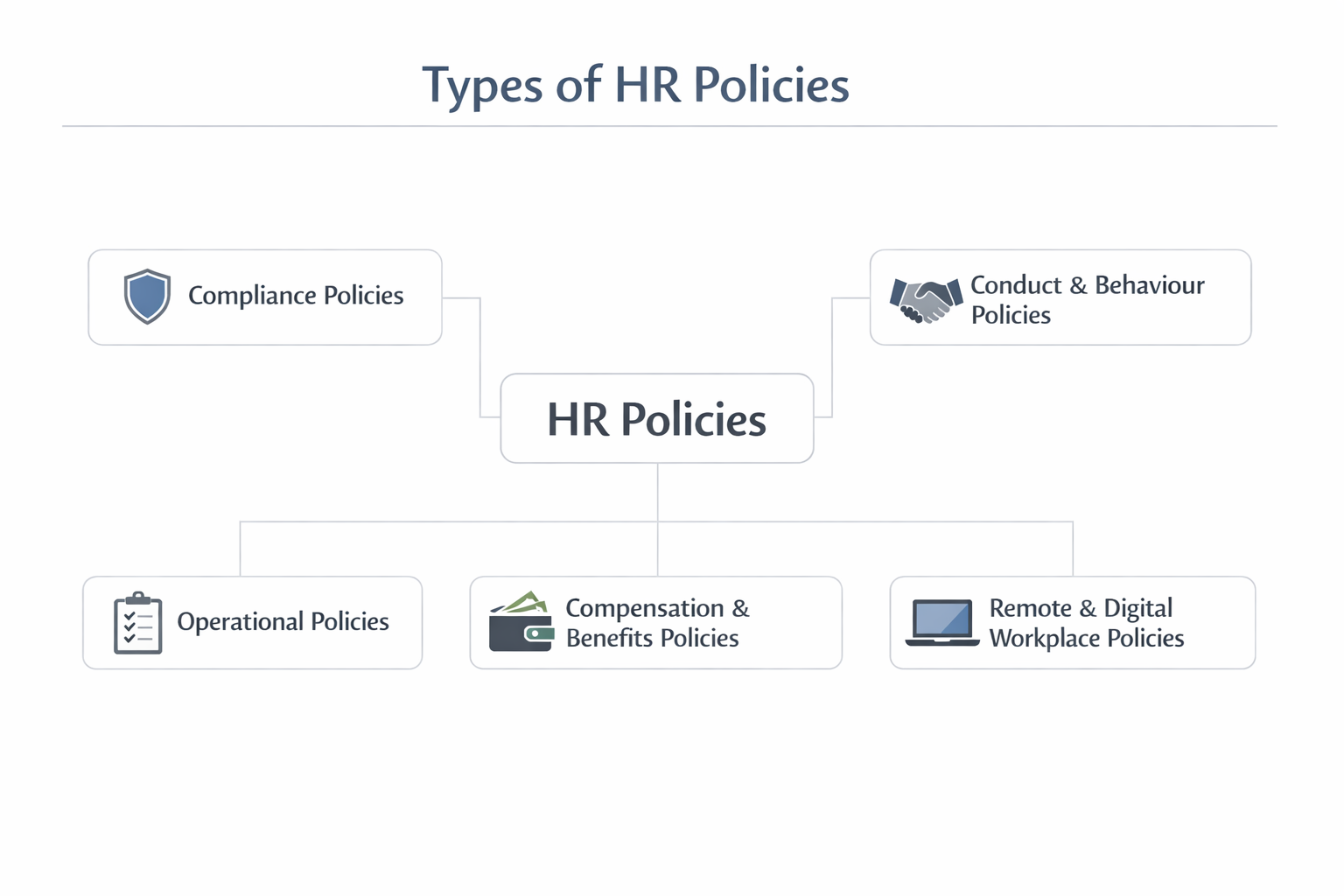
Workplace policies typically fall into five clear types, each designed to manage a specific area of the employment relationship.
Compliance Policies
These ensure the organisation meets legal and regulatory obligations. They include leave policies, wage and payroll rules, workplace health and safety standards, anti-harassment measures, and equal opportunity guidelines. For example, a company may implement a statutory leave rule or a workplace prevention of sexual harassment policy to align with labour law.
Conduct and Behaviour Policies
These define expected workplace behaviour. A code of conduct, anti-discrimination rule, conflict-of-interest guideline, and disciplinary framework help maintain professionalism and fairness across teams.
Operational Policies
Operational rules guide everyday processes. Attendance standards, onboarding procedures, performance review systems, and grievance redressal mechanisms ensure consistency in decision-making.
Compensation and Benefits Policies
These outline salary structures, bonus frameworks, health insurance coverage, and employee benefit programs. They provide transparency in rewards and entitlements.
Remote and Digital Workplace Policies
Modern workplaces require guidelines for hybrid work arrangements, data protection, cybersecurity practices, and acceptable IT usage.
Together, these policy categories create clarity, reduce risk, and establish structured expectations across the organisation.
HR Policies vs Procedures vs Employee Handbook
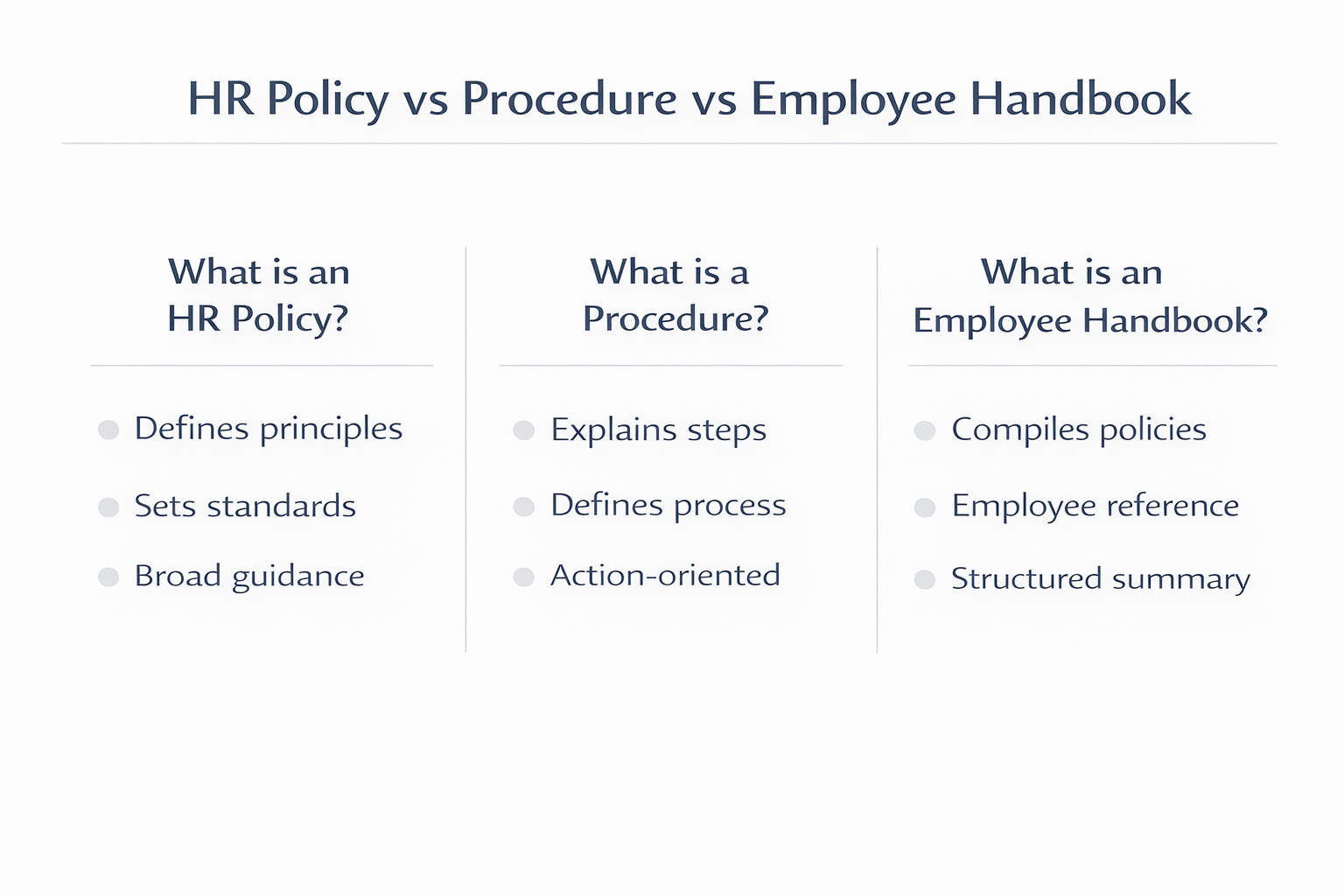
Many organisations use the terms HR policies, procedures, and employee handbook interchangeably. However, each serves a different purpose. Understanding the difference prevents confusion and improves workplace operations.
An HR policy states the principle or rule that guides decisions. It explains what the organisation stands for and the standards employees must follow. For example, an anti-harassment rule sets a zero-tolerance stance and defines unacceptable behaviour.
A procedure explains how to implement that rule. It outlines step-by-step actions. For instance, while the anti-harassment rule defines expectations, the grievance procedure explains how to report a complaint, who investigates it, and how decisions are made.
The employee handbook compiles important policies and key procedures into one accessible document. It serves as a reference guide for employees, helping them understand workplace expectations, rights, and responsibilities.
Key Differences
| Aspect | HR Policy | Procedure | Employee Handbook |
|---|---|---|---|
| Purpose | Sets principles and standards | Defines step-by-step actions | Compiles policies and procedures |
| Focus | What the rule is | How the rule is applied | Overall workplace guidance |
| Audience | Managers and employees | Managers and HR teams | All employees |
| Detail Level | Broad and principle-based | Specific and action-oriented | Summarised and structured |
Use a policy when defining organisational standards. Use a procedure when explaining implementation steps. Use hookup a handbook to communicate and centralise workplace rules.
Confusion between these elements can create compliance gaps, inconsistent enforcement, and legal exposure. Clear distinctions strengthen governance and reduce operational risk.
How HR Policies Work in Real Organisations
Policies shape daily decisions inside an organisation. They are not abstract documents; they guide real actions in real situations. When written clearly and applied consistently, they create structure and reduce uncertainty.
Practical Scenarios in the Workplace
Consider onboarding. A clear onboarding rule defines probation terms, documentation requirements, training timelines, and performance expectations. As a result, new employees understand what to expect from day one, and managers follow a standard process instead of improvising.
For leave requests, a leave rule outlines eligibility, approval steps, and documentation requirements. Consequently, managers review requests based on defined criteria rather than personal judgment, which prevents bias and ensures fairness.
During workplace disputes such as misconduct or harassment complaints, guidelines provide a framework for investigation and resolution. A conduct rule defines unacceptable behaviour, while a grievance procedure explains how complaints are handled. Because expectations remain documented, decisions stay consistent across departments.
For remote or hybrid work, policies clarify working hours, data security rules, communication standards, and performance tracking. Employees understand what flexibility means in practice, and managers maintain accountability without micromanaging.
How Managers Apply Policies Consistently
As a result, managers use documented guidelines as decision-making anchors instead of relying on memory or personal interpretation. This improves consistency across teams. When leaders follow the same framework, employees experience predictable outcomes, and trust in leadership strengthens over time.
Moreover, clear rules support difficult conversations. Whether addressing performance issues or disciplinary action, structured guidance reduces hesitation and helps leaders act confidently.
Impact on Employees and Workplace Culture
Well-implemented workplace policies improve transparency. Employees understand their rights, responsibilities, and available support systems. As a result, they feel more secure and less dependent on informal arrangements. Fair enforcement reinforces accountability and mutual respect, which strengthens organisational culture.
What Happens When Policies Are Unclear or Absent
Without clear guidelines, organisations face inconsistency. Managers make different decisions for similar situations, leading to confusion and perceived unfairness. Disputes increase, compliance risks grow, and employee morale declines. In some cases, unclear rules expose the organisation to legal challenges.
Therefore, organisations must document standards clearly, communicate them effectively, and apply them consistently. In practice, they provide structure, reduce risk, and support a stable work environment.
How to Create, Implement & Review HR Policies
Effective policies require clear drafting, proper communication, and regular review. A structured approach ensures consistency, compliance, and long-term relevance.
Step-by-Step Drafting Process
Identify the need
-
Review workplace challenges
-
Assess legal requirements
-
Identify operational gaps
Define the objective
-
State what the rule aims to address
-
Align it with organisational goals
Set the scope
-
Specify who it applies to
-
Define the situations it covers
Use clear language
-
Keep wording simple and precise
-
Avoid vague or overly complex terms
Clarify roles
-
Define employee responsibilities
-
Specify manager and HR oversight
Separate policy from procedure
-
Keep principles in the policy
-
Document detailed steps separately
Review and approve
-
Conduct leadership review
-
Ensure legal compliance
-
Align with organisational values
Legal Alignment (India + Global Context)
Additionally, organisations must ensure policies comply with applicable labour laws. In India, align them with wage, working hours, maternity benefit, safety, and harassment regulations. Globally, consider employment standards, anti-discrimination laws, and data protection rules. Proper alignment reduces disputes and compliance risk.
Communication & Acknowledgment
Publish policies through the employee handbook or HR system. Explain key points during onboarding or training. Obtain employee acknowledgment to ensure awareness and accountability.
Governance & Review Cycle
Assign policy ownership to HR with leadership support. Review policies annually or when regulations change. Regular updates keep them relevant and enforceable.
Common HR Policy Mistakes & Legal Risks
Many organisations draft policies with good intent, yet common mistakes reduce effectiveness and increase legal risk.
1. Vague or Poorly Written Policies
Unclear language creates confusion. Terms like “reasonable behaviour” without explanation leave room for interpretation. Consequently, managers may apply rules differently across teams, weakening fairness and increasing disputes.
2. Copy-Paste Templates Without Legal Validation
Generic templates rarely reflect local labour laws or company realities. Without legal review, policies may conflict with regulations and expose the organisation to penalties or claims.
3. Inconsistent Enforcement Across Teams
Even well-written guidelines fail when applied unevenly. Approving leave for one employee but denying another under similar conditions creates perceived bias and damages trust.
4. Outdated Policies Creating Compliance Gaps
Labour laws and workplace models evolve. Similarly, if organisations fail to update policies regularly, they risk non-compliance. Changes in remote work practices or statutory benefits require timely revisions.
5. Legal Exposure and Workplace Disputes
Unclear or outdated rules often lead to complaints, internal conflicts, or legal action. Therefore, organisations must review policies periodically and enforce them consistently to minimise risk.
Measuring & Future-Proofing HR Policies
Writing policies is not enough. Organisations must regularly check whether those rules actually work. If a rule creates confusion or repeated disputes, it needs improvement.
Key Signs a Policy Works
-
Employee complaints reduce
-
Managers handle issues consistently
-
Fewer conflicts reach formal stages
-
Employee turnover remains stable
If similar problems repeat, the policy likely needs clearer wording.
Listening to Employees
Surveys, exit interviews, and grievance records reveal whether people understand and trust workplace rules. Frequent questions about leave, conduct, or benefits indicate the need for clearer wording.
Using Digital HR Systems
Digital systems help track who has read and accepted policies. They ensure employees always access the latest version, reducing confusion and supporting audits.
Preparing for the Future
Workplaces continue to evolve. Remote work, data privacy, and AI tools require updated expectations for hybrid work, employee data usage, and digital behaviour.
When organisations review policies regularly and update them as needed, they reduce risk and build a stable and fair workplace.
Key Takeaways
-
HR policies define workplace standards and employee rights
-
Clear rules reduce confusion and support legal compliance
-
Different categories manage conduct, operations, and remote work
-
Policies differ from procedures and employee handbooks; overall each serves a specific purpose
-
Outdated rules increase operational and legal risk
-
Regular review and feedback keep them effective
-
Modern workplaces must address data security, remote work, and AI usage
Strong policies create clarity, consistency, and accountability across the organisation while strengthening employee trust.
FAQ
1. What are HR policies in simple terms?
They are written rules explaining how a company manages employees and workplace behaviour.
2. What are the most important types?
Compliance, conduct, operational, and remote work policies.
3. Why are they important?
They reduce disputes, support legal compliance, and ensure fair decisions.
4. How should they evolve?
They must adapt to remote work, data privacy, and AI usage.