What Is an Employee Handbook and Why Is It Important?
An employee handbook is a written company document that defines workplace rules, employee responsibilities, and company policies in one place.
It serves as a single reference employees can rely on from their first day to understand expectations and procedures.
Businesses prepare this document to maintain consistency, avoid confusion, and formally communicate HR policies such as attendance, conduct, and grievance handling.
For employees, it explains what the company expects and what they can expect from the company.
For employers in India, it documents that workplace policies were communicated.
In daily operations, the handbook functions as an operational guide that protects both the organization and its employees.
Summary
An employee handbook explains workplace rules, responsibilities, and policies in one document.
It is not legally mandatory in India, but organizations use it to communicate standards, prevent disputes, and support compliance.
Typical sections include conduct rules, leave policy, payroll details, POSH procedures, IT usage, and exit processes.
Who Needs an Employee Handbook?
Organizations of every size in India benefit from having this document, including startups, small and medium enterprises, and large companies.
For startups, it establishes workplace standards early and prevents informal practices from becoming permanent habits.
As companies grow, it ensures rules remain consistent across teams and managers.
For established businesses, it supports structured HR management and fair treatment.
Any organization employing people benefits from documenting expectations before issues occur.
Is an Employee Handbook Mandatory in India?
No single law makes an employee handbook compulsory for every organization.
However, multiple workplace regulations require employers to communicate conduct, leave, safety, and grievance rules.
A handbook becomes the practical method to document and share these obligations.
Even when not legally required, it demonstrates that employees were informed of workplace policies.
Role of HR and Management
HR teams rely on the handbook to standardize onboarding, attendance, discipline, and exit processes.
Management uses it to make decisions based on policy rather than personal judgment.
This ensures similar situations are handled consistently across employees.
Companies with remote or multi-city teams need uniform rules to avoid confusion and unequal treatment.
Written policies ensure employees are evaluated using the same standards regardless of manager or location.
A documented handbook therefore reduces disputes caused by inconsistent decisions.
What Should an Employee Handbook Include?
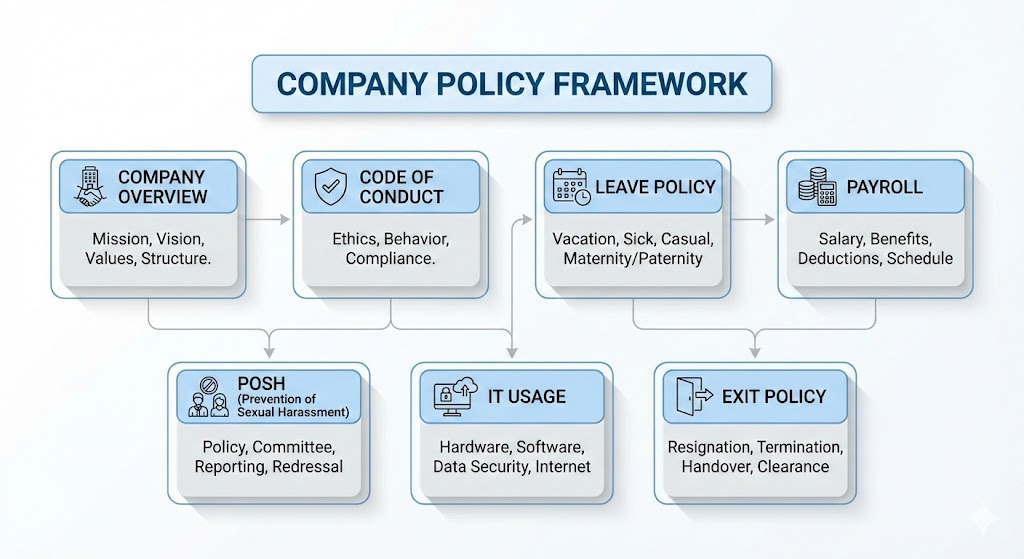
A well-designed handbook acts as a complete reference for internal rules.
A complete handbook normally covers culture, employment terms, conduct standards, compensation practices, safety, technology usage, and separation procedures.
Company Overview
Introduces the organization’s mission, values, and culture so employees understand business direction.
Employment Terms
Explains employment type, probation period, working hours, and responsibilities to clarify the employment relationship.
Code of Conduct
Defines acceptable behavior so workplace discipline does not depend on individual interpretation.
Attendance and Leave
Outlines working hours and leave rules to prevent approval misunderstandings.
Payroll and Benefits
Explains salary structure and benefits to ensure compensation transparency.
POSH Policy and Grievance
Describes complaint procedures so employees know how concerns are formally addressed.
IT and Data Usage
Provides system usage rules to protect company information and resources.
Disciplinary Rules
Specifies actions for misconduct so corrective steps follow a predefined process.
Exit and Notice Period
Clarifies resignation and termination procedures to ensure structured separation.
Together, these sections form a consistent HR operating framework.
Employee Handbook Template (Editable Format)

How to Create and Update an Employee Handbook
Start by drafting workplace rules covering conduct, attendance, leave, payroll, safety, and grievance handling.
Policies should be written in clear language so employees can understand them without interpretation.
Adapt rules to company size to keep them practical.
Review with management before implementation.
Share during onboarding and collect acknowledgment.
Update whenever policies or laws change and communicate revisions clearly.
Common Employee Handbook Mistakes and Best Practices
Common Mistakes
Copy-paste policies that don’t match operations
Complex legal language
Outdated rules
Skipping employee acknowledgment
No periodic review
Best Practices
Simple business language
Customized policies
Annual review
Written acknowledgment
Clear structure
Final Thoughts
An employee handbook helps organizations clearly define workplace rules, responsibilities, and expectations in one document. While it is not legally mandatory in India, it plays an important role in supporting compliance, consistency, and fair treatment. By maintaining a well-structured and regularly updated handbook, companies can reduce confusion, improve transparency, and build a more disciplined and professional work environment.
FAQs
Is an employee handbook legally binding?
It is not a contract by default, but acknowledged policies may carry legal weight.
Difference between HR policy and handbook?
A policy covers one topic, while a handbook combines all key rules.
How often should it be updated?
At least once a year or when laws change.
Is it mandatory in India?
No single law requires it, but employers must communicate workplace rules.