AI in HR — what it actually means inside a company
AI in HR doesn’t mean replacing people with machines. It means the system understands patterns and supports decisions instead of just storing data. Traditional HR software records information, while automation follows fixed rules. AI goes a step further — it learns from attendance trends, leave behaviour, payroll inputs, and employee queries to guide consistent actions. That’s why HR conversations shifted recently: growing teams create more decisions than humans can manually track. Today, AI already works quietly in approvals, validations, and support responses. For startups and scaling companies, it acts like a decision assistant — reducing repetitive effort while helping HR focus on judgement, communication, and people experience.
If AI entered your HR department tomorrow, what would change first?
Your day would stop revolving around checking things and start revolving around reviewing them.
Before AI in HR, HR work begins with collecting information — attendance corrections, leave balance questions, approval reminders, payroll cross-checks. You spend time asking, following up, and confirming. Most effort goes into finding what needs attention.
After AI, the system brings the important items to you. Instead of opening multiple sheets and chats, you see alerts: who needs approval, which entries look incorrect, where policy rules don’t match, and what may affect payroll. Employees check their own information because answers are available instantly, so repetitive questions drop.
Manual tracking disappears, but decisions remain. You don’t calculate leave; you confirm exceptions. You don’t verify every salary input; you review flagged mismatches. You don’t chase managers; the workflow notifies them automatically.
Nothing major is removed — the focus changes.
HR shifts from gathering data to judging situations.
So the first real change is simple:
you stop managing updates and start managing outcomes.
Will the system start making decisions instead of people?
Most teams first assume that once AI enters HR, approvals will happen automatically and human control will reduce. The actual change is more specific.
AI handles situations where the rule is already clear.
If leave balance is sufficient, the system confirms eligibility.
If attendance violates policy limits, it flags it.
If payroll inputs don’t match records, it alerts HR.
Here the system applies the written policy consistently, not independently.
Human judgment remains necessary where context exists.
An emergency leave, a special allowance, or a performance concern needs interpretation. The system only surfaces the situation — HR decides the response.
Control also stays intact through overrides.
HR and managers can approve exceptions when required. The difference is that decisions become recorded and explainable instead of informal.
Responsibility therefore does not shift to software.
People still design the rules and approve unusual cases. AI simply ensures the routine decisions follow the same standard every time.
So the change is not decision replacement.
It is decision clarification.
The system handles predictable scenarios, while HR handles meaningful ones — which makes authority clearer, not smaller.
What really happens inside HR operations when AI runs in the background
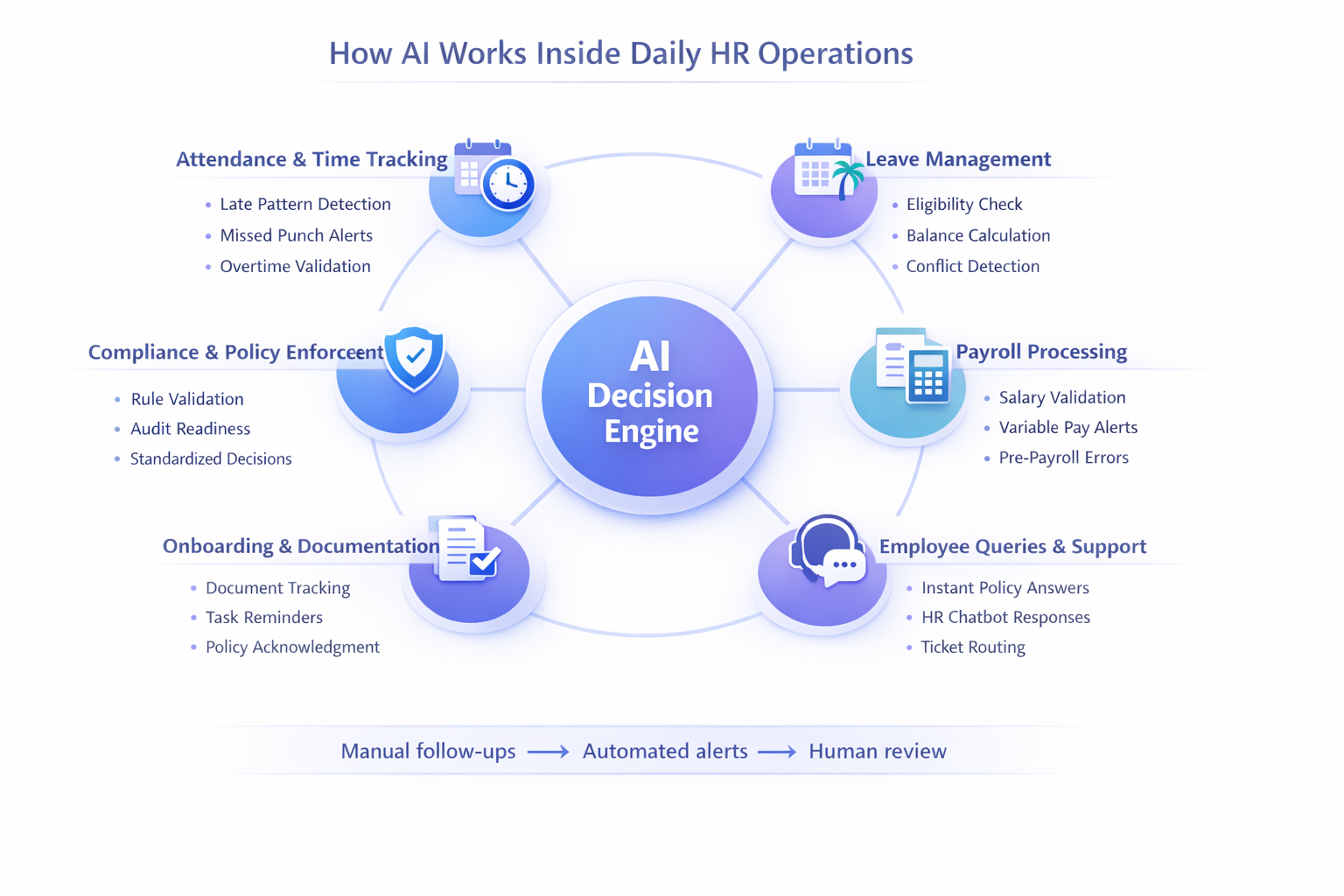
When AI supports HR operations, the change is not dramatic on the surface. The real difference appears in how work flows during the day.
In AI in HR start with attendance. Earlier, HR checked logs after employees reported problems or before payroll processing. Now the system continuously watches patterns. Instead of reviewing every entry, HR only looks at unusual behaviour such as repeated late trends, missed punches, or overtime irregularities. The effort shifts from scanning records to understanding why something happened.
Leave management changes in a similar way. Managers no longer interpret policy each time manually. The system checks eligibility instantly. If rules match, the request moves forward. If a conflict appears, HR reviews it before approval. The role moves from calculating balances to handling special situations.
Payroll becomes calmer. Traditionally, HR collects inputs and verifies them close to salary day. With AI assistance, mismatches appear earlier. Incorrect components, missing information, or policy conflicts show up during the month. Payroll turns into a validation step instead of a correction exercise.
Compliance also becomes ongoing rather than occasional. Instead of preparing records during audits, activities remain structured as they happen. The same rule applies every time, regardless of who handles the request.
Employees also get answers faster. Routine questions about policies or documents are resolved instantly, while HR focuses on sensitive matters.
Overall, decisions feel more consistent across teams. HR spends less time searching for issues and more time reviewing signals. Now the workflow feels clearer and more predictable.
How to recognize when your HR team actually needs AI
AI usually becomes useful when HR effort increases faster than clarity.
You can identify the right time by observing these stages.
Step 1: Repetition dominates the day
HR keeps answering the same leave balance, attendance, and policy questions. Most time goes into responding rather than resolving.
Step 2: Routine approvals reach leadership
Founders or senior managers start approving basic requests just to keep work moving. Decision volume has crossed manual capacity.
Step 3: The same rule produces different outcomes
Managers interpret policies differently. Employees begin questioning fairness because results vary by approver.
Step 4: Payroll corrections become normal
Adjustments appear after processing, and verification requires repeated checking. The problem shifts from calculation to validation.
Step 5: Audit preparation becomes stressful
Records exist but gathering them depends on effort and memory instead of system structure.
Step 6: Conversations replace workflows
Approvals move to chats and calls because formal processes feel slower. Traceability reduces.
Step 7: Growth exposes the gap
Team size increases while processes remain informal, so workload rises faster than control.
At this point, the need is not for more effort but for consistent decision support.
When consistency becomes more important than flexibility, the organisation is ready for AI.
Adopting AI in HR without losing control or roles
AI adoption in HR works best when it feels gradual rather than sudden. Problems usually begin when organisations automate actions before they understand their own processes. Stability comes from introducing structure first and automation later.
The safest starting point is validation. Instead of letting the system take decisions immediately, in AI in HR it should first check eligibility, flag mismatches, and highlight unusual records. HR continues approving outcomes while observing how accurately the system supports the process. Confidence develops before control changes.
Data clarity also matters more than technology. Policies must be defined clearly, leave rules aligned, and employee records complete. AI in HR does not correct unclear processes; it follows them exactly. Clean inputs lead to reliable results.
Authority must remain visible. HR and managers need the ability to override outcomes when context requires flexibility. Recording these exceptions improves transparency without removing human judgment.
Adoption also works better when introduced gradually. Starting with attendance or leave validation allows teams to adapt before expanding into payroll verification and documentation workflows. At the same time, employees should understand what the system evaluates and what remains private. Clear communication prevents unnecessary resistance.
As routine checking reduces, HR responsibility shifts toward interpretation and guidance. After rollout, behaviour should be observed and rules refined where confusion appears.
The aim is not to replace decision makers but to support them with structure.
When introduced this way, the system reduces effort while control remains human.
What the HR role looks like once AI becomes normal
From doing tasks to supervising outcomes
Earlier, HR spent time checking attendance, correcting payroll inputs, and sending reminders. When the system handles routine checks consistently, HR no longer runs the process step by step. Instead, HR reviews what the process produced and focuses on whether the outcome makes sense.
From manual verification to interpretation
Work shifts from verifying entries to understanding patterns. Repeated late trends, frequent leave requests, or delayed approvals become signals to investigate. HR spends less time fixing data and more time understanding behaviour.
Managers become accountable through data
Decisions no longer depend only on personal discretion. Since rules apply uniformly, managers explain exceptions rather than justify basic approvals. This makes responsibility clearer across teams.
AI handles volume, people handle complexity
The system applies rules repeatedly without fatigue. Humans still handle context, fairness, and unusual situations. Judgment remains human even when processing becomes automated.
HR becomes an operational advisor
Over time, HR moves closer to guiding teams and refining HR policies instead of maintaining records. The role shifts from executor to owner of the process.
In the long run, the role does not reduce in importance.
It becomes easier to demonstrate and easier to trust.
Quick recap
| Stage | What changes |
|---|---|
| Before AI | HR tracks activities |
| With AI | System validates rules |
| Mature use | HR reviews exceptions |
| Long term | HR guides decisions |
This completes the HR Operational Shift Model: clarity → consistency → supervision → strategy.
FAQ’s
1. Will AI replace HR jobs?
No. It removes repetitive tasks while HR handles decisions and people matters.
2. When should a company start using AI in HR?
When workload, errors, and inconsistent approvals grow with team size.
3. What HR tasks does AI automate first?
Attendance checks, leave validation, payroll verification, onboarding tracking, and employee queries.
4. Can HR override AI decisions?
Yes. AI suggests or validates, but humans keep final control.
5. Is AI in HR only for large companies?
No. Growing teams often benefit earlier than large enterprises.